




Nepal Culture – History, Traditions and Facts
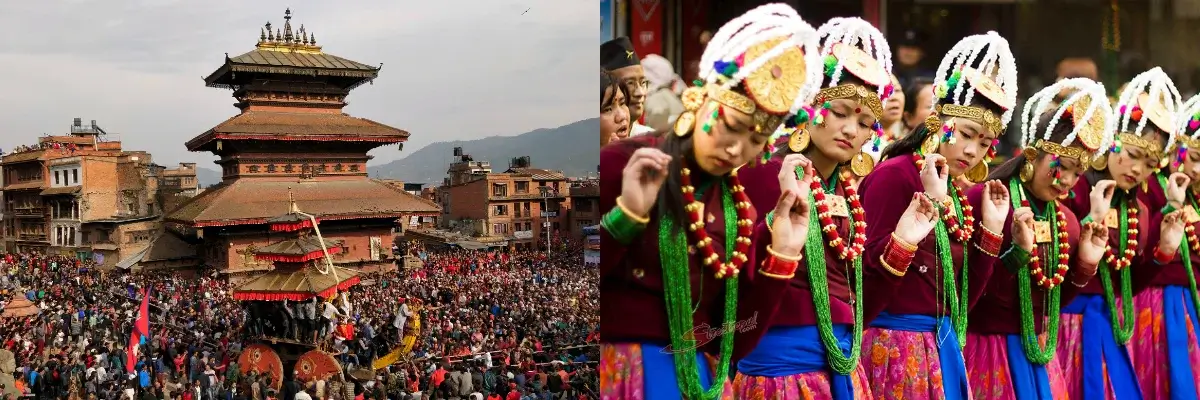
Nepal is a small yet vivid country with rich culture, tradition, ethnicity, festivals, mountains, and much more. It has some of the most breathtaking landscapes and deep-rooted Nepal culture and tradition. Nepal is home to a rich cultural heritage shaped by its diverse ethnic communities, historical importance and influence, and religious harmony.
Despite being a small country, Nepal has 142 distinct castes and ethnic groups living harmoniously. They love, respect and support each other.
Situated between two cultural giants, India and China, Nepal has absorbed influences from both civilizations while maintaining its own unique and distinct cultural identity
Nepal is particularly famous among tourists for its intricate art, architecture, music, attire, festivals, food, and, more importantly, their friendly and hospitable nature. Though you might be far from home, here, you will never feel like you’re away from home.
History of Nepalese Culture
Although the evidence of Nepalese culture can be traced back to the ancient times, the history of Nepalese culture can be found in the Hindu epic of the Ramayana. According to this Hindu scripture, there is mention of Janakpur, the birthplace of Sita (Rama’s wife), now part of the Terai region.
From then on, inscriptions can be found stating that the country was made up of several small kingdoms. Among all the kingdoms, one of the most powerful were the Shakyas of Kapilvastu, the birthplace of Lord Buddha.
Since then, Nepal culture has been moulded from a mix of Indo-Tibetan culture. Meanwhile, the Licchavi period (circa 400-750 CE) is marked as the epitome of Nepali culture. During this period, the introduction of Hindu and Buddhist culture flourished.
Several temples and stupas built during the Licchavi period are some of the major attractions of the current modern Nepalese culture. UNESCO World Heritage Site has listed some of these temples and stupas as World Heritage Sites, earning them global recognition.
Kathmandu Durbar Square, Patan and Bhaktapur Durbar Square, Pashupatinath, Boudhanath, Swayambhunath, etc., are some of the remaining structures since the known evolution of Nepal culture.
Later, the Malla kings, who ruled Nepal from the 12th to 18th centuries, further introduced the ancient Nepali culture worldwide. The intricate art, architecture, wood carvings, portraits, religious rituals, Jatras, etc., are the living reflections of the history of Nepali culture.
The Rana regime introduced European-style architecture in Nepal from 1846 to 1951. Now, travellers can experience all kinds of mixed cultures.
Nepalese people celebrate Nepali festivals such as Dashain, Tihar, Holi, Janai Purnima, etc. Beyond traditional festivals, Nepalese people also embrace international celebrations such as New Year, Halloween, and Christmas, showcasing the country’s growing cultural openness.

Religions of Nepal
The heart of Nepalese culture is the religious harmony. Hinduism and Buddhism primarily dominate Nepal.
Over 80% of Nepalese follow Hinduism, which is evident from the temples, small and big, in every town and street. Especially around Kathmandu, you can see temples in every corner, for which Kathmandu is also called the ‘City of Temples’.
Likewise, being the birth country of Lord Buddha, Buddhism is another major religion in Nepal. Influenced by Tibetan Buddhism, Tibetan and Newar communities follow Buddhism.
Hence, it is common to experience or see Nepal’s culture as highly influenced by these two religions. Moreover, people of all different religions, like Christianity and Islam, coexist in Nepal.
Additionally, indigenous spiritual practices and shamanistic traditions also exist here. This tradition is deeply rooted among many indigenous communities, including the Tamang, Rai, Magar, Gurung, and Limbu.
Nepali Traditional Dress
Nepalese dress differs based on region and ethnicity. Their traditional attire reflects the diverse climatic conditions and lifestyle of Nepal.
Daura Suruwal is the national dress for men, traditionally paired with a Dhaka Topi — a handwoven cap made from Dhaka fabric that has become one of the most recognizable symbols of Nepali cultural identity.
Similarly, Gunyu Cholo is the national dress for women. It consists of a Sari (long cloth draped around the body), a blouse, and a shawl.
Likewise, ethnic communities in the mountains, like Sherpas and Bhotias, wear Bakhu (a thick woollen robe suited for cold climates). This kind of clothing lets the people in the mountains keep themselves warm.
Meanwhile, Tharu women of the Terai region are known for wearing bright-coloured skirts and bead necklaces, while Tharu men traditionally wear a white dhoti paired with a simple shirt and a shawl draped over the shoulder.Given the hot climate of the Terai region, Tharu clothing is designed to be lightweight and breathable, helping people stay comfortable under the intense heat.
In recent years, foreign influence can be seen in clothing choices.. Young generations are usually seen in pants, a shirt/t-shirt, a skirt, etc. Nowadays, people like to dress in Western and Korean styles too. People are more likely to wear modern, fashionable, designer dresses over traditional Nepali dress.

Nepali Festivals and Celebrations
Festivals of Nepal reflect the culture of Nepali people. Each festival is celebrated by every religion with great enthusiasm throughout the country.
Dashain and Tihar are the major festivals of Nepal. During these festivals, people gather, cook a variety of delicious traditional Nepali cuisines, and eat together. People put ‘Tika and Jamara’ on their foreheads and receive blessings from their elders during Dashain.
Tihar is a vibrant five-day festival of lights where each day carries its own meaning. It begins with Kaag Tihar (Crow Day) and Kukur Tihar (Dog Day), followed by Laxmi Puja where Goddess Laxmi is worshipped, then Mha Puja marking the Newari New Year, and finally Bhai Tika — the cherished day where sisters pray for their brothers and brothers pledge to be their lifelong protectors.

Likewise, Buddhists celebrate Buddha Jayanti, which celebrates the birth of Lord Buddha. In addition, Holi (the festival of colours), Teej (a festival for women), Indra Jatra (one of the most spectacular festivals of the Newar community, best known for the ceremonial procession of Kumari, the Living Goddess of Nepal, who blesses devotees during her rare and sacred public appearance.), Janai Purnima, Lhosar, etc., are some other popular festivals in Nepal.
Besides these Nepali festivals, people like to celebrate Christmas, Eid, and other western festivals like Halloween, Easter, New Year, etc.
Among younger generations, anime and pop culture conventions are growing in popularity, where participants dress as their favourite characters and enjoy themed games and stalls.
Art, Architecture, Music and Literature of Nepal
Nepal is a country of rich art, architecture, music, and literature, where religion meets creativity.
From intricate wood and stone carvings to pagoda and shikhara-style temples and gumba, Thangka paintings, and vibrant, happening music and dance, Nepalese art has received global recognition.
Architecture and Visual Art
Influenced by Hindu and Buddhist traditions, Nepal’s architecture reflects craftsmanship and devotion. Every pillar, wall and ceiling of temples is designed in such a way that they tell a story. Especially in Hindu temples, made with wood, their windows, doors, pillars, etc. are precisely carved. They are usually carved representing deities, serpents, fish, and so on. Whereas, the walls of gomba are painted with vibrant colors, depicting their culture.
Traditional Music and Dance
Another attractive part of Nepali culture is the music and dance. Different communities have their own traditional music.Dandi Naach, Dauda, Bhairab Nritya (a traditional dance where the dancer is dressed as Bhairab), Chandi Naach, Maruni Naach, Sorathi, etc. are some of the popular dance forms in Nepal.
Further, on different occasions, people dress in their traditional dress and perform their traditional dance. One, for instance, is the Dhan Naach, the traditional dance of the Limbu community, where people sing Palam and dance in a group.

Likewise, another popular cultural dance in the Newar community is the Lakhey Naach. During this dance form, it is believed that the performer becomes possessed by a divine spirit during the dance and dances on the beat of Newari traditional musical instruments. The one performing this dance wears a mask and is dressed in a striking red costume.
Not only this music and dance, but also Nepali music and dance have seen some Western influence, where youth are inclined to the guitar and modern musical instruments.

Language and Literature of Nepal
Nepal is a country with over 123 languages. Nepali is spoken as the national language, while Maithili, Bhojpuri, Newar, Tamang, Gurung, and Tharu are notable languages. Nepalese culture has relied on literature for preservation, and old Hindu and Buddhist scriptures have impacted religious and philosophical ideas. More recently, modern Nepalese writers have gained recognition for their contributions to poetry, novels, and short stories, addressing social issues and cultural identity.
Food Culture of Nepal
Nepali food is popular for its simple yet flavorful taste. The recipe and ingredients are quite simple and basic. Usually, spices, salt, turmeric powder, and cumin powder are used for flavour. However, with the right amount of use of these spices and some additional ingredients, each dish tastes different yet reflects authentic Nepal culture.
Dal Bhat Tarkari (rice, lentil soup, and curry) is Nepal’s national staple food. Normally, Nepalese people eat Dal Bhat twice a day. It provides sufficient energy to fuel trekkers on long trails.
Other popular dishes in Nepal include MoMo, chow mein, thukpa, dhindo, sel roti, Gundruk (fermented leafy greens) and Sinki (fermented radish root), etc. Not only these dishes, but people in Nepal can try continental, Thai, Indian, Korean, Japanese, and all kinds of Western delicacies.
If you get a chance, do not forget to try traditional thali sets of Newari, Thakali, Tharu, Maithili, etc., ethnic communities. Newari Khaja set is a must-try food in Nepal. There are several restaurants serving Newari food.
Likewise, if you would like, as a celebratory drink, tourists can also sample locally brewed alcoholic drinks like Aila, Chhyang, or Tongba.
Culture and Modern Influence
Nepal is proud of its unique tradition. However, due to globalisation and modernisation, visible cultural challenges have emerged
While Nepalese people have become freer and more self-sufficient, cultural values and traditions are gradually declining, especially among the younger generation. Some cultures, languages and rituals are endangered.
Before, the national cultural dress for men used to be ‘Daura’, ‘Suruwal’ and ‘Dhaka Topi’, and for women used to be ‘gunyo’, ‘cholo’. But now, we rarely see these, only on special occasions.
Recognising the importance of cultural preservation, youths, NGOs, INGOs, and local governments have collectively taken strong initiatives. These efforts include organising cultural programs, fairs, and community events where people proudly attend in their traditional attire.
Likewise, cultural festivals and education have been modelled in such a way that actual cultural essence and modernisation are in balance.
Unique Birth, Marriage, and Funeral Culture of Nepal
You might not believe it, but Nepalese have different birth, marriage, and funeral ceremonies. Ceremony is even different before and after birth and death.
Birth
Nepal does not have a baby shower tradition. Instead, we have a culture where the mother is fed ‘Dahi Chiura’ (curd and beaten rice). Then, only on the 8th or 11th day, ‘Nwaran’ is done, the baby’s naming ceremony. At 5–6 months, the Pasni ceremony is held, where the baby is adorned in traditional attire and fed rice for the first time by elders.
Then, once the boy and girl come of a certain age, they have ‘Bratabandha’ and ‘Bel Bibaha’ respectively. According to Hindu culture, bratabandha symbolises spiritual rebirth. Meanwhile, a bel bibaha is done before menstruation starts and ensures that she will never be widowed, even if her human husband dies. On a bel bibaha, the girl is married to a bel/bael, also known as a wood apple.
Marriage
In Nepal, some communities have some unique customs for marriages. In some communities, there is a tradition of getting married to wood-apple and the sun, among the more controversial customs is ‘Jari Bibaha,’ where a man pays a sum as compensation to marry a woman already in another marriage. Rooted in older community traditions, this practice is now largely rare and legally restricted in contemporary Nepal, reflecting the country’s evolving social and legal landscape’.
Usually in Nepal, arranged marriages are common, especially in rural areas. Two families who may have never met before, are bound by astrological and cultural beliefs. Marriage includes rituals like ‘Saptapadi’ (seven steps) and ‘Sindoor Daan’ (applying red vermillion powder to the parting of the bride’s hair). Then, they receive blessings from elders and priests, and their husbands and wives are bound for life and even the afterlife.

Death
Another unique part of Nepal’s culture is the funeral ceremony. Different religious groups and regions have different funeral rites.
Family members wash the dead body, wrap it in white cloth, and cremate it near rivers in Hindu culture. Then, the remains are later scattered in holy water. Likewise, the mourning period lasts for 13 days or more, where close family members avoid social interaction and touch, wear white, and follow strict dietary rules. And, every year, ‘Shraddha’ is performed, honouring the dead.
Whereas, in the Himalayan region, in Buddhist culture, Sky burial is in practice. In this culture, particularly in Lama and Sherpa communities, a dead body is fed to vultures and eagles, and nothing goes to waste, though this practice is becoming increasingly rare.
Some Fun Facts About Nepal Culture
- Nepal is the only country in the world where a pre-pubescent girl is worshipped as a living goddess – the Kumari.
- Nepali people greet guests by joining our hands together with ‘Namaste’ instead of handshakes, which means ‘I bow to the divine in you’.
- Nepal celebrates several New Years, at least seven, based on ethnic and religious calendars, including Bikram Sambat, Lhosar, and Nepal Sambat.
- Using your left hand to eat or pass things is impolite or disrespectful unless you are left-handed.
- During special occasions, like Dashain, thousands of animals, like goats and buffaloes, are sacrificed in temples to honour the gods and goddesses.
- In contrast to Western culture, white is the color for mourning, and red is used during marriage and auspicious occasions, symbolizing prosperity.
- Killing cows, the national animal of Nepal, is illegal in Nepal. It is a sacred animal and is worshipped during the Tihar festival.
- Even dogs are worshipped in Nepal. They have a separate festival during Tihar, ‘Kukur Tihar’, where dogs are worshipped and honoured.
- Mount Everest is also called ‘Sagarmatha’ in Nepali and ‘Chomolungma’ in Tibetan, and is believed to be the home of a goddess.
- Nepal has several festivals throughout the year, from harvest events to spiritual and ancestral celebrations, for which the saying “more festivals than days in the year” is famous in Nepal.
- Every Nepali house, especially Hindu homes, has a separate room or corner dedicated to a shrine, where daily prayers and rituals are performed.
- From naming babies and choosing marriage dates to building homes and buying or selling something valuable, astrology has the final say.
- Every Buddhist household hangs colourful prayer flags to spread blessings and goodwill in the wind, not just for themselves but for the entire world.
- Spinning a Buddhist prayer wheel once is equivalent to chanting the mantra inside it thousands of times.
- In Nepal, it is still common for 3 or more generations to live together under the same roof, preserving ancestral values.
- TTraditional Nepali weddings, particularly in Hindu communities, can span 2-3 days filled with rituals, music, and feasts.
- While beef is taboo for most, Momos (dumplings) are a national obsession—served steamed, fried, jhol (soup-style), or chilli.
Loading...
related post


Author

Samyog Shrestha is a travel enthusiast and an excellent content writer at Himalayan Masters, the face behind the amazing content who likes to learn from experience.


Leave Your Comment