




Everest Base Camp Landscape | How Do Glaciers Reshape It?
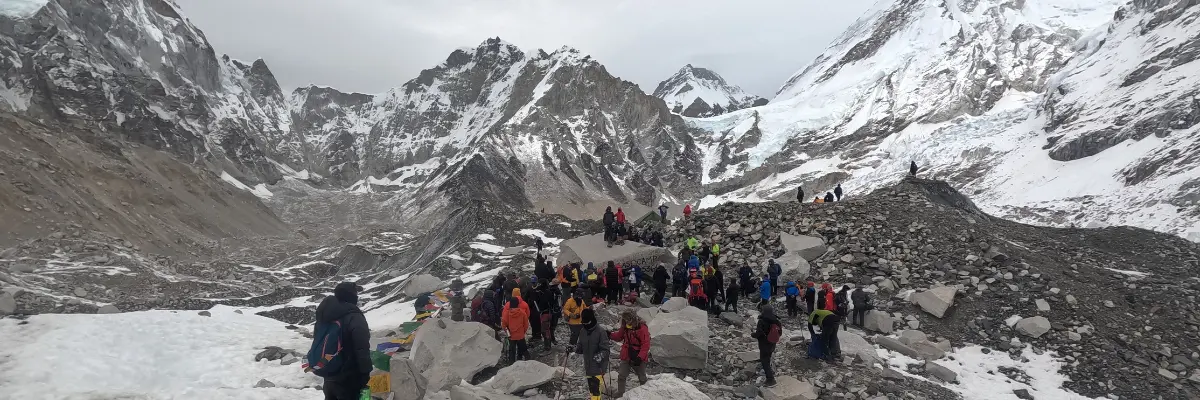
The Everest Base Camp landscape is one of the most dynamic, raw, and geologically restless places on Earth. It is far more than just a famous trekking destination, taking trekkers up to the base of the world’s highest mountain. It is a living, constantly moving environment shaped by glacial movement, collapsing ice, changing weather patterns, ancient rock formations, and the continuous force of the Himalayas themselves.
Every trekking season, thousands of trekkers and mountaineers navigate Everest Base Camp (EBC), and every season, they notice something has changed. What may seem a static destination is actually a living terrain.
For decades, trekkers have noticed how different the terrain at EBC looks compared to older expedition photographs. Positioning of the tents, the famous landmark, the Everest Base Camp stone, the ice’s shape, and the route itself change.
Even the camping zones used by climbers during the Everest expedition may shift seasonally.
The Everest Base Camp Landscape constantly evolves under the influence of the Khumbu Glacier, the number of visitors, monsoon cycles, avalanches, and climate change.
Located at 5,364 meters (17,598 ft), Everest Base Camp lies at the foot of the dangerous Khumbu Icefall and directly on top of the moving Khumbu Glacier. The beauty of the Everest Base Camp landscape makes it even more fascinating, in addition to being culturally and adventurously appealing.
One day the glacier surface may appear smooth and snow-covered, while in another season it can expose giant ice walls, loose rock, deep crevasses, and unstable moraine ridges.
Understanding the Everest Base Camp landscape means understanding why it looks the way it does, how it keeps changing, and what that change means for the hundreds of thousands of trekkers, climbers, and Sherpa communities who depend on it.
The Geological Foundation of the Everest Region
Before understanding how the Everest Base Camp landscape is changing, it is important that we understand how it came into existence.
The Everest and the entire Himalayas were once beneath the ocean surface. Over the time period of millions of years, because of tectonic plate movement between the Indian and Eurasian plates, ancient seabed rock was pushed upward, hence creating the towering Himalayan mountain range.
Since then, the landscape around Everest has been constantly changing.
The landscape around Everest is geologically young compared to many other ranges around the world. Because the mountains are still changing, the terrain remains highly active.
The trail towards Everest Base Camp transitions from lush, green forests to a rugged alpine desert landscape. Lower sections around Lukla and Phakding have vivid terrain including rhododendron forests, waterfalls, and river valleys. Whereas, in higher villages like Namche Bazaar, Tengboche, Dingboche, Lobuche, and Gorakshep, the Everest landscape changes into glacial debris, exposed rock, and ice.
These dramatic shifts in terrain are one of the defining characteristics of the Everest Base Camp Landscape that not many trekking routes in the world offer.

What the Everest Base Camp Landscape Actually Looks Like?
Let’s be clear. Many hope to see Everest straight up as they arrive at Base Camp. However, in actuality, the summit of Everest remains hidden from EBC. The view of Everest is often blocked by two massive mountains: Nuptse (7,861 m/25,791 ft) to the west and Lhotse (8,516 m/27,940 ft).
But what you actually see at the EBC is an enormous natural amphitheater of ice and rock, with the Khumbu Icefall right in front of you.
Everest Base Camp terrain is rocky, uneven, and almost lunar in character. The camp itself sits on the Khumbu Glacier moraine, a rubble of boulders, gravel, and debris carried by the moving glacier.
Although the surface appears mostly rocky, underneath, small meltwater ponds, uneven ridges, ice formations, and deep cracks can be seen throughout the area.
Towering ice pinnacles called seracs rise up to 20 meters (65 ft) tall along the glacier’s edges, and crevasses cut 30 meters (98 ft) into the ice. It is beautiful, brutal, and absolutely nothing like ordinary mountain terrain.

The Role of the Khumbu Glacier in Shaping the Landscape
Everything about the Everest Base Camp landscape begins and ends with the Khumbu Glacier. It is literally the ground Base Camp sits on.
Stretching about 17 km (10.5 miles), recognized as the world’s highest glacier, Khumbu Glacier slowly flows down from the Western Cwm near Mount Everest, and southward through Khumbu Valley like a frozen river.
Although it appears stationary to trekkers, the glacier is constantly moving. Along with it, it carries rock, ice, and debris that form the ground on which the Base Camp sits.
This movement directly affects the shape of the Everest Base Camp landscape every year. As the glacier shifts, constantly reshaping the surface, the movement creates creaking and sometimes thunderous cracks that climbers at Base Camp often hear.

Due to unstable ice surfaces, particularly the crevassed section of the glacier between Base Camp and Camp I, it is considered the most dangerous stretch in the entire South Col route. It is also why trail markers (small cairns placed by guides and porters) are repositioned every season by Icefall Doctors (the expert Sherpa team that fixes ropes and aluminum ladders through the icefall each spring).
One of the most visible transformations at Everest Base Camp in recent decades is the increasing exposure of rock and debris. Older expedition photographs often show thicker ice coverage and smoother glacier surfaces. Today, many sections look barren: rock, grey moraine fields, and uneven terrain.
Scientists studying the Khumbu Glacier have also documented gradual thinning of the ice, about one meter every year. With the increase in temperature, melting has accelerated, making it one of the major environmental concerns in the Everest region.
Why Does Everest Base Camp Look Different Every Year?
The Everest Base Camp landscape is not a permanent or fixed camping ground.
Each trekking or mountaineering season, the EBC landscape changes due to natural glacial movement and climate change. And both are happening at once and together.
Here’s why EBC can look different every year:
Camp Built on a Moving Glacier
Expedition teams establish their camps on a moving glacial moraine. They carefully select safer locations depending on glacier stability and ice conditions during every season.
So, the Everest Base Camp landscape may look different every season based on glacier movement, expedition activity, snowfall, and weather.
The Rapid Thinning of the Khumbu Glacier
As mentioned before, the Khumbu Glacier near Base Camp is thinning by about 1 meter annually. This adds roughly 9.5 million cubic meters of ice loss.
In recent studies, it shows that the glacier is experiencing a minimum of -3.3°C ice temperature, which is 2°C warmer than the mean annual air temperature around Base Camp. It might seem small, but it is a serious warning in the case of a high-altitude Himalayan glacier.
This can create new crevasses, a stream that once ran only in summer can flow through Base Camp year-round, boulders can roll or change in shape as the ice beneath them melts, and rocky ridges can become increasingly unstable. Eventually, it makes the landscape of Everest Base Camp look different every year.
The Impact of Human Activity
More importantly, human activity can highly influence the Everest landscape. Expedition teams set up a temporary tent across the glacier during the spring climbing season. However, after the climbing season is over, they are removed. So, when they set up tents next year, Everest Base Camp might look different.
Furthermore, hundreds of people are at or passing through Base Camp during peak expedition season. Studies show that around 4,000 liters of liquid waste, including urine, are deposited there every single day. Fuel burned for cooking and heating also contributes to local ice melt. Himalayan glaciers have been shrinking roughly 10 times faster over the last 4 decades than over the previous 700 years.
Weather and Seasonal Changes
Heavy snowfall during winter can temporarily smooth the terrain, and a warmer climate during summer can open new crevasses or reveal rocky and uneven glacier terrain. Weather can significantly influence how the landscape of the Everest region changes.
The exact location where trekkers take photographs beside the famous Everest Base Camp rock may also shift slightly over time, making it a symbol of a changing landscape.
So, it won’t be wrong to say that the EBC landscape is not changing slowly; it is changing now, visibly, season by season.
Changing Shape of the Everest Base Camp Rock Area
One of the most photographed spots and talked-about visual changes is the Everest Base Camp rock and its surrounding area.
Many returning trekkers notice that the terrain and the iconic marker itself appear different compared to the last time they saw it. But not many people realize that this rock area is slowly changing too.
This change is closely related to glacial movement. As the glacier moves and the ice beneath melts, the ground shifts, eventually changing the position or shape of the EBC rock. Rocks that were firmly in place one season can be tilted, slide, or repositioned by the locals or visitors.

The freeze-and-thaw cycle also plays a role in changing the shape of the Everest Base Camp rock area. Water seeps into cracks in the rock, freezes overnight, and expands, gradually breaking larger rocks into smaller pieces over time. This process, called frost weathering, is a constant and quiet force reshaping the rock formations around Base Camp.
Although Everest Base Camp remains one of the most iconic trekking destinations in the world, its appearance may look completely different after decades, finally changing the trekking experience.
How Many Times Has Everest Base Camp Shifted?
There has never been a single fixed Everest Base Camp. Every climbing season, expedition teams look for more stable ground over the Khumbu Glacier moraine and set up their tents, kitchen, and equipment.
The landscape of Everest Base Camp is constantly moving. So, the right answer to how many times Everest Base Camp has shifted is several times over the decades.
Before the modern-day Everest expeditions, during 1952, Swiss expeditions used Gorakshep as their original Everest Base Camp. Later, as mountaineering techniques improved, climbers wanted to start closer to the mountain. So, Base Camp gradually shifted farther up the Khumbu Glacier, where it is located at present.
Thereafter, too, the exact placement of tents, expedition camps, pathways, and even famous Everest Base Camp rock keeps changing. Older photographs from the 1980s, 1990s, and early 2000s clearly show visible differences compared to today’s Everest Base Camp landscape, and also in the number of tents put up.
As for formal government-driven relocation, the conversation started in 2022. Nepal Tourism Department announced its plans to move Base Camp 200-400 meters lower from its current location, citing safety concerns as the glacier thins.
However, after consulting with the mountaineering industry, almost all of the attendees rejected the idea, including Kami Rita Sherpa. The mountaineering industry and the Sherpa said that it would only add an extra stopover, not the formal Base Camp. They added that climbing from lower camp to Camp I in a single push would make it logistically impractical.
Hence, as of 2026, Base Camp remains at its traditional location on the Khumbu Glacier. The relocation debate is still very much alive, but no formal move has been made.
Climate Change and the Future of Everest Base Camp
It might be a surprise for many visitors, but the Everest Base Camp landscape does not look the same in spring as it does in autumn, and is completely different in winter.
Winter snowfall can cover moraine and glaciers, while warmer spring and autumn expose rock, ice, and crevasses, making the landscape appear completely different.
Climate change is perhaps the biggest threat in the Himalayas, directly affecting the EBC landscape. And, the effects are no longer a future concern; they are happening right now.
Glacier retreat, thinning ice, unstable moraine sections, and changing snowfall patterns are increasingly visible in the Everest region.
The ice is thinning. Permafrost that once held the moraine together is weakening. What took thousands of years to build is visibly changing within a single human lifetime. If current trends continue, scientists warn that up to two-thirds of Himalayan glaciers could disappear by 2100.
With warmer temperatures, the glacier surface has become less stable, with more unpredictable icefalls and a terrain that is difficult to navigate. This is one of the reasons why the Nepal government wants to relocate Base Camp to a lower, ice-free site in the future.
Beyond the glacier, climate change has brought problems to the entire Khumbu region. Lakes formed by glacial meltwater might expand over time.
The future of Everest Base Camp is not written yet. Responsible trekking, sustainable tourism, and meaningful climate action all have a role to play in protecting the Everest Base Camp landscape for future generations.

How the Changing Everest Base Camp Landscape Affects Tourism and Trekking?
Tourism is a major source of income in the Khumbu region. The Everest Base Camp Trek has been supporting local teahouses, lodges, porter services, and guiding businesses from Lukla to Gorakshep.
The change in the Everest Base Camp landscape has had a direct impact on tourism and trekking in the Khumbu region. As glaciers shift and terrain changes, trekking routes occasionally need adjustments, especially on the Chhukung to Lobuche route via Kongma La Pass (5,535 m/18,160 ft).
The trail from Gorakshep to Base Camp is becoming more demanding each year due to loose rocks, new meltwater channels, and exposed ice patches. This makes experienced, locally certified guides more important than ever.
Nevertheless, the changing Everest Base Camp has become a motivation not only by adventure but also by curiosity about Himalayan glaciers and environmental change.
Some trekkers are specifically fascinated by photography tourism to witness the transformations firsthand. Different snow levels, glacier exposure, and mountain visibility create unique visual experiences every year.
Trekking responsibly and choosing sustainable operators is the best way to protect both the landscape and the journey itself.
How Landscape Shifts Affect Everest Mountaineering Expeditions?
For climbers on Everest, a changing EBC landscape is not just an inconvenience; it is also a safety concern.
The Khumbu Icefall has always been the first and most dangerous section of the South Col route. Between 1953 and 2016, it was responsible for 25% of all deaths on the Nepal side of Everest. That includes the single deadliest incident in Everest history, the 2014 Mount Everest avalanche, where 16 Nepali mountaineering guides were killed.
As the glacier warms and thins, the icefall becomes unpredictable. Ice structures that held their shape at colder temperatures are more likely to collapse. This affects not only Everest climbers but also support staff and expedition logistics.
Additionally, the “Icefall Doctors” have to do more maintenance work as the glacier reshapes the route beneath the mid-season.

With Tibet’s North Col route being closed in 2026, there has been a significant increase in climbers on the Nepal side. This creates more pressure on the icefall and makes it even more challenging.
To help, in 2025, the Nepal government introduced new climbing rules. Climbers need to bring down at least 2 kg of waste from Camp 2 and above. Drones are used for surveillance and to support Icefall Doctors. This effort reduces the number of times Sherpas need to cross the most dangerous and tiring ice section.
In recent years, several concerns regarding the future of Everest mountaineering have arisen. Concerns focused on glacier stability and environmental sustainability. It is believed that if no measure is taken, continued glacier melt could significantly reshape the mountaineering experience.
Despite all these challenges, Everest continues to attract climbers globally. The constantly evolving Everest Base Camp Landscape remains part of the mountain’s identity and adventure.
Experiencing the Everest Base Camp Landscape with Care
The Everest Base Camp landscape is one of the most dynamic and fascinating mountain environments in the world. So, if you are planning to visit it, the only thing we can suggest is to go thoughtfully.
The Base Camp is constantly changing. Khumbu glacier is moving slowly, ice is melting slowly, glacial lakes are expanding, and what is known as a famous landmark today might not be the same tomorrow.
Over that, the location of the camps at the Base Camp is never constant, and even the trail leading to EBC and finally to the Everest summit also changes.
Major causes for the Everest Base Camp landscape being the glacial activities and environmental conditions; human activities also play a major role in it.

For trekkers, climbers, photographers, and mountain lovers, this ever-changing environment is exactly what makes the journey memorable. But it is our responsibility to protect this unique Himalayan landscape.
It is our responsibility to be responsible travelers, so that future generations can experience the magnificence of the Everest region, too.
Trek with certified, responsible operators. Follow “Leave No Trace” principles from the first day out of Lukla. Acclimatize properly and respect the pace the terrain demands. And take a moment, when you’re there, to look carefully at the ground beneath your feet.
Loading...
related post


Author

Samyog Shrestha is a travel enthusiast and an excellent content writer at Himalayan Masters, the face behind the amazing content who likes to learn from experience.


Leave Your Comment