




Expedition Guide vs Trekking Guide | How They Differ?
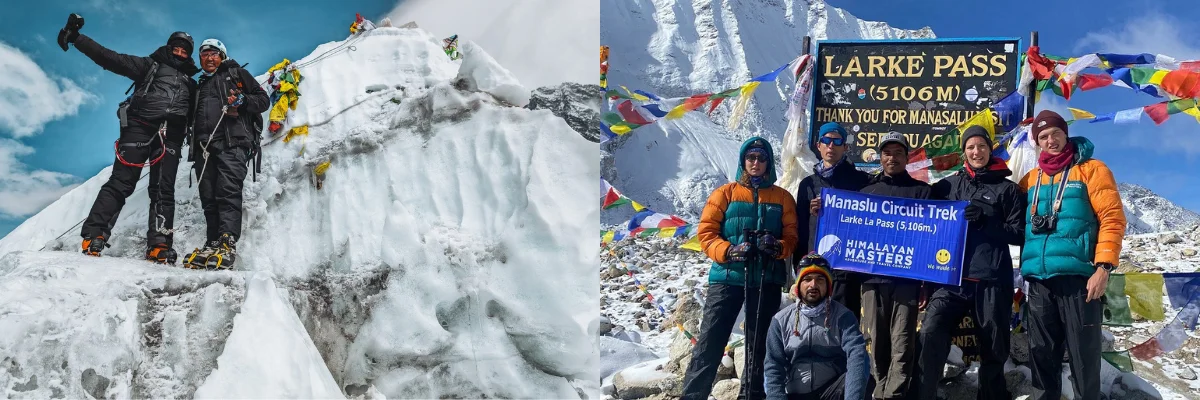
Expedition Guide vs Trekking Guide are topic to must know. Nepal is a famous destination for both trekking to the highest base camps and climbing the highest peaks in the world. Both of these activities require someone who supports you in every way.
For navigation, translation, and physical support, etc. But the confusion takes place among travelers when they cannot distinguish between a trekking guide and an expedition guide.
The roles of both individuals are very important, but they serve different purposes. Let’s find out the difference between an expedition guide vs trekking guide.
Who is a Trekking Guide?
A trekking guide is a licensed professional who is responsible for leading and helping trekkers throughout their trek. They ensure safety, comfort, and proper navigation.
Trekking guides satisfy trekkers by providing accurate navigation, sharing cultural and environmental knowledge, managing logistics (permits, accommodation, and transport), and handling emergencies or high-altitude problems effectively. They are trained in first aid, mountain safety, and communication.

Trekking guides play a crucial role in Nepal’s tourism industry. They not only help explore the remote regions of Nepal but also act as cultural ambassadors who connect travelers with local traditions and lifestyles.
When you hire a trekking guide, think of it as you are contributing to community livelihoods and sustainable tourism. Trekking guides ensure environmental protection, economic growth, and a deeper and meaningful travel experience.
Who is an Expedition Guide?
An expedition guide is a highly skilled and mountain professional who leads climbers on high-altitude expeditions to challenging peaks such as Annapurna, Manaslu, Mera peak and Everest.
Their roles include rope fixing, route planning, altitude management, and weather monitoring. They ensure the overall safety and success of the climbing team.
An expedition guide is trained in advanced mountaineering techniques, rescue operations, and first aid. They coordinate with porters and logistics teams.

Expedition guides are very important in Nepal’s mountaineering sector, as they are a major source of tourism revenue.
They are the backbone of Himalayan expeditions, ensuring safety in extreme conditions and helping climbers achieve summit goals responsibly.
By offering technical expertise, cultural guidance, and local knowledge, expedition guides improve Nepal’s reputation in adventure tourism while creating opportunities and supporting sustainable mountain communities.
Training and Certification
In order to be a licensed trekking guide in Nepal, candidates must pass the SLC or SEE and undergo formal training and certification under the Nepal Academy of Tourism and Hotel Management (NATHM), which operates under Nepal Tourism Board (NTB).
In this training, participants began by learning about map reading, navigation, mountain safety, first aid, altitude sickness management, communication, environmental conservation, and client handling.
This is called the Trekking Guide Training Course, which lasts around 4 to 6 weeks, and includes both theoretical and field-based practical sessions.
After this training, participants are required to give a written, oral, and practical examination conducted by NATHM. Those who pass through all this can become an official trekking guide with a license issued by the Department of Tourism.
An expedition guide
To be the expedition guide in Nepal, candidates must have advanced mountaineering skills, professional certification, and high-altitude experience.
An expedition guide aspirant must complete training from the Nepal Mountaineering course, which has three phases Basic, Advance, and Rescue and leadership training.
In these courses, you learn rope fixing, ice and rock climbing, crevasse rescue, high altitude medicine, weather interpretation, and expedition management.
In addition to formal training, candidates must have several years of practical experience working as assistant guides, high altitude porters, or climbing sherpas before leading their own teams.
Mostly, the Himalayan sherpas are known for being prominent expedition guides. Certification from the Department of Tourism and a mountain guide license are mandatory for legal operation.
Good physical fitness, technical climbing competence, and strong leadership skills are very important. Knowledge of first aid, oxygen handling, altitude sickness management, and fluency in English greatly improve a guide’s professional standard.
Safety and Risk Level: Expedition Guide vs Trekking Guide
Both of these roles are very important in their respective fields, but the safety and risk levels differ.
Expedition guide
- Expedition guides operate at high altitude above 6000 meters (19685.04 ft), where conditions are unpredictable and dangerous.
- Avalanche, icefalls, crevasses, rockfalls, and severe snowstorms are risks these guides face.
- Requires demanding mountaineering skills like rope fixing, technical climbing, and glacier navigation.
- The chance of getting frostbite, exhaustion, oxygen deficiency, and altitude sickness is higher.
- Work in remote areas where rescue access and medical support are limited.
Trekking Guide
- They operate mainly on established and well-traveled trekking trails at moderate altitude below 6000 meters (19685.04 ft)
- Compared to expedition guides, they face less risk, but the risk of altitude sickness, slips, falls, and landslides is always there.
- Top priorities are client safety, route guidance, and health monitoring rather than technical climbing.
- Rescues are more feasible, and lodges and communication facilities are easy to access.
- The overall risk level is moderate compared to the extreme challenges faced by expedition guides.
Cost Difference
The cost of both guides has vast differences.
- Hiring an expedition guide is significantly higher, usually ranging from USD 3,000 to 10,000 or more per expedition. The cost depends on the peak and duration.
- The factors affecting the cost of an expedition guide are the height and difficulty of the peak, logistics support (equipment, oxygen, rescue gear), and the climbing season.
- The cost for hiring a trekking guide is USD 25 – 60 per day, depending on the region and length of the trek.
- The cost is lower than that of expedition guides because trekking includes established routes, minimal equipment, and less technical risk.
- The factors affecting the cost of hiring a trekking guide are trek duration, remoteness of the trail, season, and group size.
When Do You Need Which
Expedition guides are needed when climbers are summiting peaks above 6,000 meters, where technical skills, rope work, and safety management are required.
Very important for summit expeditions like Everest, Manaslu, or Ama Dablam, where oxygen handling, rescue planning, and logistics are complex.
Trekking guides are needed for non-technical routes like Manaslu Circuit trek, Langtang Valley trek, and Annapurna Base Camp Trek. They are best when it comes to helping trekkers with navigation, altitude safety, and local coordination.

They are the best companion and support for beginners and casual trekkers exploring moderate altitude trails.
Terrain and Scope of Work
Guides’ responsibilities differ with terrain: trekking guides handle moderate trails, while expedition guides manage extreme high-altitude, technical landscapes.
Expedition guides
- They work in extremely high altitude and technical terrains such as glaciers, icefalls, steep rock faces, and snow-covered peaks above 6,000 meters.
- Their main responsibilities include rope installation, route fixing, weather monitoring, altitude management, and rescue coordination.
- These guides help climbing teams reach the summit while ensuring safety, equipment setup, and communication between camps.
- They work in regions where facilities are limited and the weather is unpredictable.
Trekking Guide
- They work in well-established trekking trails which pass through villages, forest, valleys, and mountain passes generally below 5,500 meters (18044.62 ft)
- Their main job includes navigation, managing accommodation, permits, and daily logistics during the trek.
- They provide cultural insights, manage group space, and help with altitude acclimatization.
- They work with accessible areas where lodges, rescue services, and communication are available.
Team Structure
The size and roles of a guide’s team vary with the expedition, from small trekking groups to large, special high-altitude climbing teams.
Expedition Guides
- The expedition guides have large teams including assistant guides, Sherpas, Porters, and cooks.
- Oversees safety, route planning, and coordination in high-altitude, technical environments.
Trekking Guide
- Leads a smaller and simpler team, usually consisting of assistant guides and porters.
- The trekking guide manages daily itineraries, client safety, and communication, while porters carry loads between lodges or camps.
Cultural and Local Role
Both guides promote tourism in Nepal through their roles, which empowers Nepal.
Trekking guides act as cultural ambassadors as they share local myths, village stories, and customs with trekkers. They encourage community-based tourism by connecting travelers to homestays and local lodges.
Expedition guides also represent Nepal’s mountaineering legacy, as most guides come from Sherpa, Rai, Tamang, and Gurung communities with generations of climbing experience.
Nepalese Sherpas are respected globally for guiding climbers on Everest and other peaks above 8,000 meters while preserving local traditions and high altitude culture.
What’s the difference between a climbing Sherpa and an expedition guide?
The difference between a climbing Sherpa and an expedition guide is;
Sherpas fix ropes, carry loads, set up camps, and assist climbers. They come from Sherpa communities who have generational experience in mountaineering. Sherpas do not lead the expedition or make strategic decisions about the route or safety.
Expedition guides lead the climbing team to the summit and are responsible for overall safety, route planning, weather assessment, and decision making. They coordinate with Sherpas, porters, and clients to manage logistics, permits, and summit strategy.
Famous Expedition Guides in Nepal
Nepal has produced some of the most accomplished and revered expedition guides in the world.
Kami Rita Sherpa
Kami Rita Sherpa holds the world record for the most ascents of Mount Everest, having reached the summit 31 times as of May 2025. Born in Thame, Solukhumbu, Nepal, in 1970, he began his mountaineering career in 1992.
His father was among the first professional Sherpa guides after Everest was opened to foreign mountaineers in 1950. Kami Rita’s unparalleled experience and dedication have made him a cornerstone of Nepal’s mountaineering legacy.
Tenzing Norgay Sherpa
Tenzing Norgay Sherpa, born in 1914, was a Nepali-Indian Sherpa mountaineer who, in 1953, became, with Edmund Hillary of New Zealand, the first person to set foot on the summit of Mount Everest.
His achievement brought global recognition to the Sherpa community and paved the way for future generations of mountaineers.
Mingma Gyalje Sherpa (Mingma G)
Mingma Gyalje Sherpa, known as Mingma G, is a prominent figure in the mountaineering world. He has summited Mount Everest multiple times and was part of the team that achieved the first winter ascent of K2.
Beyond his climbing feats, Mingma G is dedicated to environmental conservation in the Himalayas, actively promoting clean-up initiatives to preserve the region’s pristine beauty.
Pasang Tenzing Sherpa
Pasang Tenzing Sherpa is one of the few Sherpas to hold the International Federation of Mountain Guides Associations (IFMGA) certification, the highest qualification for mountain guiding.
He has climbed Mount Everest 10 times and has also led expeditions in other parts of the world, including Aconcagua in Argentina. His expertise and international experience make him a sought-after guide for high-altitude expeditions.
Loading...
related post


Author

Bryan BK is a storyteller at heart and an adventurer by soul. As a passionate writer and traveler, he finds inspiration in the places he visits and the people he meets. Through his words, he brings destinations to life, sharing experiences that inspire others to explore, dream, and discover.


Leave Your Comment