




Mauna Kea vs Mount Everest: Top Differences
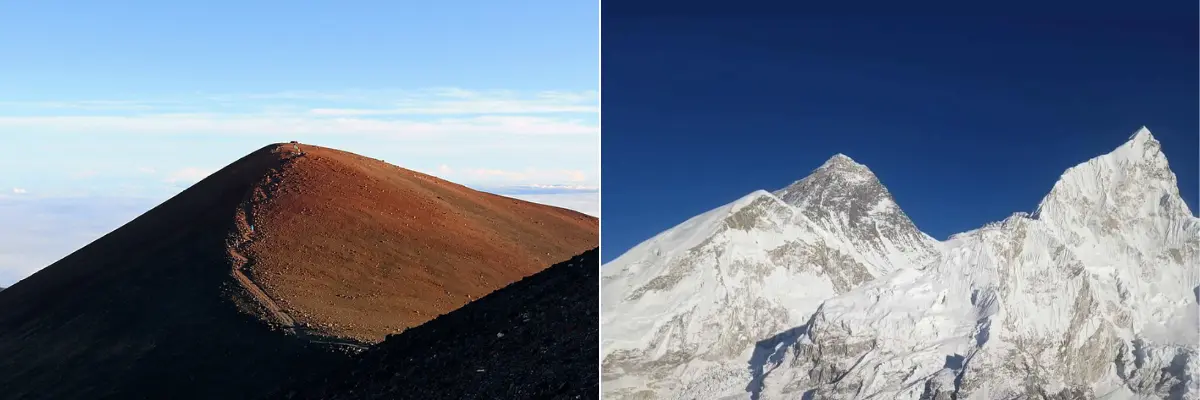
“Mount Everest is the tallest mountain in the world”. Well, many might argue with the statement, especially after they learn about Mauna Kea in Hawaii. So, Mauna Kea vs. Everest, which one is higher? has been discussed.
Mount Everest, at 8,848.86 meters (29,032 ft) above sea level, is the crown jewel of the Himalayas in Nepal. It has been luring climbers and trekkers from every corner of the world.
Yet, beneath the depths of the Pacific Ocean lies a silent, strong contender, Mauna Kea. Mauna Kea is a dormant volcano on the Island of Hawaii. It has a true height of 10,210 meters (33,497 ft) from its base to tip. However, the controversy arose as Mauna Kea is only 4,207 meters (13,802 ft) above sea level.
The debate of Mauna Kea vs Everest is a story of two giants, one rising from the deepest ocean floor and the other towering over the roof of the world.
Understanding Mount Everest vs Mauna Kea means delving deep into geology, culture, challenges, scientific importance, and human ambition. So, let’s see which is truly “the tallest”.
Location and Setting
Mount Everest is located on the border between Nepal and the Tibet Autonomous Region of China, in the Himalayas. It’s a part of the Mahalangur range, surrounded by several of the world’s highest peaks like Lhotse and Nuptse. The region is remote, rugged, high-altitude plateau base, and dramatic mountain geography.
On the other hand, Mauna Kea rises from the Big Island of Hawaii, right in the middle of the Pacific Ocean. Unlike Everest’s icy terrain, Mauna Kea features lush tropical forests, volcanic slopes, and even snow-capped summits in winter.
While the heights of Everest question the scientific reasoning, Mauna Kea’s isolated oceanic setting makes it both scientifically intriguing and visually surreal.

Geological Type, Age, and Formation
Everest is a folded mountain, formed by the tectonic collision between the Indian plate and the Eurasian plate. Although the formation process began roughly 60 million years ago, the summit we know today is younger.
This collision forced layers of rock to rise, creating the towering Himalayan range that we see today. Its rocks include metamorphic schists and gneisses, topped by sedimentary remains of an ancient seabed.
One of the most interesting facts about Everest is that the mountain is still growing each year by around 44 millimeters.
However, Mauna Kea is a shield volcano built by volcanic eruptions. About a million years old, the mountain was formed when magma from a hot spot beneath the Pacific Plate repeatedly broke through the ocean floor. Over Time, these eruptions built up layer by layer, solidifying into a broad, gently sloping volcano.

Height: Above Sea Level, and Base to Summit
As mentioned before, Mauna Kea’s summit is 4,207 meters above sea level according to the U.S. Geological Survey (USGS), while Mount Everest is 8848.86 meters above sea level according to the Nepal/China 2020 survey.
So, this answers the question “Is Mauna Kea taller than Mount Everest?” Yes, Mauna Kea is taller than Mount Everest if we measure their height from base to summit. However, Mount Everest is double the height of Mauna Kea when measured above sea level.
Therefore, if you’re confused in a Mauna Kea height vs Everest comparison, you must ask which measurement you mean: above sea level, or from base.
Climbing Difficulty and Accessibility
Mount Everest is one of the toughest climbs in the world. Its height, challenging Khumbu Glacier, thin air, freezing temperatures, and unpredictable weather make climbing Mount Everest more challenging than climbing Mauna Kea.
The ascent requires weeks of acclimatization, technical climbing skills, and a well-organized expedition team. Mountaineers first need to take the Lukla flight and trek to Everest Base Camp (5,364 m/17,598 ft), and finally start the climb.
Apart from accessibility and risk of altitude sickness, due to height, crevasses, and avalanches are constant threats, making Everest a test of endurance, patience, and willpower.
In contrast, Mauna Kea is far more accessible. Most visitors can drive almost to the summit of Mauna Kea, via a steep but well-maintained road, though the final stretch requires a four-wheel-drive vehicle.
Moreover, climbing to the top is possible on foot, too. The hikers can first drive up to the Visitor Information Station and start hiking from there onwards. It’s a 6-8 hours hike.
Although it’s not as high as Everest or other treks in Nepal, Mauna Kea’s altitude still poses challenges. Unlike Everest, it doesn’t demand technical climbing gear or weeks of preparation, but acclimatization is still essential.
So, in the debate of Mauna Kea vs Everest, Everest is the ultimate test for adventurers, while Mauna Kea offers an easier, more approachable way.
Cultural and Spiritual Significance
Both Mount Everest and Mauna Kea hold deep spiritual and cultural meanings. In the Khumbu region, Sherpa people consider Everest as “Goddess Mother of the World”, called Chomolungma in Tibetan and Sagarmatha in the Nepali language.
Mount Everest is a symbol of strength, purity, and the connection between heaven and earth. According to Tibetan culture and new rules to climb Everest released in 2025, mountaineers have to perform puja ceremonies before attempting to ascend, seeking blessings from the mountain itself.
Likewise, for Native Hawaiians, Mauna Kea is the most sacred mountain in Hawaii. For them, the mountain is a place where earth meets sky, and where ancestral power, gods, and celestial forces reside. It’s a dwelling ground for the deities, where locals perform ancient rituals and offerings.
Also known as “White Mountain”, Mauna Kea’s summit has ancient Hawaiian religious sites, altar platforms, and burial caves.
Overall, the Mauna Kea vs Everest comparison goes beyond geology or altitude. Both mountains are sacred symbols of life, spirit, and identity.
Scientific Importance
Both Mount Everest and Mauna Kea are invaluable to science, though in very different ways.
Mount Everest serves as a natural laboratory for studying climate change, geology, and human physiology at extreme altitudes. Meanwhile, Mauna Kea is one of the most important astronomical and geological sites on Earth.
Sagarmatha’s glaciers are often measured by scientists and researchers to analyze the impacts of global warming. The melting ice provides crucial insight into Earth’s changing climate.
The exposed rock layers reveal the millions of years of geological history. Fossils of marine life are proof that this towering peak once lay beneath the ocean’s surface. Additionally, Everest has been vital in understanding how the human body reacts to a low-oxygen environment. This has helped improve understanding of altitude sickness and respiratory health.
Moreover, the summit of White Mountain offers some of the clearest skies in the world, making it a perfect location for world-class observatories. From here, scientists study distant galaxies, exoplanets, and cosmic phenomena that can’t be seen anywhere else on the planet.
Geologists also examine Mauna Kea to understand volcanic processes, the formation of oceanic islands, and the long-term evolution of Earth’s crust.

Best Time to Visit, Climbing Seasons
The best time to visit or climb Mount Everest depends on the weather and safety. However, spring (April to May) and autumn (late September to November) are the most favorable climbing seasons.
During these times, it has stable weather and clear skies, making them the most popular season for expeditions. Furthermore, the ice becomes harder due to extreme cold, providing safer footing. However, you need to be prepared for cold and strong winds.
On the contrary, Mauna Kea can be visited year-round. Nevertheless, the best months are between April and October. During this period, the weather is relatively mild, and roads to the summit are more likely to be open.
But the snow often covers Mauna Kea’s peak during winter, a rare sight in tropical Hawaii. It’s a different sight where palm trees coexist with snow.
In short, when comparing Mauna Kea vs Everest, Everest demands strict seasonal timing and weeks of preparation, while Mauna Kea offers flexible access and year-round beauty without a high-altitude expedition.
Cost, Logistics, and Time Needed
Climbing Mount Everest is one of the most expensive and time-consuming adventures in the world. It can cost anywhere between $40,000 and $100,000, depending on the route, expedition operator, logistics, and level of support.
Mount Everest expedition can take around two months, including trekking, acclimatization, and the climb. Sometimes, you might have to wait longer for a suitable weather window.
Additionally, there are trainings, permits, Everest climbing gear, Sherpa support, oxygen cylinder, and insurance you need to consider.
Mauna Kea, by contrast, is far more accessible and affordable. You can even reach the summit in a single day, either by driving or hiking. You won’t need any climbing permit, expedition fee, or any climbing training if you plan on climbing Mauna Kea.
However, you will need a four-wheel-drive vehicle to reach the top of White Mountain. You have an option of travelling solo, with friends and family, or joining guided tours. A guided tour costs about $200 to $300, which includes a sunset or stargazing experience.
So, if cost is not the concern and thrill is what you’re seeking, the Mount Everest expedition is perfect. But, if you’re looking for a cheaper yet beautiful option, Mauna Kea is the one for you.
Slope, Terrain, and Other Physical Characteristics
Unlike the jagged, rugged, and icy slopes of Everest, Mauna Kea has broad, gentle slopes shaped by countless lava flows over the years. Mauna Kea is a shield volcano with a wide, dome-like, and gradual inclination.
For that reason, easy drives and hikes, all the way to the summit, are possible in Mauna Kea. In comparison, Everest tours aren’t like that. Everest is a steep mountain, with an average slope of around 35°. The terrain is rugged, perilous, and constantly shifting due to icefall and tectonic movement.
The landscape in the Everest region is formed by ice and wind, with towering seracs, sharp edges, and shifting glaciers. This makes Everest navigation and expedition technically and physically challenging.
Additionally, the height of Everest, where breathable oxygen levels drop to one-third of sea level, makes it even more difficult. Mauna Kea, although it is a volcano, has been inactive for thousands of years; scientists call it dormant rather than extinct.

Popular Activities and Tourism
When comparing Mauna Kea vs Everest, Everest has relatively more thrilling trekking, expedition, and tour options.
One for being the Everest Base Camp Trek, and the other for the Everest expedition itself. Other than that, Everest also boasts several other expedition options, such as Lobuche Peak Climbing, Island Peak Climbing, and so on.

Additionally, the Everest region is native to the Sherpa people and Tibetan culture. If you wish to explore these centuries-old cultures, monasteries, celebrations, and lifestyles, trekking is the best option.
For those on a short break or who aren’t able to walk long distances, Everest also boasts short Everest View Trek and Everest Helicopter Tour options, too.
Mauna Kea, in comparison, is a paradise for nature enthusiasts and stargazing. It is home to some of the most advanced observatories in the world. One of the most popular attractions in Mauna Kea is the breathtaking sunset and sunrise views.
Aside from that, observing constellations, galaxies, and even other planets is a popular activity on Mauna Kea. Hiking, photography, and cultural tours are also popular here.
Summary Comparison Table
Here’s a quick summary of the Mauna Kea vs Everest comparison table.
| Feature | Mauna Kea | Mount Everest |
| Elevation above sea level | 4,205 7 m/13,802 ft | 8,848.86 m/29,032 ft |
| Total height (base-to-summit) | 10,210 m (33,497 ft) including underwater base | Less than Mauna Kea if the base is below sea level; above sea level is the highest |
| Geological type | Shield volcano (post-shield stage) | A fold mountain formed by tectonic collision |
| Age | About 1 million years (shield stage ended nearly 800k years) | Uplift began nearly 60 million years ago (Himalayan orogeny) |
| Climbing difficulty | Moderate–High (altitude + remote), but far easier than Everest | Extreme — high altitude, technical, expensive, risky |
| Accessibility | Relatively high: drive-up tours, lower cost/time | Low: major expedition, high cost, high risk |
| Cultural and spiritual significance | Sacred to Native Hawaiian culture | Sacred to Nepali/Tibetan Himalayan cultures |
| Scientific importance | Premier astronomical observatories | Natural laboratory for high altitude geology, physiology, and climate |
| Best visit/climb season | More flexible; weather is less extreme than high Himalayas | Narrow windows (spring, sometimes autumn) |
| Cost and time required | Lower cost, shorter time for summit experiences | Very high cost, many weeks of commitment |
Final Thoughts: So, Which Wins in “Mauna Kea vs Everest”?
So, in the debate of Mauna Kea vs Everest, the answer depends on what the question is. Which one is taller? Which is easier, accessible, and affordable? Or, which is significant culturally or historically?
Nevertheless, both are unique and amazing on their own. One being a shield volcanic mountain has diverse landscapes and offers a chance to gaze at extraterrestrial bodies. Another, which used to be at the bottom of the ocean, is now the highest point on Earth.
Now you know the differences and similarities between Mount Everest vs Mauna Kea.
If there is anything else you would like to share or ask, please do leave a comment.
Loading...
related post


Author

Samyog Shrestha is a travel enthusiast and an excellent content writer at Himalayan Masters, the face behind the amazing content who likes to learn from experience.


Leave Your Comment