




Everest Base Camp vs Annapurna Circuit | How They Differ?
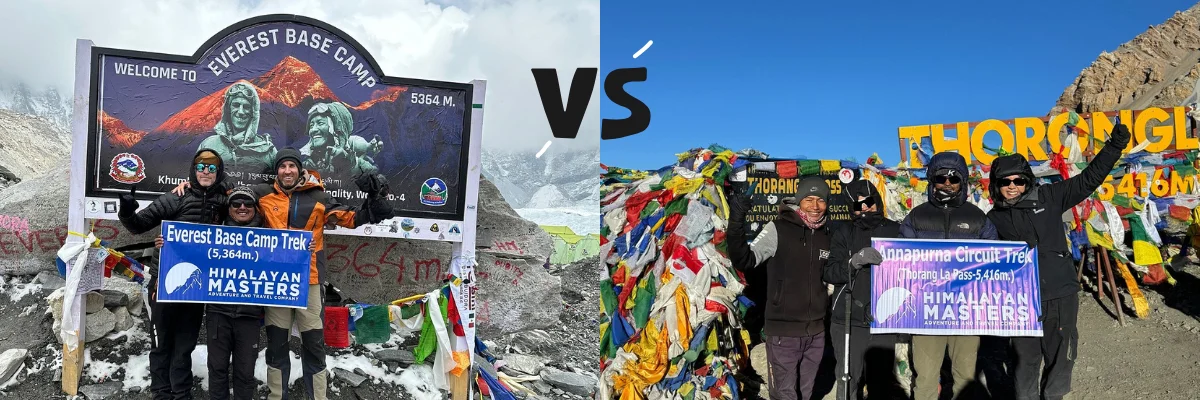
In the case of trekking in Nepal, two names stand out: Everest Base Camp (EBC) Trek and Annapurna Circuit Trek (ACT). The two are legendary routes of Nepal that draw thousands of trekkers annually all over the globe. Each trek has its own beauty, challenges, and rewards. It is hard to pick between Everest Base Camp vs Annapurna Circuit, especially for many adventurers.
The two treks are iconic to the world; however, their experiences are very dissimilar. The decision of choosing between the Everest Base Camp vs Annapurna Circuit Trek will be made based on what sort of adventure you desire to experience.
Whether your excitement of being at the bottom of the mountain, or the pleasure of crossing through diverse and constantly changing sceneries and cultures.
Overview of the Treks
The Everest Base Camp Trek is in Khumbu of the Sagarmatha National Park. The trek begins with a brief scenic flight to Lukla from Kathmandu (or Ramechhap during high seasons) to Kathmandu.
Trekkers go through the villages like Phakding, Namche Bazaar, Tengboche, and Dingboche, before reaching the point of Everest Base Camp, which is at 5,364 meters.
The Annapurna Circuit Trek is in the Annapurna Conservation Area, which is in the central part of Nepal. It starts at a subtropical village of Besisahar and goes through moist forests, terraces, and high mountain deserts until one arrives at Thorong La Pass of Nepal, which is the highest point of the trail.

Upon completion of crossing the pass, trekkers move to the sacred spot of Muktinath. After they they proceed to either Jomsom or Pokhara. The trek is one of the most diverse trekking experiences in Nepal owing to its presence in a variety of climates, altitudes, and cultures.
Region and Location
The Everest Base camp Trek is situated in the Khumbu valley of eastern Nepal and within the Sagarmatha National Park. The region has Mount Everest and numerous other towering mountains.
The trek starts with a 25 min flight from Kathmandu to Lukla, after which one will walk through the Sherpa villages, monasteries, and alpine forests.
The Annapurna Circuit Trek is within the Annapurna Conservation Area, which is at the centre of Nepal. It encloses the whole massif of Annapurna, which passes the trekkers through the Manang and Mustang valleys.
It is a journey beginning at Besisahar and finishing at Jomsom or Nayapul. The Annapurna region is also accessible by road, as compared to EBC, and provides more diverse landscapes.
Trek Distance and Duration
Everest Base Camp Trek distance is a 130 km round-trip adventure normally taking 12-14 days. It involves two days of acclimatization at Namche Bazaar and Dingboche as part of acclimatizing the trekkers to the high altitude.
The Annapurna Circuit Trek distance is more detailed. It is around 160 to 230-kilometer range of distance depending on the route of choice. Trekkers usually take 8-14 days to round the circuit.

The EBC route is steeper, whereas the Annapurna trail gives a gradual ascent, approaching changing landscapes.
Cultural Experience
The Sherpa culture is very strong in the Everest region, and it is based on Tibetan Buddhism.
The journey has a spiritual and quiet touch because of the colorful prayer flags, chortens, and antique monasteries like Tengboche Monastery. The Sherpas are characterized by hospitality and mountain climbing tradition.
The Annapurna area is much more multicultural with Gurung, Thakali, and Manangi people. There are Hindu temples and Buddhist monasteries since Nepal has diverse cultures.
Annapurna Circuit is the better place to go; in you would like to explore various traditions.
Mountain Views
The Everest Base Camp Trek is also known to offer close-up shots of Mount Everest, Lhotse, Nuptse, and the famous Ama Dablam.
Kala Patthar climb comes with a stunning panoramic view at sunrise. Thereby making Kala Patthar one of the most memorable mountain experiences of the world to the trekkers.
Extending the range of panoramic mountain distance, the Annapurna Circuit Trek is more diverse. The trekkers have a look at Annapurna I, Dhaulagiri, Machhapuchhre (Fishtail), Gangapurna, Tilicho Peak and many other smaller mountains on the trail.

The walk also goes through the dense forests, farmland terraces, and the desert mountains, and is a combination of nature and barren mountainous landscape.
Whereas in Everest Base Camp, it is all about the drama of Everest itself, Annapurna Circuit is diverse and changing in scenery.
Everest Base Camp vs Annapurna Circuit Trek Difficulty
The two treks are fairly challenging, respectively. The EBC trek is not only steep in certain sections, but it also increases to altitudes of above 5,550 metres.
Trekkers are at risk of suffering altitude sickness, particularly when there is no consideration of acclimatization. But tea houses are nearer every few kilometers and this makes logistics easier.
The Annapurna Circuit difficulty is hard, and it features diverse landscapes including river valleys and rocky high passes. The Thorong La Pass is the most challenging one, which may be physically demanding.
Even though there is the possibility of altitude sickness, the slow progression reduces the chances of serious risks. This trek involves stamina and endurance to make it.
Highest Point and Acclimatization
Kala Patthar is the summit of the Everest Base Camp Trek, and it is 5,550 metres. To limit the occurrence of altitude sickness, trekkers normally have a day or two acclimatizing at Namche Bazaar or Dingboche.
It is best to ensure that they have been well acclimatized as the high altitude may be a challenge to new high-altitude trekkers.

The Thorong La Pass, located at 5,416 metres high, is the summit of the Annapurna Circuit. Generally, trekkers take one or two days in Manang before they attempt the pass.
Trekkers can relax since the gradual ascent through the various topographies helps the body to adapt to the altitude naturally, thus the trek is not a cause of concern as to the effects of such high altitude.
Weather and Temperature
The two treks are best during spring (March- May) and autumn (September-November). In the EBC, the altitude is so high that nights are very cold since they can go down to below -10 degrees Celsius. The snow and intense wind usually occur above 4,000 metres.
The Annapurna Circuit has a greater range of climate. The low valleys are greener and warmer, and the high places are cold and dry toward Thorong La. The different weather brings an exceptional beauty to the trek.
Everest Base Camp vs Annapurna Circuit Cost
The trek to the Everest Base Camp is normally more costly. With Himalayan Masters the EBC Trek costs $1640. The Lukla flight cost, more elevated lodging, and meals are totaled. The average trekking package, guide, porter, permits, and meal rates often range between Rs. 1200 and 2,000.

Annapurna Circuit is less expensive. The trailhead can be reached by road, and the food and lodges are cheaper than in most other areas, which keeps the overall Annapurna Circuit Cost $995. Both treks could be made as luxurious or could be made with a stricter budget.
Trekking Permits
In the case of EBC Permits, the trekkers require a Sagarmatha National Park Permit and a Khumbu Pasang Lhamu Rural Municipality Permit. These can be procured easily by agencies in Kathmandu.
In the case of the Annapurna Circuit Permits, there is the Annapurna Conservation Area Permit (ACAP), which is required to visit the area. The permits are not very expensive and may be obtained in Pokhara or on the trail.
Food During Treks
Food is necessary throughout the trek to keep one on the go. Most of the meals in the Everest Base Camp Trek are customary Nepalese meals like dal bhat, noodles, momo, and soups.
Teahouses at EBC that are located higher in elevation will cost more to buy a simple meal, and the menu becomes less as you move closer to EBC.

The Annapurna Circuit trek has a greater variety of foods as the trail traverses through various ethnic groups. In Manang, you will have Tibetan prepared dishes, and in Upper Mustang, you will have Thakali, which is prepared in a special way.
Prices are normally cheaper, and the presence of hot and freshly cooked foods makes this trek a perfect experience to people who like variety at an affordable price.
Accommodation
Both treks can be accommodated mainly in teahouses, although the experience is different. On EBC, lodges at elevations will get easier and colder; most of them will have common rooms with a limited supply of hot water.
Such villages as Namche Bazaar and Dingboche contain slightly more facilities, but the costs increase along with altitude.
There are variety of teahouses in Annapurna Circuit. The places along the line offer simple to mid-range accommodation, and in Manang and Jomsom, luxury accommodation is available.

These locations tend to be warmer, with the trekkers being given a choice of staying at a cheap place or getting a place that is comfortable with their choice.
Side Trips
These two hikes have interesting side trails, which add value to the experience. The Everest region offers the traveler the chance to visit Gokyo Lakes, visit Chhukung Valley, or Island Peak Base Camp to get an adventure on mountain climbing.
Around Annapurna Trek also features a trip to Tilicho Lake, one of the highest lakes in the world, and a holy place of Muktinath Temple, a significant pilgrimage location.

Such paths give cultural knowledge and some other scenic variations, making the trek more interesting.
Festivals
There is greater historical engagement through trekking during local festivals. Sherpa traditions, dances, and prayers in monasteries can be observed in such festivals in the Everest area as Lhosar and the Mani Rimdu Festival.
Attending a festival here is equal to the observation of village life outside the trail.
Annapurna region is very diverse and not in the sense that it contains a number of festivals. There are special customs in some of the villages along the trail during such celebrations as Tihar, Dashain, Lhosar, Yartung Festival, Tiji Festival and Maghi Sankranti.
It is also interesting to schedule a trek by holding these events, so the adventure has a cultural layer of interest behind it.
Crowds
Not all treks are equally famous as the Everest Base Camp Trek in the world. Hence, it has the tendency to get too crowded during peak seasons. The trail can be crowded with popular places and opinions, and the feeling of isolation is compromised.

Annapurna Circuit Trek is not as crowded as EBC Trek. In case you are not fond of crowded tracks and tourists, it is obvious that the Annapurna Circuit will be better.
Communication
Both the trekking areas have limited mobile coverage, particularly on higher grounds.
Trekking in the Everest area, tourists can purchase an internet connection there, like Wi-Fi cards called Everest Link, and provide internet connectivity in lodges. Though it is frequently too slow and fills up the wallet.
Most of the major villages have greater coverage in the Annapurna Circuit, and there are some teahouses that provide free or paid Wi-Fi. This makes it easy to stay in contact with each other as opposed to the more isolated EBC trail.
Gears and Clothing
The gear to bring is necessarily one that would be safe and comfortable on either of these treks.
In the case of EBC, the extreme weather (high altitude and cold climate) demand good trekking shoes, a strong backpack, a sleeping bag of -25 degrees C, trekking poles, and a good down jacket. Icy path equipment gear (e.g., crampons or gaiters) might also be required in snowy areas.
Light layers are useful during the low valleys, whereas warm sleeping bags and jackets that are insulated are necessary when one is in high areas such as Thorong La. Both treks need a good pair of trekking shoes, poles, and a waterproof backpack.
Although both use similar equipment, EBC packing list will also need more specialized equipment for high altitude, and in the case of Annapurna, it is possible to do a flexible layering.
In the case of Everest Base Camp, thermal base layers, a fleece jacket, a down jacket, warm gloves, and a hat are required. Their necessity is due to the fact that temperatures may plummet sharply beyond 4,000m.
Select breathable clothing with moisture-wicking properties that are applicable during long walks during cold and windy seasons.
In the Annapurna Circuit, the nature of dressing differs according to shifts in the weather. Light fleece trousers, t-shirts, and a light jacket are enough in the lower regions. Thermal clothing, down jacket, and windproof clothes will be required as you start up Thorong La Pass.
Layering is key. It allows the trekkers to adapt to the hot valleys and the chilly highlands.
Helicopter Options
The helicopters make trekking in Nepal flexible and convenient, particularly during emergencies or leisure.
Helicopters are easily available to evacuate people in the Everest Base Camp Trek. There are also numerous agencies where the helicopter tour of Lukla to the Everest Base Camp or Kala Patthar can be taken.
One can also take Everest Base Camp Helicopter Return trip which reduces the walking days.
The use of helicopters in Annapurna Circuit mostly includes evacuations or luxurious trips. A great number of trekkers also board a flight to Pokhara, which can be timesaving compared to a long bus or jeep ride to Jomsom.

Although there are helicopters, the Annapurna region is more accessible by road, and this has made it not as important as the Everest area.
Trekking Insurance
We highly suggest you to carry a travel insurance for trekking in Nepal. It is inclusive of medical emergencies, evacuation, and interruptions of trips.
You will need a insurance for EBC Trek due to the elevation and the possibility of altitude sickness or the occurrence of other emergency health problems.
Helicopter evacuations are also included in most of the policies, which are usually required in the far-flung Everest area.
In the Annapurna Circuit, you should consider having a travel insurance such as accidents or injuries throughout the long walks and crossing the river.
Although the conditions are, in most cases, not as extreme as on Everest, there is still a threat of unforeseen weather, avalanches, or slight health problems. Insurance helps the trekkers to have a relaxing time as they will be assured of safety during the journey.
Luxury Availability
The two trekking areas are now available in a luxurious manner though the difference between the two is in terms of size and style.
There are many luxury lodges in Namche Bazaar, Dingboche, and even around Gorakshep in the Everest Base Camp Trek.
They offer individual and private rooms, hot showers, internet services, and fine dining to their guests in case they want to stay in regular rooms and have comfort in the Himalayan atmosphere.
There are slightly better and more luxury accommodations in the Annapurna Circuit due to the more comfortable access by road and larger villages, such as Manang and Jomsom.

Boutique lodges with various modern facilities and comfortable rooms, as well as quality food, can be selected along the road by the trekkers.
Although the two treks are comfortable, Annapurna offers more freedom to the traveler who seek a mid-range to a luxury experience during the process.
Which to choose?
While the classic Everest Base Camp trek and the legendary Annapurna Circuit both have their own kind of route, culture and accommodation.
But if you prefer seeing the highest mountain of the world and exploring the high-altitude villages along with the Sherpa culture then, EBC trek is best for you.
Annapurna Circuit Trek is best for those who wish to see diverse landscapes, many mountain views, lakes, glaciers, local different cultures and tradition along with the views.
Whichever you choose, choose wisely! Have a safe and happy trek!
Loading...
related post


Author

Swostika is a content writer at Himalayan Masters as well as a travel enthusiast. She loves to travel and learn about different cultures and people. With a love for writing, traveling, and embracing diverse cultures, she is on a journey to explore and inspire through words.


Leave Your Comment