




10 Amazing Facts of Nepal
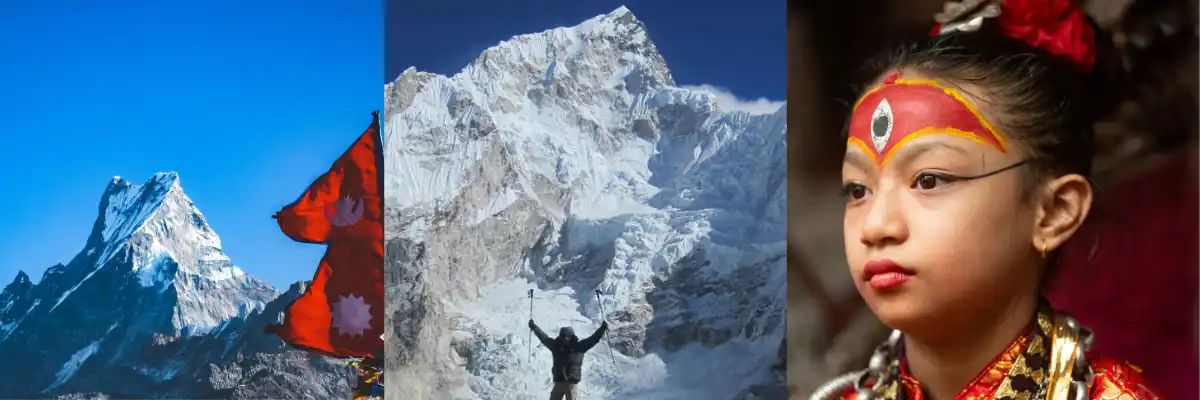
Nepal is one of those places that makes your jaw drop before you even get there. Tucked between two giants: China and India, this small Himalayan country is home to eight of the world’s ten tallest mountains, including the legendary Mount Everest.
Nepal is the ultimate dream destination for adventurers, culture lovers, and curious souls. But Nepal is so much more than just mountains. Ancient temples, living goddesses, rare wildlife, and some of the most hospitable people you’ll ever meet.
Whether you’re planning a trip or just want to know about the fascinating land, these amazing facts about Nepal will make you wonder why you didn’t visit sooner.
Nepal is Home to the World’s Highest Peak
Mount Everest, standing tall at 8,848.86 meters (29,032 ft), sits right on Nepal’s border with Tibet, and this is easily one of the most jaw-dropping facts about Nepal you’ll ever hear.
Thousands of climbers from across the globe travel here every year, chasing the dream of standing on top of the world. Nepal officially recalculated Everest’s height in 2020, correcting it from the previously accepted 8,848 meters.
Everest is also called “Sagarmatha,” meaning Goddess of the sky, in the Nepali language, whereas in Tibetan, the local language, it is called “Chomolungma,” which means Goddess Mother of the World.

Birthplace of Siddhartha Gautama (Lord Buddha)
Here’s one of the most spiritually significant amazing facts about Nepal. The Buddha was born right here! Lumbini, a peaceful garden town in the southern Terai plains, was the birthplace of Siddhartha Gautama around 563 BCE.
Lumbini was recognized by UNESCO as a World Heritage Site in 1997. Pilgrims from China, India, Japan, Sri Lanka, Cambodia, Thailand, and dozens of other countries come to visit Lumbini every year.
The sacred Maya Devi Temple marks the exact spot of his birth. Monasteries and peace pagodas built by several countries now surround the site, making Lumbini one of the most serene and spiritually significant destinations for Buddhism.
The Only Non-Rectangular National Flag in the World
Every single country in the world flies a rectangular flag, except Nepal. This is genuinely one of the quirkiest amazing facts about Nepal that surprises almost everyone. Nepal’s flag consists of two stacked pennants, forming a unique double pennon shape.
The flag is colored Crimson in the body with blue borders, featuring the white moon and sun symbols. The Crimson red represents bravery and courage, while the blue border symbolizes peace and harmony.
Whereas the emblem symbolized permanence, representing the hope that Nepal will exist as long as the sun and moon. Nepal officially adopted the modernized flag in 1962. The traditional double pennon design has roots going back centuries.
The modern flag was standardized by Nepali engineer and architect Shankar Nath Rimal at the request of King Mahendra. This national flag is famously known as the most mathematical flag in the world. Its exact shape, angles, and dimensions are defined by a strict geometric formula.

Kumari: Living Goddess of Nepal
Among all the amazing facts about Nepal, this might be the most extraordinary one. Nepal actually has a living goddess! Kumari, a young girl chosen from the Newar Buddhist community who embodies the goddess Taleju, the country’s patron goddess.
Priests carefully select prepubescent girls, aged under 4 years, through a rigorous set of 32 physical and spiritual criteria. There are approximately 10 to 12 living Kumaris in Nepal, while the chief Kumaris reside in three ancient cities of Kathmandu Valley: Patan, Bhaktapur, and Kathmandu.
The most well-known Kumari is from the Kathmandu Valley and is also called the Royal Kumari. She resides in the Kumari Ghar palace in Kathmandu Durbar Square and rarely steps out.
Devotees, including the Head of State, seek her blessing on special occasions. Once she reaches puberty, she returns to normal life, and a new Kumari takes her place.
Discover the rich heritage of Kathmandu Valley with our curated Kathmandu Cultural Tour.

World’s Greatest Biodiversity Hotspots
Few people realize just how widely diverse Nepal’s ecosystem is, and it’s one of the most overlooked amazing facts about Nepal. Despite covering just 0.1% of Earth’s land surface, Nepal shelters around 4% of all flowering plant species on the planet.
Tropical jungles, temperate forests, alpine meadows, and arctic tundra all exist within this tiny Himalayan nation. Snow leopards roam the high Himalayas.
Red pandas peek through bamboo forests. Bengal tigers stalk the southern grasslands of Bardiya National Park. Rare Himalayan birds fill the skies. Nepal’s conservation areas and national parks cover nearly a quarter of the country, protecting this extraordinary ecological wealth for the creatures that call it home.
Eight of the Ten Tallest Mountains
If Everest wasn’t enough, here’s another of the staggeringly amazing facts about Nepal. Eight of the planet’s ten highest peaks rise within its borders.
Along with Mount Everest, Kanchenjunga, Lhotse, Makalu, Cho Oyu, Dhaulagiri, Manaslu, and Annapurna all stand over 8,000 meters.
Each of these gigantic peaks attracts mountaineers all over the globe. These mountains shape Nepal’s culture, weather, rivers, and spiritual life in profound ways. Glaciers from these mountains feed rivers that sustain millions of people downstream.
Simply witnessing these giants from a hilltop village or a tea house window feels like one of life’s most humbling and spectacular experiences.

Living in the Future!
Do you know that Nepal is approximately 56.7 years ahead of the Gregorian calendar? The most wonderful and amazing facts about Nepal are that the country officially follows a completely different calendar! The Bikram Sambat.
The year 2026 is already 2083 in Nepal. Nepal celebrates its new year in mid-April, which is called “Navabarsha”. This calendar has 12 months, but the number of days in each month varies.
The exact lengths are adjusted every year based on the movement of the sun and moon. Banks, government offices, schools, and newspapers all officially use Bikram Sambat (B.S).
The Festival Capital of the World
If you love a good celebration, this ranks among the most joyful and amazing facts about Nepal. This country celebrates more than 50 festivals annually, earning the nickname “the festival capital of the world.”
Dashain, the biggest Hindu festival, brings families together across the country for 15 straight days of feasting, kite flying, and blessings.
Tihar lights up every home with oil lamps for five days, and animals are celebrated.
Indra Jatra sends giant chariots rolling through Kathmandu. Nepal is a country where two major religions, Buddhism and Hinduism, often share the same streets, with communities cheerfully joining each other’s celebrations.
The Legendary Gurkha Warriors
When it comes to bravery, one of the most spine-tingling amazing facts about Nepal is the story of the Gorkhas or Gurkhas, soldiers so fierce that even the British Empire chose to recruit them rather than fight them.
Hailing from the hills of Nepal, Gurkha warriors have served in the Indian and British armies for over 200 years with unmatched loyalty and courage. Their iconic curved blade, the Khukuri, strikes both fear and admiration across the world.
These extraordinary men carry Nepal’s pride wherever they serve, earning some of the highest military honors in history.

Invented Pagoda Architecture
Here is one of the most surprising and pride-worthy amazing facts about Nepal. The iconic multi-tiered pagoda temple architecture that you see across China, Japan, and Southeast Asia actually originated right here in Nepal.
A master craftsman named Araniko traveled from Kathmandu to China in the 13th century and introduced the distinctive tiered roof style to the imperial court. Nepali artisans had already been perfecting this design for centuries before Arniko carried it eastward.
The Pashupatinath Temple, Nyatapole Temple in Bhaktapur, and Changu Narayan all stand as breathtaking examples of this ancient craft. Intricately wooden struts, gilded rooftops, and perfectly proportioned tiers make these temples some of the most visually stunning structures on the planet.
So, there you have it! 10 amazing facts about Nepal that prove this tiny Himalayan nation carries the weight of the whole world’s wonder. Mountains, warriors, goddesses, temples, and wildlife are all packed into one extraordinary place. Nepal does not just attract visitors; it captures them for life.
Loading...
related post


Author

Himalayan Masters has been established by travel and trekking experts with several years of experience. Our consultants have travelled extensively and have in-depth knowledge of the region you will be traveling in.


Leave Your Comment