




Mt Everest vs Kilimanjaro | What We Know So Far
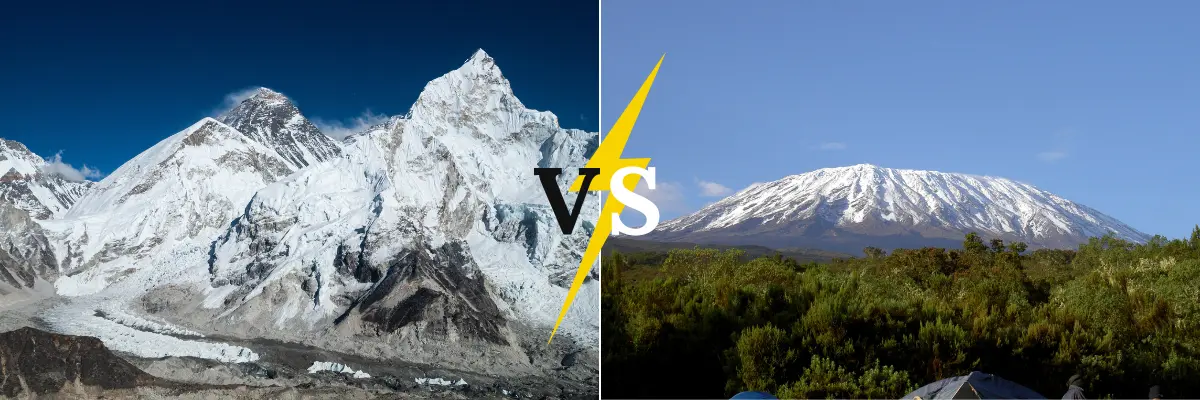
When it comes to legendary peaks, adventurers often compare Mt Everest vs Kilimanjaro, two peaks that are different in every way yet both astonishing. Among these two mountains, one soars above the icy Himalayas, while the other rises from Africa’s golden plains.
However, they are both symbols of ultimate adventure. Mount Everest is the highest point on Earth, which tests human endurance, courage, and the limits of survival while offering some of the most amazing experiences and successes.
Meanwhile, Mount Kilimanjaro is Africa’s sleeping giant, a free-standing volcano that guides trekkers through lush rainforest and alpine desert, finally to the top of the mountain for the most stunning views.
At first, for their irresistible adventures, they might seem the same. Yet, their differences are far more fascinating. While it takes around 6-8 weeks to reach the summit of Everest, it only takes 6-8 days for Mount Kilimanjaro.
Nonetheless, though they differ in duration, height, and challenges, Mt Everest vs Kilimanjaro remains an ever-talked-about debate. It’s a debate between pursuing the impossible and embarking on a journey of self-discovery.
So, let’s compare Mt Everest vs Kilimanjaro in detail: their location, heights, difficulty, logistics, culture, cost, safety, and experience.

Location, Landscape, and Region Type
When the locations of Mt Everest and Kilimanjaro are compared, they lie in different worlds.
Everest is situated in the Himalayas, within the maze of snow peaks in the Mahalangur range, along the Nepal-Tibet border. Meanwhile, Kilimanjaro is situated in East Africa, rising dramatically from the coastal savannas of Tanzania.
Everest, in comparison, is situated in much remote, rugged regions of the Khumbu Valley. Before attempting the ascent itself, trekkers need to trek up to the Everest Base Camp through Traditional Sherpa villages.

The lower Khumbu region is somewhat verdant, but as you go higher, the landscape transforms to icy glaciers and endless snowfields. The terrain becomes harsh, windy, and desert-like, reminding you that you’re in one of the most extreme yet magnificent environments.
Kilimanjaro, in contrast, is completely different. This free-standing mountain trail begins from the tropical rainforest to an arctic summit capped with snow and glaciers. The rainforest is rich in wildlife, including elephants, cape buffaloes, leopards, hyenas, black rhinos, etc.
This diverse landscape and diversity make Kilimanjaro not only a simple climb but an ecological exploration.
Despite their differences, both regions are breathtaking; Everest for its alpine, raw, and unspoilt experiences, and Kilimanjaro for its rich natural beauty and contrasting landscapes.

Height and Rank
When comparing Mount Kilimanjaro height and Mount Everest height, Mount Everest surpasses Mount Kilimanjaro by far.
Everest has a tip elevation of 8,848.86 meters (29,032 ft), while Kilimanjaro surmounts at only 5,895 meters (19,341 ft). Although Everest is higher and presents extreme altitude challenges, Kilimanjaro remains challenging due to its steep ascents and altitude gains within a few days.
Thin breathable oxygen level at Everest, one-third compared to sea level, particularly above the “Death Zone”, makes climbing Everest challenging. Icy, cold, strong winds, unpredictable weather, sharp edges, crevasses, etc. add challenges to the Everest expedition.
Whereas Kilimanjaro’s maximum elevation is just a few hundred meters higher than the Everest Base Camp (5,364 m/17,598 ft). However, rapid altitude gain without prior acclimatization makes climbing Kilimanjaro challenging.
Therefore, the height of Kilimanjaro poses a significant risk of altitude sickness, and the region gets cold. Additionally, despite being a non-technical climb, reaching its summit, Uhuru Peak, still demands strong physical endurance and mental determination.
Altitude Sickness and Death Rate
Both mountains significantly differ from each other in terms of altitude.
Everest’s summit lies in the “death zone” (above 8,000 meters), where oxygen levels drop to 33% of sea level. Even with supplemental oxygen, climbers suffer from fatigue, nausea, frostbite, blisters, and the constant risk of life-threatening conditions.
Historically, more than 300 climbers have lost their lives on Everest, many due to sudden weather changes or poor acclimatization.
Kilimanjaro, while far less deadly, quick elevation gain over a week poses the risk of Acute Mountain Sickness (AMS). Though fatalities are rare, the inherent risks due to cold nights, exhaustion, and thin air cannot be ignored.
Special Training and Preparation
Despite the low Everest death rate, climbing Everest must not be taken lightly. It required years of high-altitude experience, strong cardiovascular and strength training, and technical climbing, navigation, and rope handling skills.
Additionally, according to the new climbing rule imposed by the Nepalese government, mountaineers are compulsorily required to have climbed at least one 7,000er before attempting Everest. It is vital to build endurance, reduce fatality risk, and gain acclimatization experience. In addition to physical training, mental preparation is equally important.
Kilimanjaro, by contrast, is quite easy and accessible, but preparation still matters. Successful trekking depends on cardiovascular fitness, strong legs, and the ability to carry a small daypack over multiple days.
Learning to pace yourself and recognizing early symptoms of altitude sickness may make all the difference between reaching Uhuru Peak and turning back. While Kilimanjaro does not require technical climbing training, a disciplined approach to fitness and acclimatization is essential.
Mountain Type and Geology
Everest is a fold mountain, forged over millions of years by the collision of the Indian and Eurasian tectonic plates. The formation began over 60 million years ago and is still growing slowly every year.
Its upper slopes are composed of sedimentary and metamorphic rocks, layered with glaciers, crevasses, and icefalls that make climbing technically complex. Everest’s raw geology is both beautiful and deadly, with sharp ridges, towering faces, and ever-changing ice structures.
Kilimanjaro, on the other hand, is a volcanic mountain; it comprises three cones: Kibo, Mawenzi, and Shira. Kibo is dormant and houses the summit, Mawenzi is jagged and difficult, while Shira is old and eroded.
The volcanic soil and ash plains of Kilimanjaro give shape from the most fertile lower slopes to a barren alpine desert at the top. Its geology facilitates a non-technical climb, yet the steep inclines and rapid altitude gain create a physically demanding challenge.

First Ascent and Climbing History
Everest was first successfully climbed on May 29, 1953, by Sir Edmund Hillary and Tenzing Norgay. This feat attracts attention worldwide and solidifies Everest’s position in history as the ultimate human challenge. For which, over 800 mountaineers attempt the Everest summit during the spring and autumn windows.
Before that success, numerous expeditions met with tragic ends, underscoring the mountain’s danger and unpredictability. Since then, thousands have attempted Everest, and the mountain has become a testing ground for both elite climbers and commercial expeditions.
The first ascent of Kilimanjaro came a decade earlier in 1889, by a German geographer named Hans Meyer and an Austrian mountaineer named Ludwig Purtscheller. Unlike Everest, their climb did not need technical mountaineering but endurance and determination against altitude and harsh conditions.
Now, over 30,000 trekkers attempt Kilimanjaro annually, making it one of the most climbed high-altitude peaks in the world. It offers thousands of adventurers each year the chance to reach the top of Africa.
Popular Routes For Mt Everest and Kilimanjaro
There are two major routes taking mountaineers to the summit of Everest. One is the easy, popular South Col route from Nepal, and the other is a colder option through the North Ridge route from Tibet. Both routes are strenuous, requiring climbers to establish multiple camps, navigate icefalls, glaciers, and steep ridges, and sometimes use supplemental oxygen.
The South Col is the more popular route because it is a bit safer, whereas the North Ridge offers colder, windier, and less crowded conditions. Everest requires technical climbing skills, careful route management, and patience for acclimatization.
In contrast, there are several routes up Kilimanjaro for trekkers of different abilities and experiences.
Machame and Lemosho routes are picturesque, ensuring gradual acclimatization and increasing summit success. The Marangu Route offers hut accommodation; the Rongai and Northern Circuit routes offer quieter, more remote options.

Climbing Duration and Base Camp to Summit Height
If you are planning to climb Everest, know that it’s not a one- or two-week tour. An Everest expedition typically lasts for 6-9 weeks, including trekking, acclimatization rotation, rest days, and a narrow weather window for the summit attempt.
From the South Base Camp at 5,364 meters to the top is approximately 3,500 meters of vertical gain. As the route is mostly over ice, snow, and rock, every meter requires attention, energy, tactics, and a well-managed expedition plan.
In contrast, Kilimanjaro is a short yet intense climb. Kilimanjaro expedition usually lasts for 6-9 days, depending on your pace, acclimatization duration, and physical fitness.
Starting from Landorossi Gate at around 2,100 meters, you can reach the Uhuru Peak (summit of Mount Kilimanjaro) at 5,895 meters, gaining 3,795 meters (12,451 ft) of elevation, all within a week’s span.
While the total gain may be a bit less on Everest, the climb is far more grueling due to extreme altitude and the prolonged exposure to harsh conditions. Do not forget, by the time you start the Everest expedition, you are already at a significant elevation, almost equal to the total height of Uhuru Peak.

Permit and Regulations
Climbing Everest requires strict permits and regulatory approval. As of 2025, Nepal’s standard climbing permit costs roughly $15,000, with additional fees for Sherpa support, environmental services, and logistics. Not to forget, there are Everest trekking permits, too.
Likewise, if you wish to summit Everest through the North route, from China, you need to obtain Chinese Tibet permits, which are similarly expensive. Authorities put controls on numbers, enforce safety standards, and monitor climber experience.
As for Kilimanjaro, trekking permits and park fees are well within more modest budgets. Tanzanian law requires trekkers to hire licensed guides and porters for treks, ensuring safety and supporting local communities.
Fees vary by route and level of service, but even premium packages are only a fraction of the cost of Everest. This lower level of bureaucracy and cost makes Kilimanjaro more accessible for the casual adventurer, yet it still provides a well-managed climb.
Climbing Cost, Style, and Difficulty
The Everest expedition is quite expensive and technically demanding when compared to the Mt Everest vs Kilimanjaro expedition.
Including permits, guides, oxygen, and logistics, the Everest expedition usually costs from $30,000 to $100,000+. However, the expenses alone cannot compensate for the difficulties that you might encounter during the expedition.
Climbers need years of experience, physical conditioning, and technical skills to survive the harsh environment. One needs to learn how to navigate through glaciers, cross crevasses using a ladder, and use ropes, an ice axe, climbing boots for footing, etc.
The style of climbing is expedition-based, with multiple camps, rotations, and constant attention to risk management.
Whereas Kilimanjaro is comparatively as easy as a piece of cake. Having said that, you must not underestimate the mountains. You need to be prepared for the physical challenges, most importantly, the quick elevation gain.
Prices for Kilimanjaro range from $1,500 all the way up to $4,000, depending on route, duration, and service level. It’s a trekking-focused tour rather than a grueling mountaineering trip.
This tour tests trekkers’ stamina, patience, mental fitness, and ability to adjust to altitude. You don’t need any technical climbing skills; instead, demand respect.
Accommodation and Support on the Mountain
Before you reach the Everest Base Camp, there is a lodge or teahouse for accommodation. After that, it consists of high-altitude tents, from base camp facilities to tiny bivouacs at higher camps.
Meals, heating, and sleeping arrangements are very basic, and above 7,000 meters, life is Spartan. While support consisting of Sherpas, expedition teams, and high-altitude cooks exists, climbers are largely on their own in extreme conditions.
Guided treks up Kilimanjaro involve guides and porters, while accommodation varies according to route. Marangu offers huts, while other routes use comfortable tents, which the support staff pitch every night.
The meals will be prepared for you, gear is carried, and trekkers can thoroughly enjoy the journey. This infrastructure makes the experience safer and more comfortable, though it still challenges physical endurance and resolve.

Peak Climbing Season and Weather Windows
Everest has very narrow climbing windows. Nevertheless, the best climbing windows are April to May and September to November, during which the weather is stable and the ice is hard enough to provide good footing.
Outside these periods, heavy snow, avalanches, and extreme cold make climbing near impossible. Even during peak season, summit windows last a few days and require careful planning.
However, Kilimanjaro can be visited year-round. Nonetheless, the two main seasons for the Kilimanjaro trek are January to March and June to October, when the trails are dry and the skies clearer.
As Kilimanjaro lies near the equator, it has mild temperatures, but nights are still cold, especially at high altitudes. The wider windows and milder weather enable easier scheduling, though sudden storms or heavy rain can still impact shorter routes.
Trail Terrain and Scenery
Everest has some of the most extreme conditions. Trekkers pass through sub-alpine forests in the lower sections of the trekking trail, through traditional Sherpa villages. Then, as you trek higher, above 5,500 meters, the terrain transforms to icy, barren, and dramatic rocky terrain.

As the climb begins, climbers navigate through the Khumbu glacier, deep crevasses, and sharp-edged ridges, with snow-capped peaks surrounding every step. The scenery is harsh but awe-inspiring, a stark reminder of nature’s power.
Whereas Kilimanjaro offers a varied ecological experience. The climb starts in lush rainforest, moves through heather and moorland, crosses alpine desert, and ends on snow and ice.
The contrast between warm, green lower slopes and frozen, cratered summit is breathtaking.
Trekking Mt Everest vs Kilimanjaro, you’ll notice that Everest is a test of survival against raw forces, while Kilimanjaro is a celebration of nature’s diversity fitted into a single climb.
Cultural Experience
The Everest region is home to the native Sherpa people. Their culture can be seen through fluttering prayer flags, routes lined by mani stones and walls, chortens, ancient monasteries, and hymns from a nearby monastery.

Furthermore, festivals like Mani Rimdu and Lhosar are the prime time to experience these centuries-old cultures and rituals. They adorn the mountains with different kinds of spiritual energy. The spirituality here is the heart of the Tibetan people, offering warmth despite the cold.
Kilimanjaro is all about exploring East African culture. Local Chagga communities’ welcome trekkers with stories, songs, and guidance. The mountain’s lower slopes feature coffee farms and small villages, blending natural beauty with human history.
In the contest, Mt Everest vs Kilimanjaro, both mountains offer special cultural experiences; Everest feels mystical and remote, while Kilimanjaro feels vibrant and closer to everyday life.

Final Thought: Which Should You Choose?
So, Mt Everest vs Kilimanjaro: choosing which is cheaper, more immersive, or better depends entirely on what you are looking for. Is it a challenging yet totally worth it Everest climb, or an easier and deeply rewarding Kilimanjaro?
Everest is the ultimate mountaineering challenge; extreme, technical, very costly, and dangerous. Only seasoned, skilled, and determined climbers should dare to face the world’s highest peaks.
On the other side, Kilimanjaro is challenging in its own accord, yet a reachable trek. The trek takes adventurers to high-altitude glory, ecological diversity, and cultural richness without technical climbing skills.
Ultimately, both mountains offer profound experiences: Everest tests your limits; Kilimanjaro inspires transformation. The decision isn’t about which is “better,” but rather which journey aligns with your courage, preparation, and sense of adventure.
Loading...
related post


Author

Samyog Shrestha is a travel enthusiast and an excellent content writer at Himalayan Masters, the face behind the amazing content who likes to learn from experience.


Leave Your Comment