Nepal is home to some of the world-famous trekking trails, but not all travellers want to trek on popular trails. Some want authentic Himalayan culture, fewer crowds, dramatic landscape, and spiritual depth in their journeys.
Interestingly, the Manaslu circuit and Tsum valley trek stand out when it comes to spirituality, culture, authenticity, and off-the-beaten-path experience. Combining a circular multi-day trek around the Manaslu mountain with the sacred and remote Tsum valley.
However, unlike Everest and Annapurna, which are heavily commercialised, popularised, and crowded trails, this trek offers a completely different experience.
The 20-day trek is not just an adventure; it’s an opportunity to meditate in the Buddhist monasteries to soothe your racing thoughts.
This trek is an opportunity to explore Buddhism, Tibetan culture, traditions, and centuries-old monasteries.
This trek combines challenging high-altitude trails, a unique Himalayan landscape, and immersive cultural encounters.
The trail passes through the Manaslu Conservation Area with rich wildlife, and the Tsum Valley is an untouched piece of land, earning its reputation as “Hidden Treasure Valley”.
This trek is a test of how you manage the challenges, focus, and determination without losing your mental peace.
It does involve multiple days of walking, lasting about 7 hours each day. But guess what? The rewards are so big that whether you are trekking with a group or solo, you completely lose yourself in the adventure and find an excuse for every hardship you face on the trail.
About Manaslu Mountain
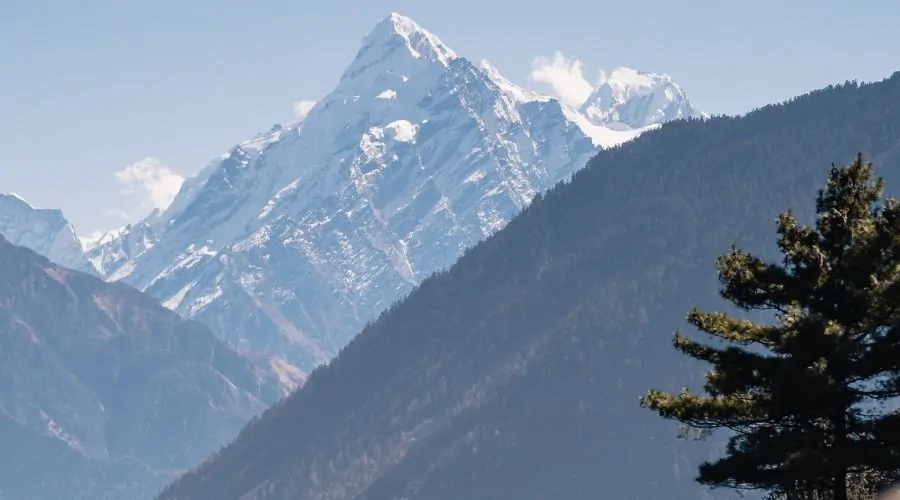
At 8163 meters (26781 ft) above sea level, Manaslu is the eighth-highest mountain in the world. It is known as the “Mountain of the Spirit.” It lies in the Mansiri Himal mountain range, situated in the Gorkha District of Nepal.
Manaslu, The Eighth Tallest Mountain in the World
First ascended by a Japanese climber, Toshio Imanishi on May 9, 1956 A.D, Manaslu still remains one of the favourite peaks among serious climbers due to its technically challenging routes and unpredictable weather.
About Manaslu Tsum Valley
Tsum Valley is one of the major hidden gems of Nepal, a remote and highly diverse culture-based valley located in northern Gorkha. Popularly known as the “Hidden Valley,” Tsum Valley opened its doors to trekkers only in 2008 and has maintained its ancient Tibetan Buddhist traditions very well.
It lies close to the Tibetan border and reflects a deep Tibetan influence on its culture, its language, and its religion. Sacred Buddhist sites dot this valley, such as the ancient monasteries of Mu Gompa and Rachen Gompa, which date back centuries and are still active spiritual centres for the local people.
Its landscape has terraced fields, thick rhododendron forests, and panoramic mountain viewpoints. The massive peaks of Ganesh Himal and Sringi Himal make it more beautiful.
Traditional villages likeChhokangparoand Nile provide a glimpse into how people in the Tsum Valley still sustain their lives through farming and livestock herding. Chhokang Paro are two beautiful twin villages in Tsum Valley trail. Tsum Valley is associated with the Buddhist saint Milarepa, who is believed to have meditated in caves in the valley.
Overview of Manaslu Tsum Valley Trek
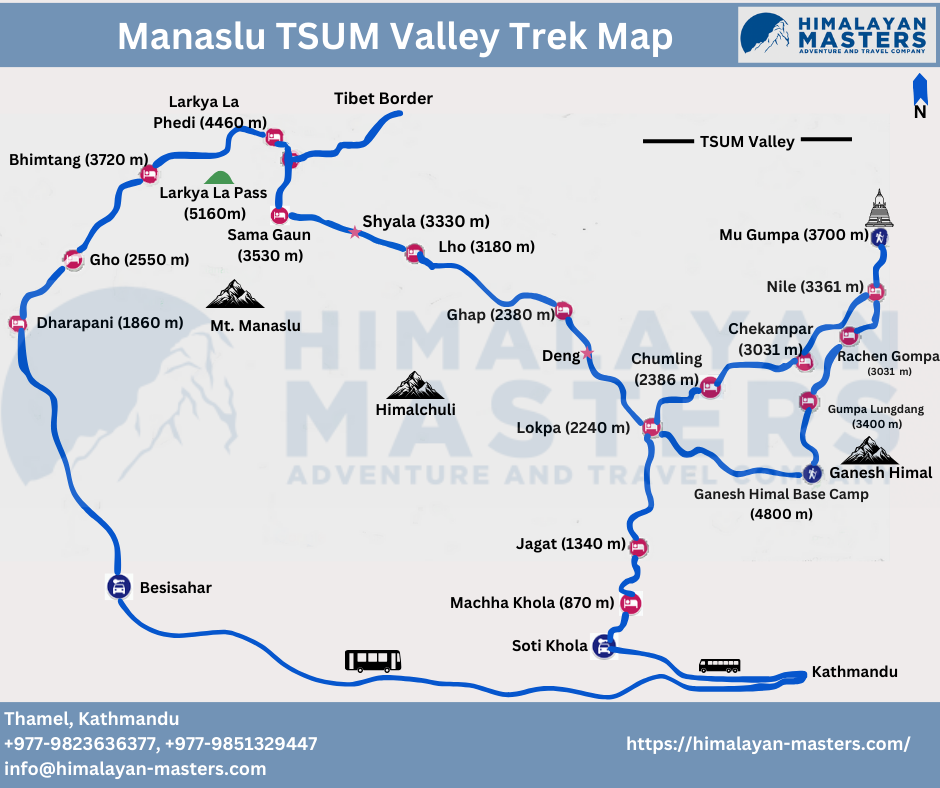
It is a 20-day Manaslu Tsum Valley trek into one of Nepal’s most remote and off the beaten trail. The journey covers the Tsum Valley and the Manaslu Circuit, both located deep in the Gorkha district near the Tibetan border.
Tsum Valley is all about deep Buddhist culture, ancient monasteries, and quiet stone villages hidden in a peaceful Himalayan valley. While the Manaslu Circuit is about dramatic mountain landscapes, rising from river valleys to high alpine terrain, crossing suspension bridges and the challenging Larke La Pass (also called Larke Bhanjyang).
This combined trek is about exploring new places, having unique experiences, and living the moments that change something within yourself.
Spotting rare wildlife such as snow leopards, Himalayan goats, Lophophorus or Himalayan Monal (National Bird of Nepal), and Langurs is common. You can also see mad honey beehives attached to cliffs or trees.
The views of iconic mountains of the Himalayan range, such as Manaslu, Ganesh Himal, Larke Peak, Shringi, Ngadi Chuli, and Hiuchuli, are breathtaking.
Over the 20-day duration, trekkers visit and sleep in a Buddhist Gompas (Monasteries), summit Ganesh Himal Base Camp and Larke la pass, walk the trails full of wildlife and beautiful landscape.
Have experience of eating Nepali and Tibetan dishes like Dal Bhat (Nepali staple meal), Dhindo, Thukpa, Thenduk, and a few other dishes too. You will be offered a menu with Western, Tibetan, and Nepalese dishes. Items in the menu become limited as the altitude increases.
The trail is long, about 200-250 kilometres (124-155 miles), but the Tsum Valley and Manaslu circuit trek never feels dull or tiring. Each step brings something new, like fresh views, quiet moments, and powerful experiences that keep the journey alive every day.
Majestic view of mountain
Manaslu Tsum Valley Trek Highlights
The following are the major highlights of the Manaslu Tsum Valley trek.
A scenic drive from Kathmandu to Machha Khola through winding roads of Nepal. A 7-hour road trip through Nepal’s landscape.
Visit the iconic monasteries like Mu Gompa and Rachen Gompa. Here, you will have a chance to interact with female and male monks (called Aani and Lama, respectively).
Take part in culturally and traditionally rich events like Lhosar (Tibetan New Year) and Marriage ceremonies if your trek coincides with these events’ timing.
Trek through diverse landscapes like terraced fields, lush rhododendron forests, alpine meadows, subtropical forests, frozen lakes, and glacial rivers like Budhi Gandaki.
Summit the Ganesh Himal Base Camp at 4800 meters (15748 ft)
Summit the highest point of the trek, Larke La Pass (Also one of Nepal’s highest passes at 5106 meters).
Explore the Manaslu Base Camp at 4800 meters (15748 ft).
Explore the iconic century-old monastery called Pungyen Monastery, sitting beneath Mount Manaslu.
Spot rare wildlife like snow leopards, red pandas, blue sheep, Himalayan goat, and many other species.
Explore the over 800-year-old Dephyu Doma Nunnery Monastery at 4000 meters (13123 ft) height.
Sidetrip to the high altitude scenic viewpoint from Mu Gompa.
Experience the Nepali and Tibetan dishes like Dal bhat, Dhido with curry, Momo, Thukpa, Thenduk, local apple pies, yak dry meat, etc.
Side trip to beautiful high-altitude Birendra Lake at 3450 meters (11318 ft).
Sleep at an altitude of 4460 (14633 ft) in Dharamsala.
Latest Manaslu Tsum Valley Trek Updates for 2026
The Government of Nepal has introduced updated laws, trekking rules have been changed slightly in 2026.
Solo trekking in Manaslu Tsum Valley was not allowed before 2026 because the Manaslu trekking trail falls under the Restricted Area. The fragile flora and fauna need protection, and also the trekkers’ safety matters, as the Manaslu trail often passes long, remote sections.
The risk of going astray, contracting altitude sickness, being attacked by wildlife, sustaining injuries, and other accidents is always there if you travel solo.
Considering these risk factors, the Nepalese government introduced a new law where a trekking agency and a guide to travel with are made mandatory.
Therefore, trekkers shall choose registered and reputable trekking agencies. They provide a reliable, experienced local guide, emergency support, and overall logistical support.
In the past, Soti Khola used to be the starting point. Now, with road construction, Machha Khola is the standard starting point of the Manaslu Tsum Valley Trek. Although the condition of the road depends heavily on the season and weather.
To make the journey smoother, the trail infrastructures of Manaslu Tsum have also improved with better and more comfortable accommodation, wider bridges, upgraded walking trails, and communication access for trekkers.
Wi-Fi and local SIM coverage have also improved. Though it can be patchy sometimes. Nevertheless, beyond Samdo village, the facilities are very basic but comfortable.
Due to global warming, the weather patterns have also changed in the mountains. Rainfall before the start of the monsoon season is common. The lower villages of trekking trails are warmer.
Don’t be surprised by the sudden snowfall, wind, and weather changes while you are in the mountains.
Why Book the Manaslu and Tsum Valley Trek with Himalayan Masters?
There are numerous benefits of booking with Himalayan Masters. Our office is located in the heart of Kathmandu, Thamel. We belong to the very few trekking agencies that focus on both authentic local experiences and professionally managed trekking services across Nepal. Below are the reasons why you should book your Manaslu Tsum Valley trek with Himalayan Masters.
Simple, seamless, and transparent booking process.
100% fixed departure as per the wish of a trekker.
Complimentary airport pickup and drop off by private transport.
Free storage at the Himalayan Masters store if you have excess luggage that you don’t want to carry along on the trek.
Easy payment through ATM card, Bank transfer, PayPal, or Cash.
Strong safety records, including successful treks during the season and off-seasons (Monsoon and Winter treks)
We have been awarded the TripAdvisor “Travelers’ Choice Award” consecutively since 2022 for delivering reliable service, memorable trekking experiences, and excellent customer satisfaction.
Successful Manaslu Tsum valley treks in every single trekking season are guided with proven consistency.
If you want company during the trek, Himalayan Masters organises a group joining the Manaslu Tsum Valley trek.
Taking care of overall logistics and transportation to and from the trail starting and ending point.
Strong network with local people and villages across the Manaslu circuit and Tsum valley.
English-speaking, first aid-trained, and experienced local guide for your entire trek.
After booking confirmation, Himalayan Masters provides an online or physical trip briefing option before departure
Multi-channel, 24/7 fast-response communication is available via WhatsApp at +977-9823636377 and for local and international calls at +977-9851329447, ensuring quick and reliable support anytime.
We provide a sleeping bag, a down jacket, trekking poles, and microspikes for the trek.
A complimentary Himalayan Masters branded T-shirt, baseball cap, and 1 litre (1000ml) BPA (Bisphenol A) free water bottle with purification tablets.
If you hire a porter, we provide you with a waterproof duffel bag (depending on your luggage, duffel bag sizes are available) for your porter to carry. You can take it home if you want.
Very careful selection of teahouses where hygiene and comforts are the best.
Emergency evacuation and coordination support.
We help you with travel insurance and helicopter rescue paperwork if your insurance covers it.
A short briefing session about the next day’s route is held daily after dinner, where you can also share your trekking experiences and any inconveniences.
Checking of body oxygen levels and symptoms of altitude sickness, if you report or your guide notices any health difficulties.
We encourage responsible trekking practices by not littering, respecting local cultures, protecting ecosystems, and supporting local mountain communities.
We help you with trekking gear check and last-minute shopping in Kathmandu.
Himalayan Masters’s guides carry satellite phones for better communication during emergencies or for safety in the remote region.
An assistant guide is provided if the group has more than four trekkers.
Flexible itineraries and acclimatisation plans for solo trekkers and special groups.
We hold an excellent reputation among international trekkers, many of whom return again and recommend us to their friends, serving as a strong testimony to the trust we have built.
Deep local expertise across the Manaslu region, ensuring authentic guidance and meaningful cultural insight.
Full assistance with onward travel planning after the trek for a smooth and stress-free continuation of your journey.
Trek completion certificate provided as a proud record of completing the 20-day Manaslu Tsum Valley Trek.
Himalayan Masters Team at Machha Khola during Tsum Valley Trekking.
Important Note About the Fixed Departure
Once you confirm your booking, the departure for the Manaslu Tsum Valley trek on a stipulated date is 100% guaranteed by Himalayan Masters. If you are travelling solo and no one joins by your departure date, a single supplement fee of USD 350 will apply.
How to Book Your Manaslu Tsum Valley Trek with Himalayan Masters?
To begin your Manaslu Tsum Valley Trek, first of all, start booking through our website, by email at [email protected], or by call, WhatsApp, to share your travel interest.
Once we receive your inquiry, we will provide a detailed itinerary, cost breakdown, and all necessary information about the trek.
It will help you prepare with clarity and confidence. After you confirm your plan, we finalise your trekking schedule and request a deposit to secure your booking of a minimum of 20% of the trek package.
Is the Manaslu Tsum Valley Trek Safe for Solo Female Travelers?
When it comes to solo female trekking in the Manaslu region, it requires careful selection of teahouses, a guide, an itinerary, and safety measures.
The mountains are beautiful, but safety, comfort and small personal needs matter a lot during the trek.
Himalayan Masters understands this very well and helps female trekkers travel with confidence and peace of mind.
Solo female trekkers are arranged in clean, safe, private or comfortable rooms or in a safe sleeping space.
Female Trekkers Sharing Experience of Traveling with Himalayan Masters
Female trekkers are guided by experienced local, respectful and knowledgeable guides who stay supportive throughout the trek.
We understand the small challenges women may face during the trek. Monthly cycle, hygiene needs, changing energy levels, body discomfort and limited facilities can sometimes feel stressful. Our team handles these situations with care, sensitivity, and understanding, ensuring that every female trekker feels comfortable, supported, and confident throughout the adventure.
We have numerous records of helping solo female trekkers every trekking season (Spring-Autumn) complete the Manaslu Tsum Valley trek.
Can Families with Kids Do the Manaslu Tsum Valley Trek?
Families with kids and senior citizens might not be able to push like fit, young and independent trekkers. We understand that families with kids and senior citizens find it hard to commit to longer-duration walking. They often need breaks, or children might need to be carried on their backs during steep sections.
We can adjust the itinerary based on the family’s comfort and energy level. Walking hours can be reduced, and extra rest days can be added in key villages so everyone can adjust properly to altitude and terrain.
Foreign Tourists in Sherpa Dress
Himalayan Masters takes care of all these needs by planning a slow, family-friendly route, arranging comfortable teahouses, and providing experienced guides who understand how to handle different age groups. They also help with luggage support and daily pacing, so no one feels pressured.
We have been providing excellent services to families with kids, senior citizens and senior couples.
Is the Tsum Valley Manaslu Circuit Trek Suitable for Seniors?
Yes, with proper preparation and a well-organised itinerary, the Tsum Valley Manaslu Circuit Trek can be suitable for seniors.
Every trekking season (spring and autumn), Himalayan masters host around 15-20 senior trekkers who complete this journey safely and enjoyably.
A private trek option is highly recommended, as it allows a flexible pace, more rest days, and a personalised approach based on fitness and comfort levels.
A Senior Citizen’s Experience of Choosing Himalayan Masters for Manaslu Tsum Valley Trek
With the right support, it becomes a meaningful way to experience retirement, slow travel, cultural depth, and peaceful Himalayan landscapes.
At Himalayan Masters, we focus on safety, comfort, and care throughout the journey. Our experienced guides, careful acclimatisation plans, and well-managed logistics create a smooth trekking experience even in remote terrain.
A broader Version of the Himalayan journey through Tsum Valley, Serang Monastery, and the Manaslu region.
This can be a 24-25-day trek. If you want to explore beyond the classic Manaslu Circuit and you have enough time for a longer adventure, this broader version of the journey offers a far deeper Himalayan experience.
Tsum Valley
Tsum Valley is a sacred Himalayan valley near the Tibetan border, known for its strong Buddhist culture and preserved traditions. It is home to ancient monasteries like Mu Gompa and Rachen Gompa.
Mu Gompa, Tsum Valley
The valley is isolated, peaceful, and culturally untouched. Local people follow traditional lifestyles, making it one of the most spiritually rich and culturally preserved trekking regions in Nepal.
Manaslu Circuit
The Manaslu Circuit is a remote trekking route around Mount Manaslu, the eighth-highest peak in the world. It offers dramatic landscapes from low river valleys to high mountain passes like Larke La.
Larke La Pass, Manaslu Circuit
The trail is culturally rich with Gurung and Tibetan-influenced villages. It is known for its raw wilderness, fewer crowds, and a strong combination of nature and tradition.
Serang Monastery
Serang Monastery is a hidden Buddhist centre located in a remote part of the Manaslu region. It holds deep spiritual importance for local communities practising Tibetan Buddhism. Trekkers usually combine the Manaslu Circuit Trek with Serang Monastery, as it lies just 4 hours away from the main Manaslu Circuit trail.
Serang Monastery
The monastery is surrounded by forests and mountains, creating a peaceful retreat environment. Monks live, study, and meditate here in isolation, preserving ancient teachings, rituals, and a quiet Himalayan spiritual lifestyle.
Combining these three creates a deeply spiritually immersive and geographically vast Himalayan journey. If you are a true adventurer, this combined trip is surely worth it.
Important Notes Manaslu Tsum Valley Trek
Obtain the required permits: Manaslu Restricted Area Permit, Annapurna Conservation Area Permit (ACAP), and Manaslu Conservation Area Permit (MCAP).
Plan for acclimatisation days to prevent altitude sickness.
Prepare for a remote and less-crowded experience with limited facilities.
Ensure physical fitness and stamina for long, challenging trekking days.
Pack sufficient gear and clothing for varying weather conditions.
Travel with a licensed guide, as it’s mandatory for the restricted area.
Be aware of basic teahouse accommodations with simple amenities in the region.
Itinerary Outline of 20 Days Manaslu Tsum Valley Trekking
Day
Route
Sleep Altitude
Distance
Time
01
Drive From Kathmandu to Machha Khola
869 m
160 km
7-8 hrs
02
Trek From Machha Khola to Jagat
1340 m
20 km
6-7 hrs
03
Trek From jagat to Lokpa
2240 m
10-12 km
5-6 hrs
04
Trek From Lokpa to Chumling
2386 m
8 km
4 hrs
05
Trek Chumling to Chhekampar
3031 m
9 km
4-5 hrs
06
Trek From Chhekampar to Nile
3361 m
7 km
3.5-4 hrs
07
Trek From Nile to Mu Gompa
3700 m
5 km
5-6 hrs
08
Trek From Mu Gompa to Chhekampar Via Rachen Gompa
3240 m
3-4 km
1.5 hrs
09
Trek From Chhekampar to Gompa Lungdang
3200 m
14-15 km
7-8 hrs
10
Trek to Ganesh Himal Base Camp & back to Gumba Lungdang
3200 m
3-4 km
7-8 hours
11
Trek From Gumba Lungdang to Lokpa
2240 m
10-12 km
5-6 hrs
12
Trek From Lokpa to Ghap
2397 m
12.5 km
9-10 hrs
13
Trek From Ghap to Lho
3180 m
16.3 km
7-8 hrs
14
Trek From Lho to Samagaon
3520 m
17.2 km
4-5 hrs
15
Rest at Samagaon or Take Side Trips
3520 m
–
–
16
Trek From Samagaon to Samdo
3875 m
9.1 km
3-4 hrs
17
Trek From Samdo to Dharmasala
4460 m
6.1 km
3-4 hrs
18
Trek From Dharamsala to Bhimthang via Larkye La Pass
On this first day of the trek, we start with a long drive towards the west lasting for about 7 hours, depending on the road conditions.
We drive along the Trishuli River for about 4 hours until we reach the place called Furke Khola. This section of the road is narrow and busy, as it is Nepal’s Prithvi highway that connects two major cities (Kathmandu and Pokhara), and is slightly landslide-prone and under construction, which can cause traffic jams.
After crossing the Dhading Besi Bridge at Furke Khola, our driver heads towards our lunch point, which is Jyamire. It is about 40 min to 1-hour drive from Furke Khola.
The road is black-topped until Taribesi, and off-road starts from there. Your drive includes 75% blacktopped road and 25% off road journey. You get to see the stunning views of green hills, numerous Nepali Markets like Dhading Besi, and small rivers.
About Machha Khola
Machha Khola (fish river, translated in English) is a starting point for the Tsum Valley and Manaslu Circuit trek. It’s a semi-commercialised village at 869 meters (2851 feet) near the river called Machha Khola (also called Machhi Khola).
The local residents belong to Magar, Gurung, and Magar communities, and most people are engaged in agriculture, teahouse services, trekking guides, and porters.
Facilities provided by teahouses in Machha Khola.
There are about 7-10 teahouses in this village.
They provide comfortable accommodation; Wi-Fi and Internet are patchy or slow, and the electricity supply is very sporadic too.
Hot shower and charging at extra cost (about NPR 350 for a hot shower)
The journey on foot actually starts from Machha Khola. We wake up early in the morning at around 6 am, freshen up, and head towards the dining area for breakfast.
After breakfast, we start our trek at around 7 or 7:30 am. One of the highlights of this day is spending time at the Tatopani hot spring (a natural hot spring). You reach the hot spring after 2 hours of trekking.
Tatopani, Natural Hotspring
You can stop here, take a plunge, and relax for a few minutes. After a brief enjoyment, we head towards Thulo Dhunga to grab lunch, which is about a 4-hour walk from Machha Khola.
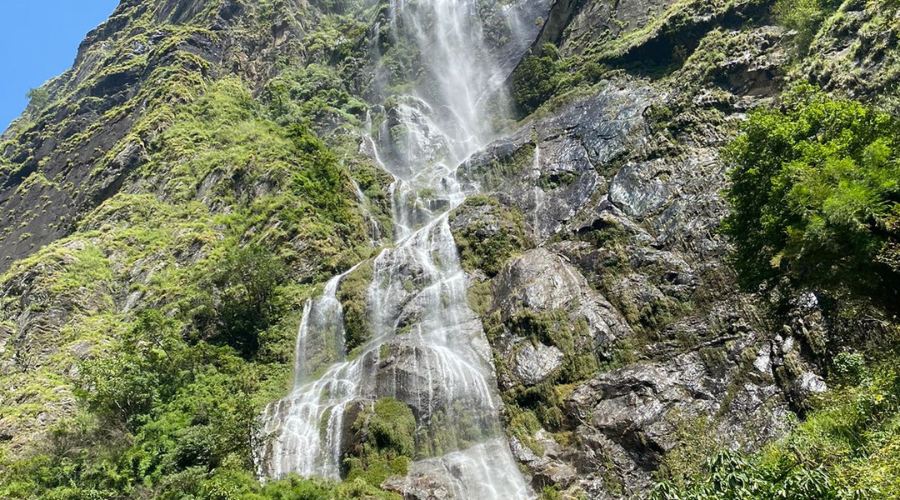
We spend about 1 hour at the lunch point and head towards the final destination of the day, Jagat. We reach Jagat in the evening at around 4 or 5 pm, and while on the trail, spotting wildlife like Langur monkeys is common.
About Jagat
Jagat is located 1340 meters (4396 ft) above sea level and is surrounded by hills on all sides. You get to see teahouses, guesthouses, and local houses here. Jagat has a church, mani walls, an MCAP office, a Customs office, and a viewpoint of Shringi Himal.
Facilities in the teahouses of Jagat
Jagat has about 5-7 teahouses in the area.
Neat and clean bedrooms are provided with Wi-Fi, charging sockets, and good food. A hot shower is also provided at a cost.
Our Mansalu Tsum Valley Trek officially begins on the third day. We are now entering the Manaslu Restricted Area as Jagat marks its starting territory.
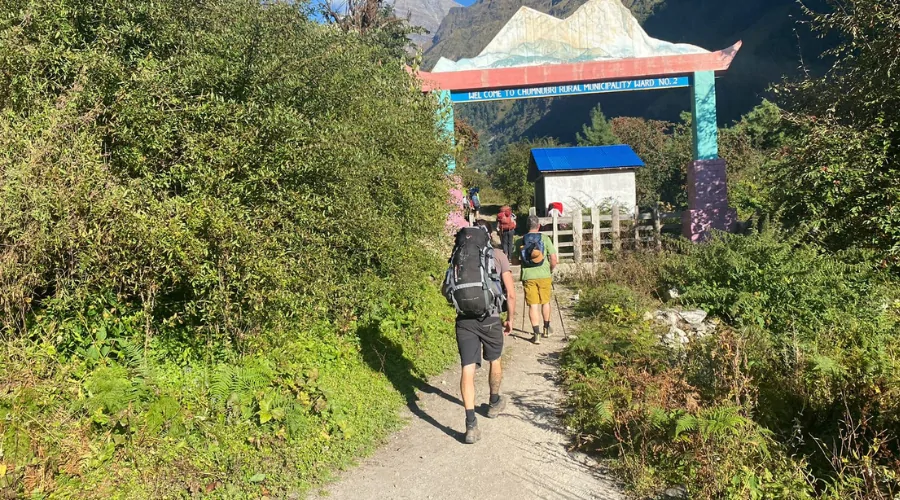
Your guide manages the permit process here, and then you start your walk towards Salleri before climbing to Philim. The trekking trail is well marked, and we get to see the first beautiful waterfall and suspension bridge after 30 minutes of our trek. After crossing a bridge, we will walk slowly uphill. After walking for 3 hours, we will reach Philim.
All About Jagat to Lokpa Day
In Philim, there is a checkpost for checking our permits for Manaslu and Tsum Valley. Philim is the last village where you will find things like sleepers, buffs, shoes, and other clothing items.
Your permits are checked here. Philim is a large village in the Manaslu region. We have our lunch at Philim. You can have both Nepali and Western food items in Philim.
Then, after walking for around 1 hour, we will reach Chisapani. You will get a good view of the Budhi Gandaki River.
Again, you will have to walk for 2 more hours to reach Lokpa via villages like Ekle Bhatti via Nyak Phedi (the point where the Manaslu Circuit trail separates from Tsum Valley). The route to Lokpa is enjoyable and a bit uphill.
Nyak Phedi Bridge
Here, we see the Shiar River before getting to the first village in Tsum. In the evening, we visit the Lokpa, the isolated valley of happiness. Locals believe that Padmashamva blessed this village centuries ago.
About Lokpa
Lokpa is a small village that consists of 5-7 houses of the local people. They are the ones who run the teahouses in the area. You get to see the beautiful views of the Shringi mountain range.
Lokpa Teahouses Facilities:
There are around 2-3 teahouses.
You will have Wi-Fi, electricity, and a bucket shower, but no attached bathrooms.
Today, the trail leaves the quiet village of Lokpa and enters the hidden world of the Tsum valley. You walk through the dense rhododendron and pine forest where the sound of birds and rushing Shiar Khola (Shiar River) follows you almost the whole day.
The path goes uphill on narrow hillsides and crosses small wooden and suspension bridges above deep gorges. You will see the beautiful views of Ganesh Himal and Boudha Himal appear between the trees as the trail slowly opens.
After walking 4 or 5 hours, the peaceful village of Chumling comes into sight across the river. The village feels calm and untouched, with traditional stone houses, prayer flags, mani walls, and old monasteries spread across the hillside.
The warm hospitality of the locals and the quiet mountain atmosphere make Chumling one of the most memorable overnight stops in the lower Tsum Valley.
About Chumling
Chumling is a small local village in the Tsum Valley of Nepal. You will find local muddy houses of the people who follow Buddhism. Most of the people in the region are Tibetan. There are monasteries in the area. In Chumling, you will find 10-15 local houses of the people.
Chumling Teahouses Facilities
As you begin the remote region, the services in Chumling’s teahouses will be remote.
You will find 2-3 teahouses with basic services.
One gets to taste the local food of Tsum Valley.
There are basic services like Wi-Fi, electricity, and a bucket shower.
: Breakfast, Lunch and Dinner
: Tea House
: 4-5 hours walk
Day 05:
Trek from Chumling to Chhekampar
Trek Route: Chumling → Gho→ Kowo → Chhekampar Starting Point: Chumling (2386 m/ 7828 ft) Ending Point: Chhekampar (3031 m/ 9944 ft) Lunch: Chhekampar Chumling to Chhekampar Distance: 9 km (5 miles) Total Descent: 645 m/ 2116 ft Overnight: Chhekampar
The trail from Chumling to Chekampar is full of natural beauty, and it is one of the most culturally rich days in the Tsum Valley. Your morning starts with a gradual climb through a pine forest. Entering this section, you will get to see the Tibetan lifestyle and villages, which are quite fascinating.
Along the way, trekkers can see prayer flags, chortens, and small monasteries that reflect the deep Buddhist culture of the region.
As you gain altitude, the valley feels more open and peaceful. Small settlements like Ripchet and Rainjam, where locals live in small houses and are involved in animal husbandry and agriculture. After 4-5 hours of walking, the twin villages of Chhokang Paro finally appear beneath dramatic mountain backdrops. We have our lunch here and settle for the day here.
Stone houses, spinning prayer wheels, and the slow rhythm of mountain life are something you feel here.
About Chhekampar village
It is a village located at 3031 meters (9,944 ft) where you will see wide open lands, yaks grazing, and friendly faces.
Chhekampar has a school, health post, Micro hydropower, and monasteries. You will also get telephone services.
There are around 30-40 houses for local people. They all follow the Buddhist religion.
Many people raise goats and yaks and make chhurpi, Yarshagumba, and other kinds of food.
Chhekampar Teahouses Facilities
Chhekampar has around 3-4 teahouses.
The services and facilities are basic but good enough to get a warm sleep.
There are no attached bathrooms in Chhekampar.
But you will have Wi-Fi, a bucket hot shower, and NTC sim network services.
: Breakfast, Lunch and Dinner
: Tea House
: 4-5 hours walk
Day 06:
Trek from Chhekampar to Nile
Trek Route: Chhekampar → Lamagaon → Lar → Phurbe → Pangdun → Nile Staring Point: Chhekampar (3031 m/ 9944 ft) Ending Point: Nile (3361 m/ 11026 ft) Lunch: Lamagaon Chhekampar to Nile Distance: 7 km (4.3 miles) Total Descent: 330 m/ 1082 ft Overnight: Nile
The trek from Chhokang Paro to Nile takes you deeper into the upper Tsum valley, where the landscapes become remote, wider, and more spiritual.
The trail passes through small Tibetan settlements, open barley fields, mani walls and ancient chortens with views of Ganesh Himal and surrounding snowy peaks. After walking for 2 hours from Chhekampar, we reach our lunch point, Lamagaon.
After having lunch, we continue our trek towards the Nile. Nile is a 1 or 1.5-hour walk from Lamaggaon.
Around 30-45 minutes before reaching the Nile, we cross a bridge over Shiar Khola, through villages like Phurbe, Pangdun and Chule. Nile is the last permanent settlement of the Upper Tsum Valley before Mu Gompa.
Along the way, you explore the century-old Milarepa cave, also called the pigeon cave. It is a holy meditation site filled with old murals, prayer flags, and Buddhist carvings.
About Nile Village
A big village of 30-40 villages made up of stones, mud, and wood. The Village has mani walls, stupas, and schools. Also, they have a primary health post. You will get views of mountains in the Tsum Valley, like Ganesh Himal.
Nile Teahouses Facilities
There are around 4-5 teahouses on the Nile.
The rooms and services are basic yet comfortable and warm.
You will get a gas, hot shower, Wi-Fi, charging, and a good and neat dining area with healthy foods.
: Breakfast, Lunch and Dinner
: Tea House
: 3.5-4 hours walk
Day 07:
Trek from Nile to Mu Gompa
Trek Route: Nile → Sengum → Chho Syong → Mu Gompa Starting Point: Nile (3361 m/ 11026 ft) Ending Point: Mu Gompa (3700 m/ 12139 ft) Lunch: Mu Gompa Nile to Mu Gompa Distance: 5 km (3.1 miles) Total Descent: 339 m/ 1112 ft Overnight: Mu Gompa
This is a very significant day on our trip as we head towards Mu Gompa, our high-altitude monastic accommodation in Tsum Valley.
We wake up early in the morning and observe the beautiful sunrise. At around 7 am, we have breakfast before heading towards Mu Gompa.
The trail to Mu Gompa is slightly uphill, and some sections of the trail contain pine forest. We start easy and walk at a relaxed pace while also enjoying the scenery.
While on the way, we also explore the iconic over 800-year-old Dephu Doma Nunnery Gompa.
Dephu Dompa Nunnery Gompa is located at a height of 4000 meters, and it is believed to earliest monastery in the Tsum valley. The monastery has Tibetan Buddhist scriptures, prayer halls and hosts evening rituals.
It is located in an isolated location and offers the sweeping views of mountains like Chhyosing himal, Langju himal and deeps valleys and rolling hills. From here, it takes around 45 min to reach Mu Gompa
After around 2.5 or 3 hours of trekking from the Nile, we finally reach Mu Gompa before noon and stop there for lunch. Mu Gompa will be our overnight stay for today.
Monastic Accommodation, Mu Gompa
After lunch, we have a choice to hike further towards the upper viewpoint, which is around a 1.5-hour hike from Mu Gompa. The scenery from the viewpoints feels just out of the world. You see the long mountain coat and deep valleys. It is also a great acclimatisation hike as we have a couple more high points on our trail.
About Mu Gompa
Sitting quietly beneath the mountains, the monastery gives a truly remote Himalayan experience. The peaceful atmosphere, fluttering prayer flags, and ancient Buddhist culture make this place unforgettable.
Mu Gompa is the biggest monastery in the Tsum Valley and is located at 3700 meters (12139 ft). More than 200 students live and learn about Buddhism in Mu Gompa, Tsum Valley.
Established in the late 19th century, this ancient Buddhist monastery is one of the spiritual highlights of the Tsum Valley Trek. Surrounded by barren Himalayan landscapes and snow-covered peaks, Mu Gompa offers a peaceful and deeply spiritual atmosphere.
The monastery follows the Gelugpa tradition of Tibetan Buddhism and preserves ancient murals, scriptures, and religious artifacts.
Facilities in Mu Gompa
Warm and Comfortable accommodation facility
Nutritious food options
No Wi-fi, No Electricity but local telecommunications work fine.
: Breakfast, Lunch and Dinner
: Tea House
: 3 hours
Day 08:
Trek from Mu Gompa to Chhekampar via Rachen Gompa
Trek Route: Nile → Pangdun → Lar → Rachen Gompa Beginning Point: Nile (3361 m/ 11026 ft) Ending Point: Chhekampar (3031 meters/ 9944 ft) Lunch: Rachen Gompa Mu Gompa to Chhekampar Distance: 14 km (8.6 miles) Total Descent: 329m/ 1079 ft Overnight: Chhekampar
This is the day we trace back on the same trail. We start early in the morning at around 7 am. Have breakfast and start walking downhill.
The morning trail feels calm and spiritual. As we walk downhill, the views of snow-capped mountains, ancient mani walls, and scattered villages continue to accompany us. The descent is easier on the lungs, allowing us to walk more comfortably while fully soaking in the surroundings.
On our way down, we visit the beautiful Rachen Gompa, one of the most important nunneries in the Tsum region. It takes about 3 hours to reach Rachen Gompa from Mu Gompa. The monastery carries a peaceful atmosphere filled with prayer flags, chanting sounds, and traditional Buddhist culture. Spending some time here gives a deeper insight into the spiritual lifestyle of the valley.
After exploring the monastery and having lunch here, we continue descending through small settlements and terraced fields. Along the trail, we meet friendly locals, yaks grazing on open hillsides, and fellow trekkers heading upward toward Mu Gompa.
We rest for a while before continuing towards Chhokangparo. By late afternoon, we arrive at the village and settled into our teahouse. It is a 2-3 hour walk from Rachen Gompa to reach the Chhokangparo village.
The evening is relaxing, with beautiful mountain views and a quiet Himalayan atmosphere surrounding us.
About Rachen Gompa
Rachen Gompa is one of the most important and peaceful Buddhist nunneries in the sacred Tsum Valley, located at an altitude of around 3,240 meters near Chhokangparo village.
Surrounded by open valleys and Himalayan mountains, the monastery is home to many Buddhist nuns who dedicate their lives to prayer, meditation, and spiritual practice.
Founded over a century ago, Rachen Gompa preserves ancient Tibetan Buddhist traditions, colourful murals, prayer halls, and sacred scriptures.
The calm atmosphere, fluttering prayer flags, and deep spiritual energy make it one of the cultural highlights of the Tsum Valley Trek.
The trek from Chhekampar to Gumba Lungdang is one of the most peaceful and spiritually rich days in the Tsum Valley.
We wake up early in the morning, freshen up, and after having breakfast, we start with a gradual descent through traditional villages and barley fields before crossing the Shiar khola (river) on a suspension bridge. We either carry a packed lunch or have our lunch at Gho, which is about 1.5 or 2 hours from Chhekampar. This section of the trail is very remote, and there aren’t enough teahouses on the way.
The total duration for walking on this day is 5-6 hours. The route descends through Domche and uphill through silver pine and rhododendron forest, which starts after Domche. After crossing the bridge in Domche, the trail diverges from the main Tsum valley path. We arrive at Gumba Lungdang in the evening and settle there.
About Gumba Lungdang
Gumba Lungdang is home to about 40 nuns and offers an incredibly serene, spiritual atmosphere. Try to arrive in time to attend their powerful evening puja (usually held daily from 6:00 PM to 7:30 PM). From there, the stunning, unobstructed, and photogenic views of the Ganesh Himal Range are a must-see, especially during sunrise.
Gumpa Lungdang Teahouses Facilities
You will only get the accommodation in the monastery itself.
Bucket showers are available in the area.
You will get enough basic healthy food and warm and comfortable lodging.
: Breakfast, Lunch and Dinner
: Tea House
: 5-6 hours walk
Day 10:
Trek to Ganesh Himal Base Camp and back to Gumpa Lungdang
Trek Route: Gompa Lungdang → Ganesh Himal Base Camp → Gompa Lungdang Starting Point: Gumba Lungdang (3200 m/ 10498 ft) Ending Point: Gumba Lungdang (3200 m/ 10498 ft) Lunch: Packed Lunch Overnight: Gumba Lungdang Gumpa Lungdang to Ganesh Himal Base Camp Distance: 3-4 km (2.3 miles) Total Descent: 471 m/ 1545 ft Overnight: Gumpa Lungdang
This is the most strenuous, adventurous, and exciting day as you wake up early in the morning, have breakfast, and set out walking towards Ganesh Himal Base Camp.
Since there are no teahouses on today’s trail. Your guide will be carrying a packed lunch, which you can eat while sitting and enjoying the open mountain view.
We cross Landan Kharka before reaching Ganesh Himal Base Camp. The walk becomes slightly slow, and you have difficulty walking since you are entering a high-altitude area. It takes about 4 hours to get to Ganesh Himal Base Camp and 2.5-3 hours to go back to Gumba Lungdang.
Reaching the Ganesh Himal Base Camp gives trekkers an otherworldly experience as you stand at 4,800 meters above sea level and between giant mountains.
You explore the base camp area for a while and trace your way back to Gumba Lungdang. The day gets wrapped up, and you rest for the other day.
We wake up early and have breakfast before heading towards Lokpa, from where we continue our journey towards the Manaslu Circuit trek route.
It is a long descent through forests, rivers, valleys, and remote mountain trails. The morning begins with a beautiful sunrise over Ganesh Himal as prayer flags flutter around the monastery.
The downhill sections are often harder than ascent. It requires careful footing and can be hard on the knees. The air feels warmer, and the landscape changes from green hills to alpine terrain as we are lowering in altitude.
We reach Ripchet, which is our lunch point, after 3-4 hours of walking from Gumnba Lungdang. We spend some time here and head towards Lokpa village. Reaching the village feels rewarding after a long day of walking. You walk for 6-7 hours on this day.
: Breakfast, Lunch and Dinner
: Tea House
: 6-7 hours walk
Day 12:
Trek from Lokpa to Ghap
Trek Route: Lokpa → Nyak Phedi → Deng → Bihi Phedi → Banrung → Ghap Starting Point: Lokpa (2240 m/ 7349 ft) Ending Point: Ghap (2397 m/ 7864 ft) Lunch: Deng Lokpa to Ghap Distance: 12.5 km (7.7 miles) Total Descent: 157 m/ 515 ft Overnight: Ghap
The trail once again descends to the Budhi Gandaki River. After having breakfast, we head out towards our destination of the day, Ghap. We cross deep river gorges, dense forests, and traditional mountain villages.
The forest is full of birds, and you can also see monkeys playing in the trees. Waterfalls flow down the cliffs while suspension bridges connect both sides of the valley. After 3-4 hours of walking, we reach Deng, where we have our lunch. Deng is a small village with stone houses and beautiful mountains surrounding it beside the river.
After lunch, the trail continues through the bamboo forest and crosses several bridges over the Budi Gandaki.
As the valley slowly opens, the trail reaches the peaceful village of Ghap after walking for around 3 hours from lunch point. Prayer flags, mani walls, and traditional houses give the village a peaceful Himalayan atmosphere perfect for resting after a long day.
About Ghap
Ghap is a small village where you will find around 15-20 local houses. You will get to see the jungle and river views. You will also get to see the monasteries in this region.
Ghap Teahouses Facilities
Ghap has 3-4 teahouses.
You will get very basic services in Ghap.
You will find Wi-Fi, electricity, and a hot shower in Ghap.
After a morning breakfast, our trek begins through dense pine and rhododendron forest alongside the Budi Gandaki River. The trail crosses several suspension bridges and passes waterfalls, stone staircases, and narrow riverside paths.
After 2 hours, we reach Namrung village, which is an important gateway to the Nubri region. This area is strongly influenced by Tibetan culture and is mainly inhabited by descendants of Tibetan migrants. The architecture, language, prayer walls, and monasteries all reflect deep Himalayan Buddhist traditions.
Chorten Gate and Small Settlement on the way to Lho
Beyond Namrung, the trail passes small gompas, mani walls, and traditional villages with stunning views of the surrounding peaks.
From Namrung, we will reach our lunch point, Lihi, after 1.5 hours of walking. A gradual uphill walk finally leads to the beautiful village of Lho, our overnight stay.
About Lho Village
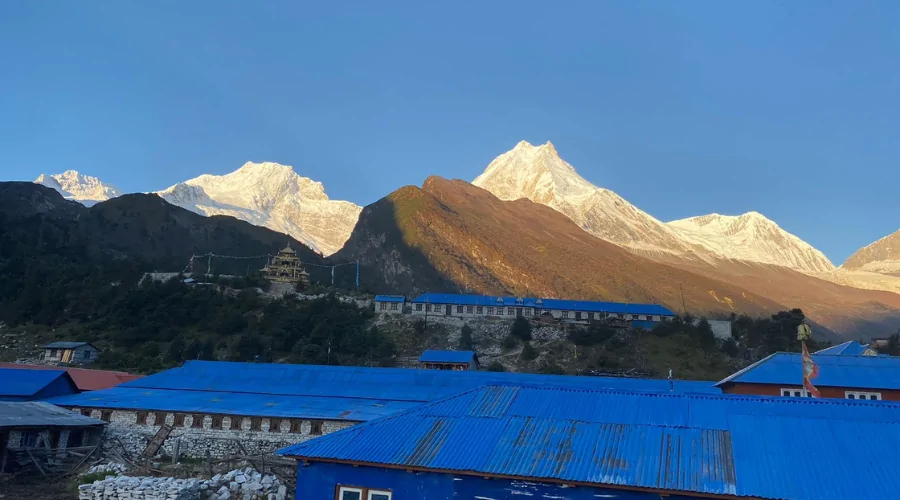
Lho is one of the major highlights of the Manaslu Circuit Trek. The village has around 40 to 50 traditional stone houses, a monastery where monks live and study, small health posts, and a primary school. The biggest highlight is the breathtaking close-up view of Mount Manaslu from Lho Monastery, especially during sunrise and sunset.
Lho Teahouses Facilities
There are around 6-7 teahouses.
You will also find Wi-Fi, electricity, a hot shower, an attached bathroom, and charging plugs in the room.
: Breakfast, Lunch and Dinner
: Tea House
: 7-8 hours walk
Day 14:
Trek from Lho to Samagaon
Trek Route: Lho → Shyala → Samagaon Starting Point: Lho (3180 m/ 10433 ft) Ending Point: Samagaon (3520 m/ 11548 ft) Lunch: Shyala Lho to Samagaon Distance: 17.2 km (10.6 miles) Total Descent: 340 m/ 1115 ft Overnight: Samagaon
We will wake up with the stunning Manaslu before our eyes. After breakfast, we start with a relatively easy trail leading to the Shyala village, though the final stretch of about 1.5 hours is challenging.
Shyala is one of the most beautiful locations on the Manaslu circuit trail, where you will see the fine wood art of the monastery, alpine houses and picture-perfect views of Manaslu Mountain. We reach Shyala after walking for 2 hours. We have our lunch at Shyala and rest there for some time before heading out for today’s destination.
Passing along the fields of potatoes, we hike with Himalchuli and Manaslu ahead of us. We also have the option of visiting Pungyen Monastery, which is about 2.5 hours from Shyala.
Pungyen monastery is one of the iconic monasteries in the Manaslu region, located beside Pungyen glacier and right below Manaslu mountain.
The route has local houses of people who depend on crops, farming, animal husbandry, and tourism.
After a few hours of walking, the beautiful village of Samagaon appears with long rows of stone houses beneath the towering presence of Manaslu.
Reaching Samagaon feels special as the village combines rich Tibetan culture, peaceful mountain life, and some of the best Himalayan scenery on the entire trek.
About Samagaon
Samagaon is a charming village in the Gorkha District of Nepal. It is home to the Nubri people, who have Tibetan roots and practice Tibetan Buddhism.
The village has traditional stone houses and a population of around 1500 residents. Many locals engage in yak herding and tourism, providing teahouses and lodges for trekkers on the Manaslu Circuit.
Samagaon Teahouses Facilities
Samagaon consists of 10-12 teahouses.
You will have Wi-Fi, electricity, a hot shower, and bathroom.
This is the day you focus on relaxing and exploring nearby sites. Samagaon is an interesting place as it is a major village for Manaslu Mountain climbers.
The major highlights of this village are monasteries, the Budhi Gandaki River, and Birendra Tal (Lake). Most trekkers love going to Birendra Lake. It’s a blue lake at 3644 meters (11955 ft), which is located just below the Manaslu glacier. While on the way, you can see Yaks and Dzopkyo grazing on vast pastureland.
You can also visit Kargyu Chholing Monastery, which is a 500-year-old monastery, and it is an example of fine woodwork. It is part of the ancient Tibetan Buddhist culture of the Nubri region, and there is also a large, significant statue of Guru Rinpoche.
All About Side Trips From Samagaon
Another side trip option in the Manaslu region, around Samagaon, is the Manaslu Base Camp. It is a 7-8-hour round trip. This can be an interesting side trip for people who love to challenge and push themselves.
You gain an altitude of 1270 meters (4166 ft) as you hike from Samagaon at 3530 meters (11581 ft) to Manaslu Base Camp at 4800 meters (15748 ft).
If you choose to do this side trip, then your lunch will be served on a mountain, which guides carry packed in hot cases.
Taking side trips will also help you acclimatise as we cross one of the highest passes of Nepal, the Larke La Pass at 5106 meters (16751 ft). You can also choose to rest, and it is not compulsory to hike on this day.
: Breakfast, Lunch and Dinner
: Tea House
Day 16:
Trek from Samagaon to Samdo
Trek Route: Samagaon → Samdo Starting Point: Samagaon (3520 m/ 11548 ft) Ending Point: Samdo (3875 m/ 12713 ft) Lunch: Samdo Samagaon to Samdo Distance: 9.1 km (5.1 miles) Total Ascent: 355 m/ 1164 ft Overnight: Samdo
We wake up early in the morning, freshen up, pack our stuff, and head to the dining room for breakfast.
We start our trek, leaving behind the rows of houses of Samagaon, and cross Budhi Gandaki. It is a trek of about 3-4 hours towards Samdo village. Unlike other days where we used to walk for more than 6 hours on steep uphill and sloppy downhill narrow trails, it is a very easy day as we walk on almost flat terrain for about 3-4 hours.
Before reaching Samdo, we once again cross the Budhi Gandaki and walk for 5-10 minutes uphill before reaching the Samdo village.
Your stay in this village can be slightly problematic if you are not prepared. This village lies at 3875 meters (12713 ft). The water supply pipes freeze, and water in the washrooms may be unavailable at times.
If you keep your clothes outside to dry, they can freeze up, too. Keep the bottle of warm water tucked under your sleeping bag or bed so you can use it in the morning to hydrate yourself and also keep you warm at night.
About Samdo
Samdo is a small village in the Gorkha District of Nepal. The village is considered to be the last village of Nepal from Tibet’s side. The local economy relies on animal husbandry, yak herding, and tourism. It consists of around 30-40 local houses.
Samdo Teahouses Facilities
Samdo has around 6-7 teahouses.
There is a facility for Wi-Fi, electricity, and a hot shower.
You will not get an attached bathroom in Samdo.
: Breakfast, Lunch and Dinner
: Tea House
: 3-4 hours walk
Day 17:
Trek from Samdo to Dharmasala
Trek Route: Samdo → Larkya Bazar → Dharmasala Starting Point: Samdo (3875 m/ 12713 ft) Ending Point: Dharmasala (4460 m/ 14633 ft) Lunch: Dharmasala Samdo to Dharmasala Distance: 6.1 km (3.8 miles) Total Ascent: 585 m/ 1919 ft Overnight: Dharmasala
On this day, we have breakfast early in the morning and start on flat terrain. After walking for 10–15 minutes, we came across a small, isolated settlement called Larke bazaar.
This place used to be an old salt trading route used by Tibetans. There, we also see the trail junction where one trail leads to the Tibetan border and the other to Dharamsala.
We take the route leading us to Dharamshala. The terrain consists of gradual uphill and downhill; altitude adds to the difficulty and makes even normal walking hard. But we pace ourselves and walk in a relaxed way.
As you move higher, the path becomes rocky and barren. The trail is simple and shorter than usual days.
Samdo to Dharamsala isn’t that long, as you trek for 3 or 4 hours only. Finally, you will reach Dharamsala. Dharmasala is also known as Larke Phedi. It serves as the base camp for crossing the Larke La Pass the next day.
The Most Remote Stop on Manaslu Tsum Valley Trek, Dharamsala
The settlement is small with few teahouses providing basic accommodation and food. Dharamsala lies significantly high, so it is better if you keep your body warm, sitting in the dining hall and eating soups.
About the Dharamsala village
It is a village at a high altitude of 4460 meters (14633 ft). It is very remote, which is the reason behind the limited infrastructure. There are about 4-5 teahouses. During the peak season, these teahouses fill up quickly and might have to share space with other trekkers.
Dharmasala Teahouses Facilities
Dharmasala is the most remote region, with very basic services from the teahouses.
You might even sleep in the dining hall, tents, or share space if the season is very busy.
No Wi-Fi, Internet, or Electricity is available. Though solar power is available, in case of an emergency, you can charge your electronic items.
: Breakfast, Lunch and Dinner
: Tea House
: 3-4 hours walk
Day 18:
Trek from Dharmasala to Bhimthang via Larkye La Pass
Trek Route: Dharmasala → Larkye La Pass → Larke Phedi → Dovan → Bimthang Starting Point: Dharmasala (4460 m/ 14633 ft) Ending Point: Bimthang (3590 m/ 11778 ft) Lunch: Larke Phedi Dharmasala to Bimthang Distance: 16 km (9.9 miles) Total Descent: 870 m/ 2854 ft Overnight: Bimthang
This is the peak of the entire trek as you will be crossing the Larke La pass. The day begins very early in the morning at around 3:45 a.m. You freshen up, have breakfast, and prepare your gear to leave at around 4:30 a.m.
The trail starts with a gradual ascent over rocky terrain and winding paths. The trail is mostly gradual uphill, but because of the altitude, it makes it hard. You will pass through glacial moraine, frozen lakes, and loose rocks, often surrounded by snow at higher altitudes
As you climb higher, views of iconic mountains like Himlung Himal, Cheo Himal, Kang Guru, Gyanji Kang, Larkey peak, Ratna Chuli, Namjung Himal, and Annapurna II open up as you climb.
At Larke La Pass, the views are breathtaking. You are surrounded by jagged peaks and glaciers, standing at one of the trek’s highest points. After a short break of 20-30 minutes to celebrate the climb on Larke La Pass, you will start the descent. The total ascent time from Dharamsala to Larke la pass s about 4 hours.
The way down is steep and needs caution. You will find rocky sections as the trail zigzags across rough ground. The area is grassy, and you cross a rockfall area, so you will have to be careful on a downhill walk.
After a few hours, the path gradually eases, leading you through alpine landscapes with rocks and shrubs and eventually into lush meadows. On your way down, you can see the beautiful Ponkar Lake.
We have our lunch at a place called Larke Phedi, which is 3-4 hours from Larke La Pass and trek for 2 more hours to get to Bimthang.
All About Dharamsala to Bimthang Via Larke La Pass
Approaching Bimthang, the scenery changes to rhododendrons, pine forests, clear streams, and green meadows. This peaceful valley, surrounded by peaks and with the Manaslu range in the background, is a perfect reward after a long day.
It is a long walking day lasting 9-10 hours, so packing some snacks is suggested.
About Bimthang Village
It is a beautiful village in Manang district at 3590 meters (11778 ft) with numerous alpine homes and other houses. Bimthang is surrounded by mountains where you can see the North side of Manaslu, along with Lamjung and Cheo mountains.
Bhimthang Teahouses Facilities
There are around 7 teahouses in Bhimthang.
You will get Wi-Fi and electricity services. But as of 2026, there is no electricity, internet, or Wi-Fi.
There are charging plugs in the room, but since there is no electricity, they are of no use. You can charge your electric essentials from a solar battery only if it’s sunny.
The journey from Bhimthang to Tilje is scenic through beautiful forests, rivers, and traditional villages. Starting from Bhimthang, you gradually descend through pine and rhododendron forests.
The path takes you past Yak Kharka, where open meadows offer clear views of surrounding peaks and grazing yaks. Following along the Dudh Khola River, you will cross several small streams over wooden bridges, adding a bit of adventure to the day’s journey.
As you continue, the forest thickens with a mix of rhododendron, pine, and oak trees. Then, you will reach Gho Village after walking 4-5 hours, a traditional settlement where you can rest and enjoy a meal. The locals are warm and welcoming, and the area provides a peaceful break before the next stretch.
From Gho, the trail is gentler and leads you through terraced fields, gradually descending towards Tilje, we reach here after 1.5 hours of walking from Gho. This is a larger village with multiple teahouses.
About Tilje
Tijle Village is a beautiful village that consists of 30-40 local houses. Most of the people residing in Tilje are Buddhist, and some are Hindu, as well. They follow Tibetan culture.
Tilje Teahouses Facilities
4-5 teahouses are in Tijle.
You will also get Wi-Fi, electricity, a hot shower, and charging.
The food is available in both Western and Nepali local options, which are warm and healthy
: Breakfast, Lunch and Dinner
: Tea House
: 5-6 hours walk
Day 20:
Drive from Tilje to Kathmandu
Drive Route: Tilje → Beshisahar → Dhading → Kathmandu Beginning Point: Tilje (2300 m/ 7546 ft) Ending Point: Kathmandu (1400 m/ 4600 ft) Lunch: En Route Tilje to Kathmandu Distance: 200 km (124.3 miles) Total Descent: 900 m/ 2952 ft Overnight: Kathmandu
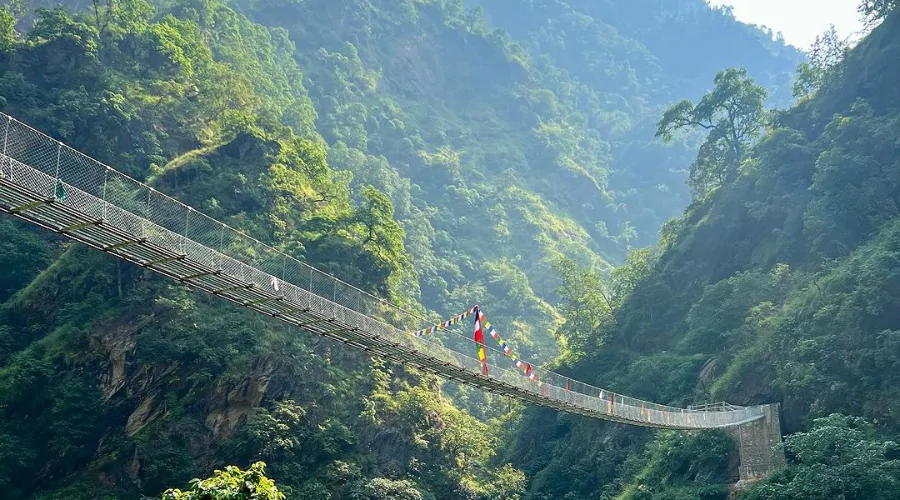
From Tiljie, we cross the last suspension bridge of our trek, which is decorated with prayer flags. Firstly, we drive to Besishar from Tilje, Lamjung’s headquarters, in quite a rough patch. We come across locations like Dharapani and Chamche, which are the starting points of the Annapurna Circuit trek. After a short stop in this town, we begin our drive to Kathmandu. A fun drive along the riverbank of the Marsyangdi and Trishuli rivers, which lasts about 9-10 hours
We will stop on the way for lunch during the return journey. After driving for hours, we will finally reach Kathmandu.
In Kathmandu, you can enjoy your staycation properly with luxurious and sufficient services. You can go out and explore Kathmandu more, or buy souvenirs and prepare your departure.
Instead of Kathmandu, you can also go to Pokhara to explore more, and Himalayan Masters shall arrange that as well.
: Breakfast and Lunch
: Not Included
: 10 hours drive
include / exclude
Trip Cost Includes
The International Airport is picked up and dropped off by a private car
Kathmandu to Machha Khola with a comfortable private jeep
Travel from Tilje to Besisahar with a comfortable private jeep
From Besishar to Kathmandu or Pokhara with a comfortable private jeep
Manaslu Conservation Area permits
Manaslu restricted area permits
Annapurna Conservation Area permits
Tsum Valley restricted area permits
Three Meals a day during the trek: 1 set Breakfast, 1 set lunch, and 1 set dinner (Anything from the Menu
Three cups of hot drinks a day (Tea or coffee)
best available private teahouse accommodation in the mountains for 16 nights,
Three Nights accomodation in the Monastery
Professional English-speaking trekking guides will be available during your 20-daytrek
Trekking porter for 20 days (One porter can carry up to 26 kg)
Guide and Porter insurance
All government taxes and company service charges
Complementary services from Himalayan Masters
Himalayan Masters Brand: Good sleeping bags during the trek.
Himalayan Masters Brand down jacket during the trek
Trekking poles during the trek, if needed
Water bottle and purification tablets are in the Himalayan Masters
first-aid kit box.
Seasonal fruits for dessert.
The Himalayan Masters brand-new 70 liters duffle bags
Himalayan Masters Brand Trekking T-Shirt and Cap.
You can store your stuff in my office in Kathmandu
Note: Complementary service doesn’t add to or reduce the original price. It’s just an additional service for Himalayan Masters’ customers.
Trip Cost Excludes
International flight airfare
Nepal entry visa fees at Tribhuvan International Airport (paid in cash)
All accommodations and meals in Kathmandu, before and after the journey
Personal expenses (shopping, snacks, bottled water or boiled water, and cold drinks, hot showers, alcohol, Wi-Fi, telephone calls, battery re-charge fees, extra porters, etc
Personal clothing and gear
Travel insurance has to cover emergency helicopter high-altitude rescue, and evacuation, along with medical costs (compulsory).
Tips for guides and porters
Additional costs due to delays caused by circumstances beyond our control, for example, landslides, lousy weather, itinerary modification due to safety concerns, illness, change of government policies, strikes, etc
All the costs and expenses not listed in “What is included in this Trek package?” will be counted as excluded.
Gallery
useful info
Manaslu Tsum Valley Trek Difficulty
The Manaslu Tsum Valley trek is a moderate to challenging grade trek. Manaslu Circuit combined trek with Tsum valley requires careful planning, reliable gears, both physical and mental preparation, and a relaxed pace
The challenges that trekkers really face while on this amazing adventure require careful attention and preparation.
You will be walking some of the remotest trails of Nepal, which may be completely unfamiliar to you. Trails are not the same everywhere and are not smooth at all.
Lose rocks, slippery and narrow slopes, and some potholes covered by snow can be challenges. Very careful footing is crucial. Let your guide lead and follow his suggestions.
Another challenge is altitude, as you will be climbing to significant heights where your health is affected. You will be sleeping above 3,500 meters (11482.94 ft) in many places and summit high points like Ganesh Himal Base Camp at 4,800 meters (15748.03 ft) and Larke La Pass at 5106 meters (16751.97 ft).
More than 70% of your trek includes walking above 3000 meters, where the human body is most vulnerable to altitude sickness. This is the reason the itinerary is carefully designed to let trekkers acclimatise without rushing.
Acclimatisation is a slow adjustment to a higher altitude. Acclimatisation is one part, but also your self-consciousness and awareness play a big role in avoiding altitude sickness. For example, avoiding alcohol, smoking, pacing your walk, keeping yourself warm, and others.
Pacing yourself is very important in this trek, as it is a long-duration trek. Your normal day includes 6-7 hours of walking.
There are also days when you walk longer distances than on average days. Those days can really drain both physically and mentally, so pacing and keeping yourself relaxed help a lot.
Tsum Valley Trek Route Conditions
The Manaslu Tsum Valley Trek follows two connected Himalayan trails that offer different trekking experiences. In the beginning, the route follows the main Manaslu Circuit trail through the Budhi Gandaki Valley. Trekkers trek along rocky paths, stone staircases, suspension bridges, riverside trails, and small villages. Some sections are narrow and carved into cliffs, while others pass through forests, waterfalls, and terraced farms. During monsoons, parts of the trail can become muddy and slippery.
After walking for a few hours, we come across a bridge at a place called Nyak Phedi. From here, the trail separates from the Manaslu Circuit and enters the hidden Tsum Valley. The route becomes quieter, less crowded, and more culturally rich. Trekkers pass through traditional Tibetan-influenced villages such as Chumling, Chhokangparo, Nile, and Mu Gompa. The trails are narrower with stone staircases, pine and rhododendron forests, mani walls, prayer flags, and mule tracks.
As the trek gains altitude, the landscape changes into a dry alpine region with fewer trees and colder weather. The trail toward Mu Gompa becomes more remote, windy, and exposed, surrounded by high Himalayan mountains.
After returning from Tsum Valley, trekkers continue the Manaslu Circuit through Namrung, Samagaon, and Samdo before crossing the challenging Larke La Pass.
If you choose to visit Manaslu Base Camp and the Tibetan border side trip near Rui La, the trails become more rugged, steep, and physically demanding as they include walking uphill for long durations at high altitude.
Manaslu and Tsum Valley Weather
The Tsum Valley and Manaslu circuit trek involves days of walking at high altitude, so the weather plays a very crucial role in your trek.
As you ascend to higher elevations, the temperature drop is certain, and you will experience reduced oxygen levels, which makes your journey challenging
The peak season for the Manaslu Tsum Valley trek is during Autumn and Spring. These two offer similar weather conditions, but there is a very thin line between them.
Understanding the weather before the trek helps you prepare better. You can pack the right clothing, choose the best trekking season, and stay mentally ready for changing mountain conditions.
The weather in this region can change quickly, especially at higher altitudes, where sunny mornings may turn into cloudy or snowy afternoons.
The best seasons for the Manaslu and Tsum Valley Trek are spring (March to May) and autumn (September to November). Both seasons offer stable weather, clear mountain views, and comfortable trekking temperatures.
Spring brings blooming rhododendron forests, green hills, and slightly warmer temperatures. Autumn, on the other hand, offers crystal-clear skies, dry trails, and excellent visibility after the monsoon rain washes away dust and haze.
Temperatures in lower regions range between 10°C and 25°C, while higher areas like Larkya La Pass and Ganesh Himal Base Camp can drop to -10°C or lower at night. Spring stays slightly warmer, whereas autumn brings colder mornings and evenings.
The best time to do the Manaslu Tsum Valley Trek
Spring (March to May)
Spring is among the best times to visit the Manaslu and Tsum Valley trek. The weather is clear, and the days are warm with cool nights. The forests have taken on the colour of rhododendron flowers and thus look very beautiful. The trails are dry and easy to walk on, with little chance of rain. This is a good time for views of snow-capped mountains and greenery. Many trekkers prefer spring as it offers comfortable weather and beautiful natural scenery.
Summer/Monsoon (June to August)
The summer season brings warm weather, but simultaneously, it is the time for the monsoon. Heavy rain during this time makes the trails slippery and muddy. There is a possibility of landslides in some areas, which will make the trek more troublesome. But yes, the valleys look green and fresh, and the rivers have full water. If you don’t mind the rain and want to take an easier trek, summer might still be an option.
Autumn (September to November)
Autumn is considered the peak season for Manaslu and Tsum Valley trekking. The weather is clear, and the mountain vista looks magnificent to watch. The temperature is moderate, with warm days and relatively cool nights. After the monsoon, the trails are in good condition, which makes the trek easier.
Winter (December to February)
It is cold in winter and at height, although the trek is less preferable. The skies are clear, showing breathtaking views of the mountains in their full snow form. The trails are quiet, with few trekkers visiting them. However, some high passes and routes may get blocked due to snow. Nights are freezing, and hence, proper gear besides warm clothes is mandatory.
Altitude Sickness and Remedies
There is a high risk of altitude sickness in Tsum Valley. The height that we will elevate to on the Tsum Valley Trek is 5106 meters, known as the Larke La Pass. So you must be extra careful when trekking in such high-altitude areas.
If the condition worsens, please get in touch with your guide without any hesitation. As the guide can help you out in many ways during the trek, please inform him. Garlic soup helps reduce altitude sickness, so make sure you drink it.
Also, diamox, a medicine used to reduce altitude sickness, is carried. Please drink enough water during the trek.
Tsum Valley Travel Insurance
Yes, travel insurance is mandatory for the Tsum Valley trek. Because you hike above 5000 meters in height, get travel insurance, and make sure that your travel insurance covers all emergencies and helicopter evacuation at the mountain, too. If you do not have travel insurance and get into problems like severe altitude sickness, injuries or other. The rescue and evacuation cost can be very expensive, which is financially very hard for one person to cover.
Fitness, Medical and Health
High-altitude trekking is harder than low-altitude trekking. It contains some long, uphill, steep up and down descents and some easy flat routes. Though the previous hiking experience is advantageous, technical skills are optional for this trek. If you can walk 5 to 6 hours every day at a reasonable pace in a straightforward way, this will be a simple Tsum Valley and Manaslu trek.
However, a good level of fitness and preparation for such long days is required, as some days we need to walk for longer hours. Regular exercising is recommended a few weeks prior to the trip to build up stamina. Remember, the fitter you are, the more enjoyable the Tsum Valley and Manaslu trek will be.
Trekkers must be healthy and have a positive attitude when joining the Tsum Valley and Manaslu trek. A self-confident and determined individual will enjoy this wonderful trek.
A Typical Day on Manaslu Tsum Valley Trek
It’s up early for an early morning start on the trek. For breakfast, have something to eat at a simple teahouse; one could have bread, eggs, or porridge. Then, it is time to pack up and start walking. This morning trail could go through forests, over rivers, or up to small villages.
Monastery in Tsum Valley trek
Lunchtime is noon at the teahouse, and you rest, have a light snack of dal, types of rice and lentils and energise your energy for the afternoon. After lunchtime, you will walk another 3 to 4 hours. This trail could be relatively flat or steep, yet the view of mountain ridges and valleys keeps pulling you forward.
Later in the afternoon, you finally get to your stoppage for the night. You check into a teahouse and rest. Dinner in the evening and chatting with other trekkers are also common activities during this period. Some people explore nearby places, and some, with books, retire. You went to bed early, quite tired but happy, ready for another day of adventure.
Manaslu Tsum Valley Trek Experiences
The experience you feel in the Manaslu Tsum Valley trek is one of the factors that separates it from other treks
The Manaslu region is not that commercialised, which is a good way to feel its authenticity, as it is still keeping its natural charm.
One of the strongest feelings comes after meeting local people. You meet friendly locals smiling and greeting you with “Namaste” or “Tashi Delek”. These small moments stay with you even after you leave.
Teahouse stays are another layer of the journey. They are basic but very welcoming. Wooden rooms, warm blankets, and shared dining space create a homely environment where trekkers from different countries gather, eat together, and share stories after long walking days.
Visiting ancient monasteries like Mu Gomba and Rachen Gomba ignites spiritual energy. The sound of prayer wheels, butter lamps, and monks chanting creates a peaceful atmosphere that slows your mind naturally. You begin to feel the depth of Buddhism, not just see it.
Local male carrying Doko in Samagaon, Manaslu
As you move deeper into Tsum Valley, the landscapes become more remote and untouched. Narrow trails, silent valleys, and hidden villages give a feeling of exploring a forgotten world.
Crossing the high mountain pass is one of the most challenging and rewarding parts. The air gets thin, the views become vast, and every step feels powerful. The emotions after reaching the Larke La pass cannot be explained.
The road journey in Nepal from Kathmandu to Machha Khola and Tilje to Kathmandu adds an extra layer to the adventure. The road travel feels awesome as you travel by the Trishuli and Marsyangdi River, and eat at simple Nepali lodges.
Manaslu Tsum Valley Trek Permits
There is the Manaslu Restricted Area Permit (MRAP). You need this permit if you’re trekking from Jagat to Samagaun. The Department of Immigration issues it. This permit costs $100 per week from September to November during peak season, $15 for each additional day. For the other months, the charge is $75 per week and $15 extra per day.
Then, there is also the Manaslu Conservation Area Permit or MCAP and the Annapurna Conservation Area Permit or ACAP. Both are available from the Nepal Tourism Board. MCAP costs $20 for most countries and $2 for SAARC nations, while ACAP is $30 for most countries and $2 for SAARC countries.
The next is the TIMS card or Trekkers Information Management System. It’s USD 10 for most nations and USD 20 for Free Individual Travelers. It’s not necessary, but getting one for a hassle-free trek is a good idea.
Lastly, the Tsum Valley trek requires a special permit. This permit can also be obtained from the Department of Immigration. For the months of September to November, this will have to be $40 per week, plus an additional $7 for each day. In other months, it will be $30 for a week and $7 for each additional day.
Manaslu Tsum Valley Trek Cost
The Manaslu Tsum Valley trek costs $1900 per head. The cost of Tsum Valley will include the expenses of permits, accommodation, food, guides, and even the governmental tax. The offer provided by the Himalayan masters is quite a great value for money.
Extra Cost
There are some extra costs that one should bear when on the trek. The extra cost of the Manaslu Tsum Valley trek cost includes the expenditure on the extra meals and drinks you have on the trek. Also, if you want private transportation, then you need to pay extra for it.
ATM/Credit Card and Money Exchange
Now, ATMs are very common in Kathmandu and Pokhara and are more frequently accessible in Thamel areas. Some ATMs have daily withdrawal limits, from Rs 10,000 to Rs 35,000; they often charge around USD 4 per transaction. Your bank may also charge a fee for using international ATMs. Though very few functional ATM machines are available in the Manaslu Tsum Valley Trek. According to recent information, there are functioning ATMS in Philim and Samagaon.
Cost of Hiring a Porter
A porter will make your Manaslu Tsum Valley Trek easier. A porter can normally carry up to 20-25 kg of luggage. It costs around $18 to $25 daily to hire a porter, depending on the season and their experience. This cost will also cover his food, accommodation, and insurance. The porters help carry your heavy bags so you can enjoy the trek without much strain.
Tipping Tsum Valley Guide Culture in Manaslu
Tipping is the most effective means of showing appreciation to your guide and porters. Guides usually get $6 to $10 per day. This depends on your experiences with them. Porters take around $4 to $6 per day.
It is good to give tips at the end of the trek. Many trekkers give tips in an envelope and thank them personally. Tipping is not obligatory, but it is considered appreciated as a gesture of gratitude for their support during the trek.
Acclimatization Guide for Tsum Trek
We acclimatise by having rest stops as we trek through the wilds of the Manaslu Circuit and the Tsum Valley trek. Acclimatization helps to reduce the possibility of altitude sickness, which can affect the human body when it cannot adapt to higher altitudes with lower oxygen levels.
One significant rest day is reserved at Samagaun at 3530 meters above sea level, allowing trekkers to acclimatise further and then take up the journey ahead.
All the side trips that you take, like beyond Mu Gompa, Manaslu Base Camp, Tibetan Border (Rui La Pass) and Pungyen Monastery. These Monasteries lie significantly at a higher elevation than your teahouse elevation, which helps you a lot to cross the Larke La Pass at 5106 meters (16751 meters).
Be very careful when you feel the symptoms of altitude sickness, like nausea, dizziness, headache and fatigue above 2700 meters (8858 meters). Altitude sickness is a big concern in the Manaslu Tsum Valley trek, as most of the trip includes walking and sleeping at significant heights.
Do let your guide know if you are not feeling well. Our experienced trek leaders and guides are trained in first aid and equipped with a first aid kit that contains an oximeter along with altitude sickness medicines.
Guides know very well what measures to adopt according to the severity of altitude sickness.
What type of Teahouses should I Expect?
Accommodation during the Manaslu Tsum Valley trek is basic but comfortable. Most trekkers stay in teahouses, small lodges run by local families. These teahouses offer simple rooms with twin beds, wooden walls, and thin mattresses.
While the facilities are modest, they provide essential services like clean bedding, blankets, and shared bathrooms. Electricity is available in most places but is solar-powered and limited, so charging devices often require an extra fee. The warmth of the hosts and the authentic experience of staying in local homes make up for the simplicity of the accommodations.
As you ascend higher into the valley, teahouses become more rustic. Some villages might only have homestays in remote areas, where you share living space with the host family. These stays are a unique way to experience the Tsum Valley’s culture and traditions. Meals are usually served in a communal dining area, and dal bhat (rice and lentils) is the most common dish.
Manaslu Trek Meals Uncovered
Breakfast
The Manaslu Tsum Valley Trek breakfast typically includes Tibetan bread or chapati, mostly toasted with jam or honey. Porridge is what many trekkers love; whether made from oats or millet, it forms a healthy and filling dish. Boiled eggs or omelettes are also common sources of added protein.
To keep warm during cold mornings, there are always available hot drinks, such as tea, coffee, or hot chocolate.
Lunch
Lunch is freshly prepared and available at teahouses en route. Dal Bhat is one of the most popular options for lunch since rice with lentil soup and vegetables is healthy and gives energy.
Fried noodles or fried rice with vegetables and eggs are other common options. Many trekkers also enjoy hot soups, such as garlic or noodles, which help them stay hydrated and warm.
Dinner
Dinner will be done at the teahouse, where you’ll be stopping for an overnight. Dal Bhat is the favourite dinner for trekkers because of its unlimited servings and balanced nutrition. Pasta, spaghetti, or fried potatoes are other options for different tastes.
Guide to Safe Drinking Water on the Trail
Himalayan Masters will provide free water purification tablets. We will also provide you with advice on how to use the purification tablet.
You should drink enough water to prevent altitude sickness and take purification tablets so no contamination happens in your body. We also recommend that you have a bottle with a filtration system.
The other thing is that you will find enough water refilling areas where you can refill. So you do not need to worry about it.
Mobile Connectivity, Charging, and Wi-Fi in the Manaslu Tsum Valley
Even though the Tsum Valley is regarded as the remotest region of Manaslu, it is less remote than we think.
You will have Wi-Fi, electricity, and mobile networks in most of the teahouses.
In the lower regions, like Machha Khola, Jagat, Lokpa, and Chumling, you get excellent service, including Wi-Fi and mobile network. Charging sockets in the room are also available until places like Nile and Samdo.
The network carriers like NTC and Ncell work in these regions. NTC’s network coverage is very smooth in most areas of the Manaslu Tsum Valley trail.
Though places like Dharamsala and Mu Gompa are very hard to access. As no Wi-Fi, electricity or network coverage is available. Your days in these places can be used to have meaning conversation with fellow trekkers, or just sit calmly and reflect on yourself.
Keep in mind that the higher up you go, the slower the mobile network and Wi-Fi gets.
Transportation Options and Costs Guide
You have two days in your Manaslu Tsum Valley Trek Itinerary, which includes travelling in a vehicle. You take a drive to get to the trail head, Machha Khola and to get back from the trail ending point, Tilje. Considering Kathmandu as the starting point.
You have two options: local and private vehicle transportation. The direct local bus leaves at around 8 am and goes via Gorkha, lasting for 7-8 hours, which costs in the range of NPR (1400 to 1800, USD 9-11) depending on the fuel price hikes.
Another option is vehicle switching. You can first take a local bus from Kathmandu to Arughat, which costs around NPR 1000 (USD 6). From Arughat, you switch to another shared jeep or local vehicle to Machha Khola, costing approximately NPR 300-400 (USD 2–3)
Another option is a private vehicle. This transportation option offers more comfort, freedom, and a worry-free experience. Himalayan Masters provides private vehicle transportation service.
The one-way private vehicle cost from Kathmandu to Machha Khola is around USD 200. Similarly, private transportation from Tilje back to Kathmandu costs approximately USD 160.
Nepalese Currency and Payment in Trek
The currency is the Nepalese Rupee, which works in Nepal. If you need to change money, it is best to have it in USD, AUD, GBP, Swiss Franc, Canadian Dollar, SGD, or Euro; these are the ones easily exchangeable in Kathmandu or Pokhara.
Credit card and debit card payment facilities like Visa, MasterCard, and American Express are available at major tourist places, hotels, restaurants, and larger stores in the main cities like Kathmandu, Bhaktapur, Patan, and Pokhara. However, 3.5% surcharge on card payments is applied.
Easiest Way to Book the Manaslu Tsum Valley Trek with Himalayan Masters
This is a really easy and fast process for booking the trek with Himalayan Masters. All you need to do is visit our website, then you can choose Manaslu Tsum Valley Trek, then you can see a button saying book now; from there, you can choose the direct method of booking, in which you need to fill in the details that you are asked for.
Once your booking is completed, you will receive an email with confirmation for the trek with Himalayan Masters.
Trip Cancellation Policy
Himalayan Masters doesn’t refund the deposited amount; it is the deposit that never expires. But we do have a policy that you can use the amount anytime you want to come to Nepal for your trek. Even if you cannot trek with us, you can even send your loved one with us to Nepal.
Route Map
FAQs
When is your next departure for TSUM valley?
This TSUM valley trek can be done throughout the year. We can book your TSUM trek whenever you wish to depart. Just let us know you’re available.
Can we trek to TSUM without an travel agency?
As per the law, you should trek with a licensed guide. Trekking with a travel agency is mandatory. The trek comes with many booking, permits, and management issues. Having a trusted travel agency like a Himalayan master’s is a blessing. We neatly arrange your trek at the minimum cost.
What is Accommodation in Manaslu Tsum Valley Trek like?
On the trek, we will stay in the tea houses that the local families own. The lodge has a central dining area with a big stove for heating the room. The room alongside mostly has two/ three beds. They provide you with mattresses, a small blanket, and pillows. You might need to use sleeping bags for the night in High elevation villages like Samagaon, Samdo and Dharamsala. They offer a hot shower at additional cost (not in all places) but the infamous ‘drop’ toilets might be your most significant difficulty. Thankfully, a handful of newly made tea houses have a flush system.
How much is the permit for TSUM valley?
Tsum valley Permit
Cost for September, October, and November– US$ 40.00/ person (for 8 days), then US $7 per day per person
Rest of the year – US$ 30.00/person (first 8 days), then US $7 per day per person
TIMS card
TIMS card is available at the Tourist Service Center, Bhrikutimandap, Kathmandu, at the cost of NRs. 1,000 for group trekkers and NRs Rs 2000 per trekking route per entry.
Manaslu Conservation Area Project permit – US $20 per person
To cross the Larkya La pass and join Annapurna Circuit trekking, you’ll also need an ACAP permit that costs US $20.
Where is TSUM Valley?
TSUM valley lies to the west-north of Kathmandu in the premises of Ganesh Himal in the Gorkha district of Nepal. This village lies right next to the famous Manaslu circuit trek in the east for about 50 km. The route to TSUM separated from Lokpa between Jagat and Deng.
How far is Kathmandu from Tsum Valley?
Tsum Valley is about 200 km away from Kathmandu in the northwest direction. Although the distance is not very high, you will need to drive for about 8 hours to Maccha Khola and hike for at least two days to reach the first village of Tsum Valley. Then, you hike for 2 more days to reach the Nile, the last village in the area.
What is the altitude of Tsum Valley Nepal?
Nile village, the farthest valley to Tsum, lies at an altitude of 3,361 metres. During this trip, you can go to the Ganesh Himal Base camp, which lies up to 4800 meters above sea level.
Who are the people living at the highest altitude in Nepal?
People in the Tsum Valley live at one of the highest altitudes on earth. However, the dwellers of Dingboche (near Everest Base Camp Trek), who are 4,410 metres high, are the highest-altitude settlers in Nepal.
Can beginners do the Manaslu Tsum Valley Trek?
Yes, the Manaslu Tsum Valley Trek can be done by beginners, but it is considered to be strenuous. A high-altitude hike is involved in the trek; proper preparation for physical fitness and acclimatization needs to be adhered to.
Can I do a solo trek in Manaslu?
No, a solo trek in the Manaslu region is not available. Manaslu is a restricted area, which means that a guide registered with the government has to accompany trekkers in the area.
Is it possible to recharge electronic devices?
Yes, there are a few recharging facilities at teahouses for your electronic devices, but the teahouses are available in a few parts only.
Is flying out from the endpoint possible?
The endpoint of the trek is Tilje, so yes you can book a helicopter and fly out from there to Pokhara or Kathmandu.
What kind of cultural experience can I expect during the trek?
The trek is culturally rich, from visits to ancient monasteries and traditional Tibetan villages to the possibility of observing local customs and festivals special to the Tsum Valley.
Does it snow in the Manaslu region?
Yes, it does snow in the Manaslu region, but most of it occurs during the winter months. These can also occur at higher altitudes during other seasons.
Does the weather change quickly in the Manaslu region?
Yes, the Manaslu weather can be unpredictable. A trekker has to be ready for various conditions and take with him the right equipment in case of extremely hot and cold conditions.
Can I extend my trek to include additional villages trips?
Yes, trekkers can extend their journey to visit additional villages within the Tsum Valley or nearby areas. This allows for more cultural immersion and exploration of remote landscapes.
Are there options for luxury accommodations?
Accommodation along the trek is usually simple teahouses, but something more comfortable may be available in places. The remoteness limits luxury options.
What is the wildlife that I might spot on Manaslu Tsum Valley trek?
On the Manaslu Trek, one might see snow leopards, Himalayan tahr, blue sheep (bharal), and different species of birds inside the Manaslu Conservation Area.
How much luggage can I bring to the Tsum Valley and Manslu Circuit Trek?
How much luggage to bring on your trek depends on whether you are hiring a porter or not. Porters usually carry a maximum limit of 26 kg (57 lbs.), and your everyday carry (EDC) should weigh about 5-7 kg. Maintaining the ideal weight for the everyday carry is essential as this 20-day trek includes long daily walks lasting over 6 hours on average.
Do the Manaslu Circuit and Manaslu Tsum Valley Trek have the same starting point?
Yes, both the Manaslu Circuit Trek and the Tsum Valley Trek have the same starting point at MachhaKhola. The trail follows the same route untilNyak Phedi, where the path separates towardLopkaand enters the Tsum Valley region.
Reviews
E
Ellen V
USA
Verified Purchase
Beautiful and Memorable Trekking with Experienced Guide
We researched a number of trekking companies and chose Himalayan Masters because Sandip the owner was so responsive to our inquiries and requests. We chose the Tsum Valley & Manaslu Circuit tour and explained that we wanted a guide who was knowledgeable about the
...
We researched a number of trekking companies and chose Himalayan Masters because Sandip the owner was so responsive to our inquiries and requests. We chose the Tsum Valley & Manaslu Circuit tour and explained that we wanted a guide who was knowledgeable about the culture and history of the region. Our guide, Amrit, was wonderful. His English was excellent and he shared so much information about our daily activities and where we were going and what we were seeing – definitely more informative than other guides I heard talking to their clients. Amrit was always checking in on how we were doing and was happy to accommodate our wishes for lingering along the trail and visiting specific areas. He was organized and made sure our accommodations and meals were in order. We always felt safe along the way and even when caught in a snow storm at Lharka Pass and had to turn back, he had Plans A, B & C to get us out as safely and expeditiously as possible. We can definitely recommend Himalayan Masters for a fantastic time trekking.
J
Jamie C
USA
Verified Purchase
Manaslu Circuit w/Tsum Valley trek
What a privilege it was to be in Nepal and experience this trek, authentic, peaceful, raw and rugged are what make the circuit still so untouched. It was even more quiet than usual, but we met incredible people during what
...
What a privilege it was to be in Nepal and experience this trek, authentic, peaceful, raw and rugged are what make the circuit still so untouched. It was even more quiet than usual, but we met incredible people during what Is a unique time.
Starting from the beginning, Himalayan Masters were outstanding: laid-back yet professional, passionate, clear, and thoughtful. They helped me organise this trip back way back when I didn’t know about Nepal or Manaslu and trusted Sandips knowledge – so finally arriving from India and setting off felt surreal. Everything was taken care of, from a perfect hotel to reset and plan, to making sure we had all the gear we needed. They truly went above and beyond to give us the best possible experience from start to finish. These are passionate people who care about your experience in Nepal.
The Manaslu Circuit, and especially Tsum Valley, felt untouched—both culturally and in terms of the landscape. It made the whole journey feel even more remote and authentic knowing we were somewhere not many tourists get to experience. If you’re looking for an off-the-beaten-path adventure that offers an true blend of Nepali and Tibetan culture, set against the backdrop of an constantly changing valleys and different faces of many peaks, this is it. We were also incredibly lucky with the weather, and many of the days still feel dreamlike. This a tough trek so a good baseline level of fitness is required.
Our guide, Kanchan, was truly one of a kind. Generous, thoughtful, professional, and full of joy—he made the entire trek effortless for us. With over 10 years of experience on this route, his local knowledge and connections meant we never had to worry about a thing. He understood us quickly and adapted everything to suit—whether that meant bigger food portions or rooms with the best views, or helping us plan what came after the trek. Beyond that, it was the laughter, care, and genuine connection that made such a difference as he created space for us to fully take in everything around us while always being there when needed. I couldn’t recommend him more highly to anyone considering trekking in Nepal, no matter the type of person or group you are.
Some days on this trek honestly felt like a blur and it will take us a long time to process it all. We’ve made friends for life, experienced unforgettable landscapes, absorbed unique history and cultures that will stay with us for years to come.
Thank you again to Himalayan Masters and Kanchan, we’ll definitely be back.
C
Cheryl S
Australia
Verified Purchase
Remarkable Experience
After a year of planning and training our Tsum Valley and Manaslu circuit really exceeded all our expectations. It was fantastic!!! Himalayan Masters is an excellent company to deal with and can highly commend our guide Kanchan and porters Denish and Surya. They went
...
After a year of planning and training our Tsum Valley and Manaslu circuit really exceeded all our expectations. It was fantastic!!! Himalayan Masters is an excellent company to deal with and can highly commend our guide Kanchan and porters Denish and Surya. They went above and beyond to ensure a safe and memorable adventure which has been a highlight of our travels over the years. We experienced the unusually harsh weather system that affected the region early October. Kanchan was very safety conscious and eased our trepidation and anxiety about the potential dangers and risks. Kanchan, Denish & Surya all had a wonderful sense of humour and brought a lightness and fun to what were sometimes long and challenging days on the trek. They treated us like family and really looked out for us. Kanchan quickly assessed our abilities ( as an older couple) and adapted our itinerary to get the best out of the route for us. The tea houses he chose were comfortable and more importantly had hygienic kitchens. We were never sick from the food and the meals enroute were delicious. As a guide, Kanchan was outstanding in his knowledge of the route, the landscape , village traditions and religious customs. He was respected by the locals and other guides wherever we went. Small details were not missed – honestly, he went above and beyond. Himalayan Masters provided us with high quality sleeping bag, down jacket and crampons all of which were essential and invaluable above 3000m. Sandip was great to deal with especially when planning the trip. We were sad to farewell , three very special guys…. Thanks Kanchan, Denish and Suria for helping us through a challenging but most rewarding trek of a lifetime. We will definitely go through Himalayan Masters again and request Kanchan, Denish and Surya for future treks.
J
Jamie C
UK
Verified Purchase
Manaslu Circuit w/Tsum Valley trek
What a privilege it was to be in Nepal and experience this trek, authentic, peaceful, raw and rugged are what make the circuit still so untouched. It was even more quiet than usual, but we met incredible people during what
...
What a privilege it was to be in Nepal and experience this trek, authentic, peaceful, raw and rugged are what make the circuit still so untouched. It was even more quiet than usual, but we met incredible people during what Is a unique time.
Starting from the beginning, Himalayan Masters were outstanding: laid-back yet professional, passionate, clear, and thoughtful. They helped me organise this trip back way back when I didn’t know about Nepal or Manaslu and trusted Sandips knowledge – so finally arriving from India and setting off felt surreal. Everything was taken care of, from a perfect hotel to reset and plan, to making sure we had all the gear we needed. They truly went above and beyond to give us the best possible experience from start to finish. These are passionate people who care about your experience in Nepal.
The Manaslu Circuit, and especially Tsum Valley, felt untouched—both culturally and in terms of the landscape. It made the whole journey feel even more remote and authentic knowing we were somewhere not many tourists get to experience. If you’re looking for an off-the-beaten-path adventure that offers an true blend of Nepali and Tibetan culture, set against the backdrop of an constantly changing valleys and different faces of many peaks, this is it. We were also incredibly lucky with the weather, and many of the days still feel dreamlike. This a tough trek so a good baseline level of fitness is required.
Our guide, Kanchan, was truly one of a kind. Generous, thoughtful, professional, and full of joy—he made the entire trek effortless for us. With over 10 years of experience on this route, his local knowledge and connections meant we never had to worry about a thing. He understood us quickly and adapted everything to suit—whether that meant bigger food portions or rooms with the best views, or helping us plan what came after the trek. Beyond that, it was the laughter, care, and genuine connection that made such a difference as he created space for us to fully take in everything around us while always being there when needed. I couldn’t recommend him more highly to anyone considering trekking in Nepal, no matter the type of person or group you are.
Some days on this trek honestly felt like a blur and it will take us a long time to process it all. We’ve made friends for life, experienced unforgettable landscapes, absorbed unique history and cultures that will stay with us for years to come.
Thank you again to Himalayan Masters and Kanchan, we’ll definitely be back.
Hannah Kadi
Australia
Verified Purchase
Trip of a life time
Trip of a life time! My second time back with Himalayan Masters and they exceeded my expectations yet again. Manaslu and Tsum valley trek organised by Sandip was a great itinerary and Dipak was an amazing guide that truly went
...
Trip of a life time!
My second time back with Himalayan Masters and they exceeded my expectations yet again. Manaslu and Tsum valley trek organised by Sandip was a great itinerary and Dipak was an amazing guide that truly went above and beyond the duties of a trekking guide. He supported our group through all our ups and downs and we certainly couldn’t have done it without his help. The 3 porters, Syren, Pawan, and Pitumber also went above their duties to help cook, serve us fresh fruit every day and keep spirits high! I would recommend Himalayan Masters to anyone who is interested in trekking in Nepal. Miss it already
Hannah Kadi and her friends completed the Manaslu and Tsum Valley trek in November 2022 with the support of Himalayan Masters. (Photo: tripadvisor/review)
Based on your preferences, location, timeframe, and budget, our team can design your dream trek based on our extensive knowledge and experience of the Himalayas. Get in touch with us for detailed information and assistance planning your dream trek. With our 97% success rate on trekking and climbing trips in 2025 and 2026 spring season, we will answer any questions you may have and guide you for an unforgettable experience.