




Mera Peak vs Island Peak | Difficulty, Route, View and More
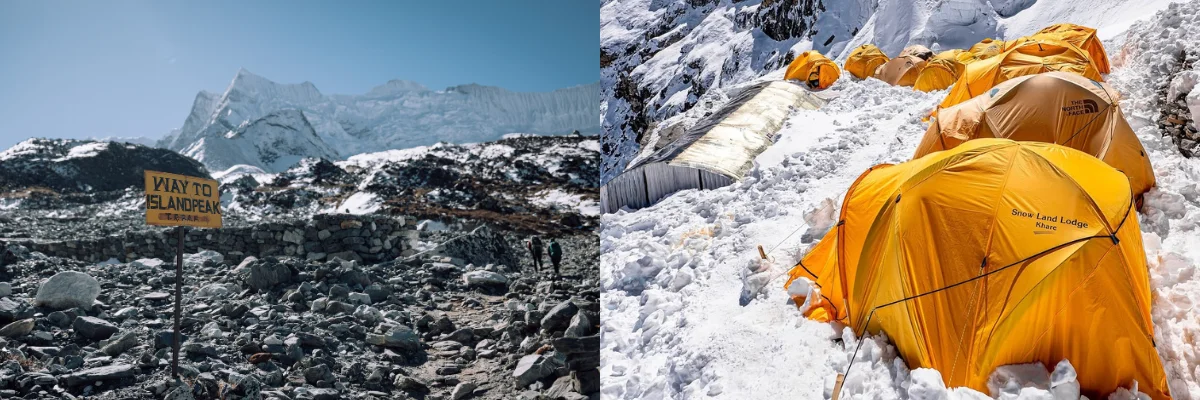
The Mera Peak vs Island Peak are two of the most common trekking peaks in Nepal. Both are excellent beginner Himalayan peaks; however, the experience on each mountain is not very similar.
The highest trekking peak in Nepal is Mera Peak. It has been famous due to non-technical climbing routes. Meanwhile Island peak is known for the technical trekking peak of Nepal.
Most of the climb is easy, and it does not require any special training for beginners, as it gives them a chance to experience high altitude.
So in this blog we will discuss all the differences between these two mountains, their difficulty, routes, cost and much more.
Overview of the Two peaks
Imja Tse or Island Peak is 6,189 meters (20,305 feet) high. It is lower than Mera Peak, yet it is more technical. Climbers require simple skills in mountaineering activities such as using ropes, crampons, and ice axes.
These two mountains differ not only in terms of their height. Mera Peak presents challenges in terms of longevity and coping with the elevated level of altitude. Island Peak Climbing, however, is not so much about technical climbing skills.
The two are within the same region of Everest and give excellent views of the Himalayas. Five of the top mountain peaks in the world, such as Everest, are visible from Mera Peak. Island Peak provides a wider view into the other mountains closer to the observer.
Mera Peak
The highest trekking peak in Nepal, Mera Peak, is located at an altitude of 6,476 meters ((21,247 feet). It is located in a remote Hinku Valley, which is not along the busy trail to Everest Base Camp. This leads to a quiet and peaceful climb.
The ascent of the Mera Peak Climbing is primarily non-technical. It does not have any steep parts of rocks or complex parts of climbing. Most of the paths are slow, snow and ice-intensive.
Due to this, it may be regarded as the right choice for beginners. It is, however, physically demanding due to the carbonated altitude. You require good stamina and good acclimatization.
In comparison, the trekking path to Mera Peak is longer than the Island Peak. It averages between 15 and 18 days. The path is over forests, small villages, and the alpine mountains. The peak is not as crowded, hence it is rawer and more natural.
The summit view is one of the largest attractions of the Mera peak. During a clear day, you would also see five of the highest mountains in the world, among them being Everest, Lhotse, Makalu, Cho Oyu, and Kanchenjunga. This is one of the panoramic views that is best in Nepal.
Mera Peak is recommended when one experiences the desire to have a high-altitude hike that is not as technical and has a serene trekking experience.
Island Peak
Imja Tse or Island Peak is 6,189 meters (20,305 feet). It falls within the Everest region, and it is also one of the most popular trekking summits in Nepal. The Everest Base Camp trek is normally followed by the summit as an extension.
Island Peak is technical compared to Mera Peak. It has steep passages, glacier hiking, and a headwall that involves the use of fixed ropes. To use crampons, a harness, and an ice axe, you require the basic skills in mountaineering. Due to this fact, it more resembles a real climbing experience.
Island Peak takes a shorter route than that of Mera Peak. The average time spent on most expeditions is 12-16 days. The path goes through some of the popular Sherpa villages, such as Namche Bazaar and Chhukung, and it is more vibrant and cultural.

The location of Island Peak is among the best. It is in proximity to the massive mountains of the Everest region. The views from the top are close-up shots of some of the peaks, such as Lhotse, Ama Dablam, and Everest.
Island Peak is usually a popular attraction among the trekkers wishing to enter the field of mountaineering. It provides a real climbing experience, but not to the level of an extreme expedition. Nevertheless, the technical sections and elevation are yet to be prepared well.
Island Peak will be the best choice when a person wants something adventurous, little skills in climbing, and a more challenging experience in the Himalayas.
Difficulty Level Island Peak vs Mera Peak
Mera Peak and Island Peak are trekking peaks in Nepal, but the actual climbing experience on each of the peaks is quite different. Height is not the only determinant of difficulty. It is subject to the terrain, climbing style, exposure, and the nature of skills needed in the process of ascent.
Mera Peak Difficulty
Mera Peak has been referred to as a non-technical yet physically challenging climb. The climbs will not contain any rock climbing or complicated ice climbing.
From base camp, you keep walking, mostly on a glacier that has melted and frozen again. Climbers usually wear special boots with spikes, but ropes are not used as much as in harder climbs.
The last summit ascent was hard. It is an endurance walk at a high altitude rather than a technical walk. The path is broad in most places, and exposure to perilous drop-offs is minimal.
The actual challenge of Mera Peak is its extreme height. The oxygen level is low at 6,476 meters. Most climbers find it hard to move at a slow pace, to be tired and experience headaches and effects of altitude sickness.

At higher camps even mere walking becomes tiring. Physical fitness, good lungs, and the appropriate state of acclimatization are required for the climb.
The second obstacle is the long trek route. The trail to Mera Peak goes through isolated valleys, and it takes several days of walking before one gets to the climbing part. This time-consuming drive is an addition to the weariness of the summit climbing, which has not yet started.
Island Peak Difficulty
The Island Peak difficulty is more technical than the Mera Peak, and is also evident when climbing starts after the Base Camp.
The path begins with a regular hike across the Everest area, but on crossing the glacier area, the landscape entirely transforms. Climbers have to walk on ice and cross crevasses with the help of fixed ropes. This is where basic mountaineering skills come in.
The hardest section of the Island Peak is the final headwall. This is a steep ice slope, and it generally falls at around 45 to 60 degrees. Fixed ropes and a jumar (ascender) need to be hired by the climbers as a means of dragging themselves upward.
This part involves power and stamina as well as the ability to use climbing equipment. This section can be both physically and mentally exhausting in the absence of the right technique.
The narrow and bare ridge, which is found in the aftermath of the headwall, outlets towards the summit. The ridges might be a pain to work in when it is really windy or icy.
The Island Peak does not offer climbers a chance to get a rest like in the Mera Peak since the terrain there is relatively explosive, which is steeper and more irregular.
Although the duration of the climb is not as long as that of Mera Peak, the technical parts require attention, coordination, and an elementary experience in working with the systems in question. Errors while footing or working with ropes may make the climb very slow.
Altitude Differences: Mera Peak vs Island Peak
Both peaks, Mera Peak and Island Peak, are high trekking peaks, though the difference in their elevation is important and has an impact on the climbing experience as well.
The highest trekking peak in Nepal is Mera Peak, which is 6,476 meters. Due to such heights, it provides one of the most extreme altitude experiences without going into full expedition-level climbing.
Although the route is not that technical, its high elevation alone makes the highways very demanding to the human body. Due to high altitudes, oxygen content greatly reduces even higher heights, like more than 6000 meters, and so every step is very sluggish and tiresome when pushing for the summit.
The Island Peak is slightly lower, and its height is 6,189 meters. Although it does not stand as high, it is still quite high, with an altitude of less than 6,000 meters, which is very high for altitude climbing.
A difference of approximately 287 meters might look negligible on paper, but in climbing in the Himalayas, this can make or break the weather and also create a strain in the physical activities going through the final climb.
However, in comparison, Island Peak is slightly smaller on top, yet the ascent is more dramatic due to the steep technical parts preceding the mountain summit.
Experience Required: Mera Peak vs Island Peak
Mera Peak is an ideal mountain that is new to high-altitude climbers. This mountain does not require any technical mountaineering experience. The only requirements for most climbers are good trekking experience and physical fitness.
In case you have the strength to walk many days with many hours in high altitude conditions, you can give a go at Mera Peak. The climbing part is also easy, and it consists of walking over snow using crampons.
Simple tools for applications such as harnesses and crampons are commonly acquired throughout the expedition, and as such, prior training is not a prerequisite. The thing is that stamina, patience, and the possibility of working in very thin air at high altitude are highly demanded.

The Island Peak, however, requires additional preparation and the fundamentals of climbing. It is not entirely a trekking adventure, such as Mera Peak.
The mountaineers are supposed to be knowledgeable about the use of an ice axe, crampons, and fixed ropes. The last climbing involves some steep ice climbing during which you have to rope yourself doing some ice climbing by the use of a jumar.
Island Peak can be referred to as the most convenient trekking option for a trekker who has previous experience in high-altitude trekking and is willing to begin practicing technical climbing.
Climbing Route Differences
Trekking and climbing routes to Mera Peak and Island Peak are very different in length, scenery, and difficulty level. Knowledge of the road contributes to making decisions on which mountain is appropriate in regard to experience and time.
Mera Peak is more of a long walk and slow climb, and the peak is not technical. Island Peak is steep ice climbing mixed with trekking and involves more severe mountaineering, which has more rope work. The decision of the path taken will be determined by the preference for endurance trekking or technical climbing.
Mera Peak Route
The Mera Peak trek begins in Lukla and follows the valley of Hinku. The path goes through isolated villages such as Kothe and Thangnak and cuts across forests and open alpine terrain. The base camp approach is non-technical with no steep gradients and takes many days walking.
Once in base camp, climbing to high camp, then to the summit is predominantly snow and glaciers. No vertical walls of rocks and challenging ice. The path is focused on stamina and mountain climbing, as opposed to technical climbing.
Island Peak Route
The classic Everest Base Camp trek journey is the usual approach to the Island Peak, wherein the routes go through the Sherpa townships, namely Namche Bazaar, Dingboche, and Chhukung.
The route is more frequented, and tourist hubs are located on the route. It is in the climbing part that one starts once they have arrived at Island Peak base camp.
In this case, trekkers would cross over a glacier and then face the final headwall, an ice slope of high steepness that would demand the use of fixed ropes and minimal climbing technologies.
Technical Challenge: Mera Peak vs Island Peak
Mera Peak is popularly regarded as a non-technical trekking peak; hence, climbing is not accompanied by complicated mountaineering skills. The trail is largely a snowy and glacier trail of mostly continuous walks.
Climbers tend to prefer using crampons after attaining higher camps, which have no change in direction. It does not have steep walls of the rock and vertical ice climbing areas. Little use of rope and predominantly safety, as opposed to technical climbing.
Due to this fact, Mera Peak does not require any previous climbing experience. The biggest problem lies in acclimatization to altitude and a gradual yet gradual approach to the peak.
Island Peak is, however, rated as a moderately technical trekking peak. The climbing part provides exposure to actual mountaineering. Climbers have to traverse glacier areas that have concealed crevasses that may also necessitate rope.
The last part is the headwall, which is an ice slope that is steep and is generally an uphill climb, and is often taken using fixed ropes, a harness, and a jumar (ascender).
Cost Comparison of Climbing Mera Peak and Island Peak
The climbing cost of Mera Peak and Island Peak climbing is subject to a few factors, such as permits, the guiding services, meals, lodging, equipment, and the distance of the route. Although they both are trekking peaks in Nepal, the overall worst is not equal, as the logistical arrangements and form of climbing are varied.
Cost of Mera Peak
The standard duration of Mera Peak is higher; however, it is a little less logistically challenging. The trek is more distant and takes more time when staying on food, lodging, and a guide, hence more days. The average length of most of the expeditions is an estimated 15-18 days, raising the price.
The permit fee on Mera Peak is also determined as a trekking peak permit, but due to the longer distance route, the support personnel, such as porters and guides, will be employed for a longer duration.
You should also have the correct high-altitude equipment and in most instances, oxygen aids can be carried in case of emergency.
Overall, the price of Mera Peak is rather affected by trekking days and remoteness, not a technical challenge.
Cost of Island Peak
The package of Island Peak and Everest is normally based on the total days, whereas the climbing support varies greatly. The climbing is of less days between 12 and 16 days, particularly when joined with the Everest Base Camp.
The Island Peak, however, is more technical as it will need the support of technical climbing equipment. The Island Peak Climbing cost per day may be increased when there is a fixed rope arrangement, ice climbing equipment, and more skilled climbing guides.
Due to the technical bits, the guide ratio can be made higher, ensuring safety. Thus, though the expedition will be shorter, the price will be lower because of technical climbing necessities and the increased experience of the guides.
Success and Safety: Island Peak vs Mera Peak
The effectiveness and safety of the Island Peak is normally better than the Mera Peak if we look at the death cases in the summit. Most climbers can reach the peak when they are well acclimatized and in physical condition.
The death rate of Island Peak is lower compared to the death rate of Mera Peak in the Everest region.
Climbing difficulty is not the primary cause of failure, and the main failure is altitude sickness, particularly beyond 6,000 meters. The path is broad and less open, hence the possibility of falling or technical errors is reduced.
The climbing remains predictable and stable, but the weather continues to contribute. The level of safety is good throughout the majority of the expedition owing to good pacing, rest days, and support of guides.

There is a lower success rate of Island Peak, mainly due to its technical climbing parts. The crevasse crossing, the glacier walk in general, and the steep headwall, in particular, demand the presence of adequate usage of ropes, crampons, and a jumar.
When a climber does not feel certain about the use of equipment, then the climb is slow or strenuous. It is also more exposed when climbing, specifically in the final ridge, where wind and ice elements can influence balance.
Mountain Views Experience Mera Peak vs Island Peak
The Mera Peak and Island Peak are almost different in terms of overall experience, though they are both in the Everest region. The variation is based on landscape, altitude sensation, and proximity to the great Himalayan mountains.
Mera Peak has one of the most extensive panoramic views of Nepal. On a clear day, there are a number of the highest mountains in the world that can be seen in one frame at the summit, including Everest, Lhotse, Makalu, Cho Oyu, and Kanchenjunga.
The sight is infinite and spacious since the peak is elevated and enclosed by massive snow-capped ridges.
Island Peak is a more dramatic and close-up mountain climb experience. At the summit, you are surrounded by enormous mountains such as Lhotse, Ama Dablam, and the other mountains around the Everest region. The sight is more dramatic due to the proximity to steep cliffs and glaciers.
Which one to choose: Mera Peak or Island Peak?
The selection of Mera Peak vs Island Peak fully depends on the type of experience you desire in the Himalayas, your level of fitness, and your interest in climbing.
The better choice will be Mera Peak in case of a high-altitude trekking peak with less technical difficulty. It is also appropriate for beginners who wish to have a first-hand experience of climbing a mountain above 6,000 meters.
The trail is a long, peaceful, and less frequented one that gives a more natural trekking experience in the Himalayas.
Island Peak is superior if you are seeking a more exciting and technical climbing experience. It would best suit those who already have some high-altitude experience and are willing to experience the actual aspects of mountaineering, such as climbing a rope, walking on a glacier, walking on ice steeps, and so forth.
Loading...
related post


Author

Swostika is a content writer at Himalayan Masters as well as a travel enthusiast. She loves to travel and learn about different cultures and people. With a love for writing, traveling, and embracing diverse cultures, she is on a journey to explore and inspire through words.


Leave Your Comment