Langtang Valley, located in the central northern part of Nepal, in the Bagmati Province, is a wonderful valley that could be your next adventure destination. One of the most prominent adventure options in the region is the Langtang Valley Trek.
The Langtang Valley Trek is a short and one of the easiest beginner treks in the Himalayas of Nepal. It is considered a moderate-grade trek overall. Trekkers can experience everything from lower-altitude river valleys and lush rhododendron forests to alpine high-altitude settlements within a week’s interval.
Located in the central northern part of Nepal, Langtang Valley offers a chance to witness breathtaking alpine scenery with deep cultural immersion while on the trek.
As the trek navigates through the Langtang National Park, the region also offers a chance to spot some of the rare wildlife species, including the red panda, black bear, snow leopard, Himalayan Monal (Lophophorus, the national bird of Nepal), and so on.
Unlike the Everest and Annapurna regions, the trek route has not yet been touched by commercialization. Therefore, for trekkers who are short on time and looking for a peaceful route while enjoying the spectacles of the Himalayas, Langtang Valley Trek might be just the right choice for them.
During the trek, trekkers are rewarded with some of the best views of the Langtang Himal range, including Langtang Lirung and Gangchenpo. Additionally, they can explore traditional villages and Tamang hospitality and culture, influenced by Tibetan culture.
The fact that it does not require internal flight connections or climbing experience makes this trek popular among beginners as well as seasoned trekkers.
Also, due to its proximity to Kathmandu, easy accessibility, and affordability, this trek has become popular among local as well as international trekkers.
Important! Rasuwa Flood 2026 Update
A devastating Rasuwa Flood on August 26, 2026, occurred after a sudden surge of water entered the Bhote Koshi River from the Tibetan side; the flood severely affected Timure, Rasuwagadhi, Syabrubesi, Trishuli, and villages and infrastructure along the Trishuli River.
It damaged settlements along its approximately 40 km (25 miles) river channel, bridges, roads, vital infrastructure, and claimed the lives of several.
For trekkers heading towards the Langtang Valley Trek, the route to Syabrubesi (trailhead) is currently inaccessible following the standard route via Betrawati. However, the Langtang trekking trail itself remains safe and has not been reported as directly affected by the flood.
We are closely monitoring the situation and road conditions, and continue to provide updated information. If you are planning a Langtang Valley Trek in 2026/27, contact us for the latest situation, current route conditions, and possible alternative access options before traveling.
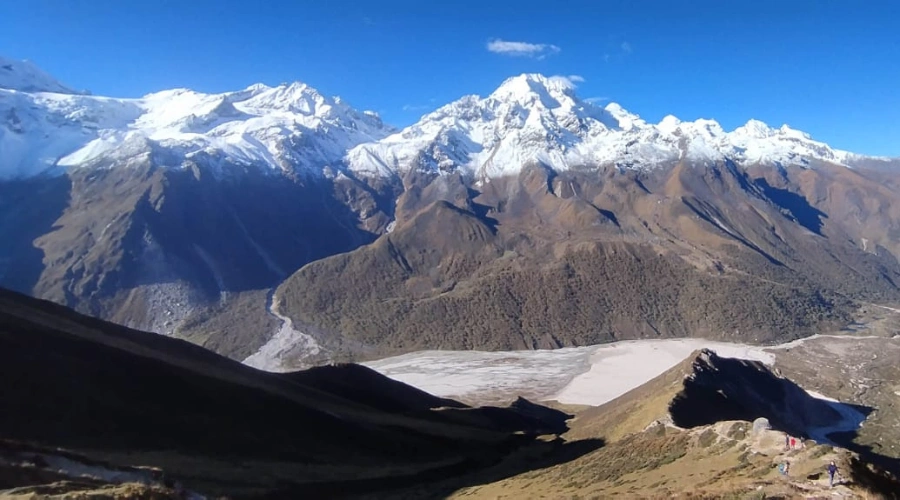
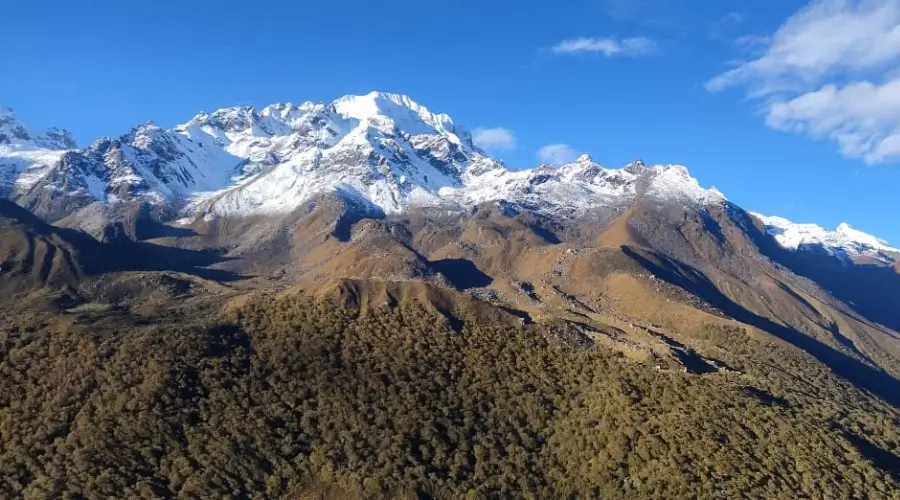
View of mountains of Langtang region from Kyanjin Gompa
Langtang Valley Trek Quick Facts
Location: Langtang region, Central Nepal, North of Kathmandu, Bagmati Province
Rich Rare Wildlife: Explore rich biodiversity within the Langtang National Park, including Himalayan Tahr, snow leopards, red pandas, Himalayan Monal, and over 250 bird species.
Diverse Range of Flora: An opportunity to explore rich flora, including wild orchids, oak, hemlock, various rhododendron species, juniper, scrub, etc.
Learn Buddhist Culture: Visit Buddhist shrines and monasteries and learn about their lifestyle.
Glacier View: See the mesmerizing views of Langtang Glacier.
Taste Authentic Local Delicacy: Taste locally produced yak cheese at Kyanjin Gompa Cheese Factory.
Traditional Teahouse Stay: Stay in beautiful, wood-crafted teahouses and experience the Himalayan lifestyle.
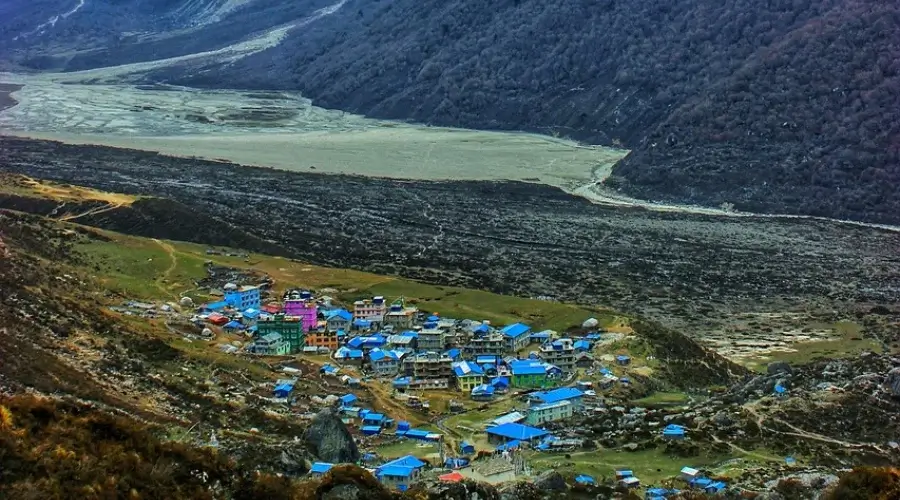
Explore Newly Built Settlement: Visit the new settlement of Langtang Village, built after the 2015 earthquake, showcasing resilience and local cooperation.
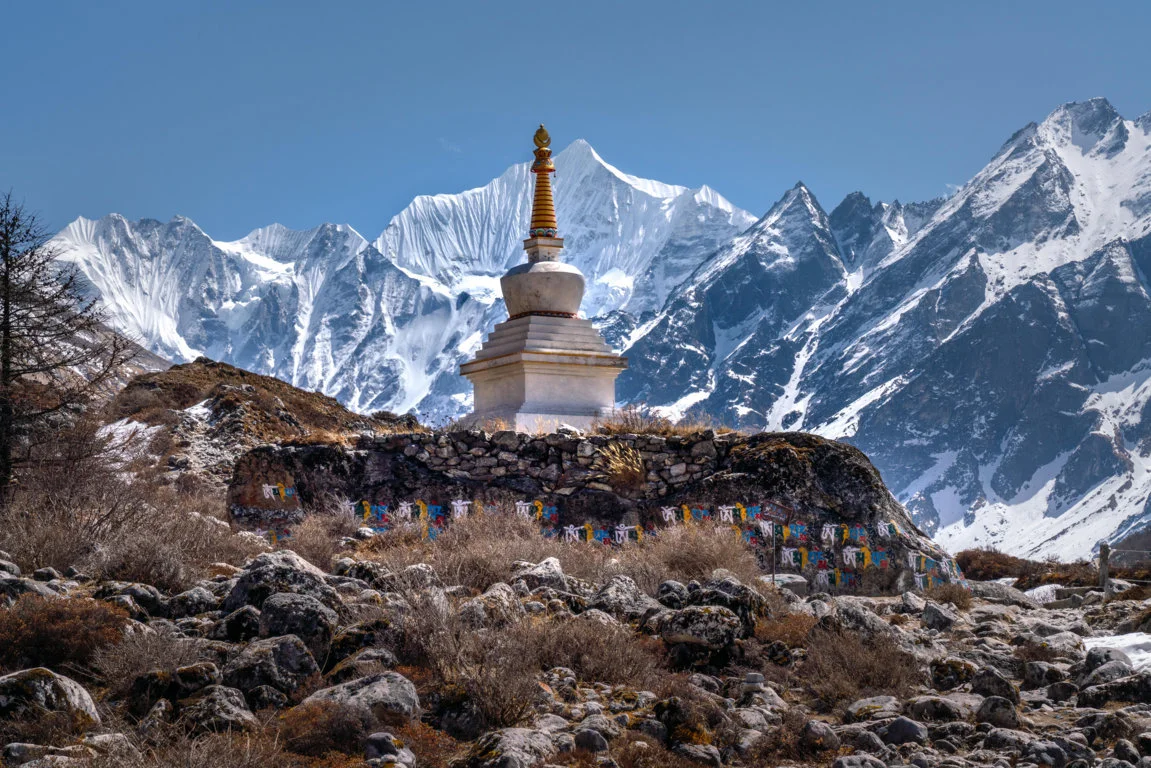
Small Stupa on the way to Langtang
8 Days Langtang Valley Trek Experience with Himalayan Masters
The 8-day Langtang Valley Trek, organized by Himalayan Masters, is a well-planned short Himalayan journey that takes trekkers from Kathmandu to the very core of the Langtang region.
The trip usually starts with a scenic drive from Kathmandu to Syabrubesi. Thereafter, the trek continues through forested trails, riverside traditional Tamang villages, and sub-alpine landscapes towards the last section of the trek.
The official trek route finally ends at Kyanjin Gompa, where trekkers can spend 1 or 2 nights acclimatizing and exploring villages or nearby viewpoints such as Kyanjin Ri and Tserko Ri.
If you want to extend the adventure further, you also have the option to explore Langtang Glacier or trek further up to Langshisha Kharka. Attempting the Yala Peak climb is also an option for adrenaline junkies and seasoned trekkers.
After enjoying the high valley and local culture, the trail retraces back to Syabrubesi before returning to Kathmandu.
We, Himalayan Masters, have designed this 8-day of trek in such a way that the trekkers acclimate to the increasing culture while experiencing all the cultural aspects of Langtang Valley within a short timeframe.
What Makes the Langtang Trek Special?
Unlike the popular Everest Base Camp or Annapurna Base Camp Trek, Langtang is known for a quieter route, a peaceful environment, diverse terrain, panoramic vistas, and cultural immersion.
Langtang Trek is one of Nepal’s most rewarding short Himalayan treks. It offers a perfect balance of scenic mountain landscapes, rich cultural heritage, and accessibility.
In this trek, your day begins with the tolling of bells from a monastery nearby or the dangling of a cowbell. Soft, cool breeze brushing off your cheek. All you can do is immerse yourself in its spiritual atmosphere and respect and admire Mother Nature.
In addition, you can not only be an observer but also a participant in the Langtang region’s culture. Langtang is known for its authentic Tamang culture. The people of Langtang are busy running their daily errands like fetching water from the nearby well, milking cows or yaks, churning yak cheese, or preparing food for their family.
So, you can be humble and ask if you can partake in it. Maybe you can help fetch water, or just appreciate their hard work, and eat wholeheartedly. Sometimes, you can even get dressed in their traditional dress and interact with the village’s elders and listen to their tales.
Furthermore, Langtang Trek is also popular for awe-inspiring views of Langtang Glacier, Langtang Lirung, Ganchenpo, Ganja La, Naya Kang, Scout Peak, and many other peaks.
This 8-day long Langtang Valley Trekking is a perfect package for those who are short on time or those with moderate physical fitness.
Within a short interval of time, they can explore the verdant greenery and roaring Langtang Khola in the lower sections, while experiencing high-altitude trekking and beautiful mountain villages.
Why Do Most Trekkers Choose Himalayan Masters for the Langtang Valley Trek?
Himalayan Masters is a premier, government-approved, licensed trek organizer based in Nepal specializing in Himalayan trekking. With a well-organized trek itinerary and logistics, ensuring trekkers’ safety and comfort, it won’t be wrong to say that Himalayan Masters is the best company for the Langtang Valley Trek.
Hundreds of trekkers have approved our stellar performance on TripAdvisor and Google Reviews in managing your Langtang adventures.
Experienced Local Team
We provide experienced, licensed local guides with strong knowledge of Langtang trails, culture, and weather conditions for every trekker.
Complementary Services for the Trek
Complimentary trekking gear for the trek: Himalayan Masters provides sleeping bags, down jackets, trekking poles, and microspikes.
Free Himalayan Masters’ branded baseball cap, t-shirt, and duffle bag (if you hire porter), and BPA-free 1000 ml water bottle and purification tablets.
Safe and free luggage storage.
Personalized packing guidance and assistance in buying them (if you need to buy).
Flexible Customization
Flexible pre-trip briefing, available physically as well as online. During the session, you’ll be briefed on packing advice, the trip, meals, and accommodation, or a Q&A session.
Easy trek customization. You can easily extend your trek to other trekking routes or add additional days. Trekkers can also customize their trek, including cultural tours, yoga sessions, and mental retreats.
Enjoy 24/7 hours of technical support, easy trip booking and payment service, with no hidden costs.
Guaranteed Safety
Emergency preparedness, including helicopter rescue arrangements if needed.
100% fixed departure guaranteed.
Small groups focused on better guidance, flexibility, and personal attention.
Veg, vegan, and non-veg food, all kinds of food options are provided in the trek route (according to availability), along with seasonal fruits.
Satisfied Trekkers with Himalayan Masters
From Inquiry and Booking to Trek Completion with Himalayan Masters
Planning your Langtang Valley Trek with Himalayan Masters is simple, transparent, and well-organized. From your first inquiry to the successful completion of the trek, we ensure a smooth, stress-free experience with full support at every stage.
Inquiry and Consultation: Contact Himalayan Masters via email ([email protected]) or WhatsApp (+977-9823636377) to inquire about the trek. 24/7 available.
Trip Booking: Confirm your trek with a 20% advance payment. The remaining balance is payable after arrival in Kathmandu.
Briefing Session: A detailed briefing is conducted one day before the trek. It can be done physically or online, too.
The Trek: Enjoy a well-organized, guided trek in the Langtang region, led by experienced, licensed guides.
After Trek Completion: After returning to Syabrubesi, drive back to Kathmandu. Then, you can collect your luggage and receive an official trek completion certificate from Himalayan Masters.
Himalayan Masters at Tserko Ri summit
The 8 Days Langtang Valley Trek Itinerary Outline
Day
Itinerary
Distance
Time
Sleep Altitude
01
Drive to Syabrubesi
75.8 miles
7-8 hrs
1503 m
02
Trek to Sherpagaon
6-7 miles
7-8 hrs
2563 m
03
Trek to Langtang Village
7-9 miles
7-8 hrs
3430 m
04
Trek to Kyanjin Gompa and Hike to Kyanjin Ri
3-4 miles
3-4 hrs
3870 m
05
Active Day at Kyanjin Gompa Hike to Tserko Ri
4-6 miles
7-8 hrs
3870 m
06
Trek to Lama Hotel
11 miles
5-6 hrs
2470 m
07
Trek to Syabrubesi
6.2 miles
5-6 hrs
1503 m
08
Drive back to Kathmandu
75.8 miles
7-8 hrs
1400 m
Important Update:
Rasuwa flood, which occurred on August 26, 2026, significantly affected the drive route between Kathmandu and Syabrubesi (trailhead of Langtang Valley Trek) on Day 1 and 8. While the drive route is damaged, trek route stays relatively safe and unaffected.
For trekkers looking to trek Langtang Valley, we are looking alternative safe route. Adding a few extra days on your itinerary, the route via Chisapani and Gosaikunda Lake is a great option.
Is the Short Langtang Valley Trek With Himalayan Masters Possible?
Yes, a 5 days short Langtang Valley Trek is possible for a trekker with a really tight schedule and who wants a shorter version of the standard Langtang Valley Trek. Himalayan Masters can arrange a 5 days short Langtang Valley Trek at your request.
Here’s what a short Langtang Valley Trek itinerary looks like:
Day 1: Drive to Sherpagaon (2,563 m/8,409 ft) from Kathmandu (1,400 m/4,593 ft)
Day 2: Trek to Langtang Village (3,430 m/11,253 ft) from Sherpagaon
Day 3: Trek to Kyanjin Gompa (3,870 m/12,697 ft) from Langtang Village and Hike to Kyanjin Ri (4,773 m/15,659 ft)
Day 4: Trek Back to Lama Hotel (2,470 m/8,104 ft) from Kyanjin Gompa
Day 5: Trek Back to Syabrubesi (1,503 m/4,931 ft) via Bamboo (1,970 m/6,463 ft) and Drive to Kathmandu
The entire trail for the 5 days of Langtang Trek is the same as that of the 8 days, but in a more compact itinerary.
In this itinerary, instead of driving only to Syabrubesi on the first day, you’ll drive almost up to a roadhead located slightly above Sherpagaon, followed by a 30 to 45 minutes’ walk to reach the village.
Another way to cut your itinerary by 1 day is to skip an extra acclimatization day at Kyanjin Gompa and avoid a side trip to Tserko Ri.
Furthermore, on a normal itinerary, we trek from Lama Hotel to Syabrubesi and, the next day, only drive back to Kathmandu. However, in this short 5 days Langtang Valley Trek itinerary, we’ll trek back to Syabrubesi and drive to Kathmandu on the same day.
In this way, you can reduce the trek itinerary by 3 days while still enjoying almost everything that the Langtang Valley has to offer.
Langtang Valley Trek Cost
The cost of the Langtang Valley Trek 8-day itinerary is $800 per person, which covers key trekking needs, including permits, meals, accommodations, and professional trek leaders.
However, this price can fluctuate depending on the agency chosen, the number of people in the group, and other services required.
The standard Langtang Valley Trek itinerary offered by Himalayan Masters is 8 days. However, due to unforeseen circumstances such as bad weather, health issues, poor road conditions, low fitness level, or personal reasons, the standard itinerary may change. In case you need or wish to extend the trek, trekkers will need to pay an extra fee for each additional day spent.
Itinerary
Expand All
Day 01:
Drive from Kathmandu to Syabrubesi (1,503 m)
Drive Route: Kathmandu → Trishuli → Dhunche → Syabrubesi Beginning Point: Kathmandu (1,400 m / 4,593 ft.) Ending Point / Overnight: Syabrubesi (1,503 m / 4,931 ft.) Kathmandu to Syabrubesi Distance: 122 km (75.8 miles) Lunch: Trishuli Bazaar Total Ascent: 103 m/338 ft
The trip begins from Kathmandu. After breakfast, Himalayan Masters will pick you up from your hotel at around 7:30-8 am and drive to Syabrubesi in a private shared jeep through the Pasang Lhamu Highway. It’s a 122 km (75.8 miles) long drive. You will have a wonderful experience driving through Shivapuri National Park.
Trekkers posing by the side of a private vehicle for the Langtang Trekking
Most of the route is black-topped. However, some sections are under construction and have bumpy roads. Nonetheless, the zigzag country road, traditional villages, terraced farmland, and fantastic mountain views from the window keep you alert and excited throughout 5 to 6 hours of driving. If you take the local bus, it might take an additional 1 or 2 hours.
Before reaching Syabrubesi, trekkers drive through the Trishuli River and Tadi Khola. After driving for about 3 hours, at around 11 am, we will stop at Trishuli Bazar for lunch. There we rest for about an hour and have a hearty meal.
From there, you will continue driving to Syabrubesi via Dhunche. Dhunche is the district headquarters of Rasuwa. There is a Langtang National Park head office, where your permits will be checked. Or, you can also issue a new permit.
Dhunche is about 2-hour drive from Trishuli Bazaar. Then, with just 45-minute to 1-hour additional drive, you can reach Syabrubesi, at around 3 to 3:30 pm.
After reaching Syabrubesi, you can spend the rest of the day resting and planning for the trek ahead. Or, you can further explore the village.
We most probably will have our dinner at around 7 pm. Then, your guide will brief you about the next day’s route and everything.
On the way, you can witness the snow-capped peaks of the Ganesh Himal range. The distance between Kathmandu and Syabrubesi is around 122 km.
Syabrubesi Village
About Trishuli Bazar
Trishuli Bazaar, situated at an altitude of 625 meters (2050 ft), is a small town and the headquarters of Nuwakot district. All official governmental works are done here. The town has good facilities for hospitals, restaurants, schools, army barracks, etc. You can find decent guesthouses and hotels, too.
About Dhunche
Dhunche, situated at an elevation of 1960 meters (6430 ft), is another small and beautiful village you will encounter on the way. The head office of Langtang National Park is located here, where your permits will be checked.
Dhunche is also the starting point for the Langtang Gosaikunda Trek. Here, you can visit a mineral water factory and enjoy the view of the mountains.
About Syabrubesi Village
Situated at an altitude of 1,503 m/4,931 feet, Syabrubesi is a small, picturesque village on the way to the Langtang Valley Trek.
The bustling local market of Syabrubesi serves as a gateway to Tibet via the Kerung Highway. This small Tamang village, Syabrubesi village, is a starting point for alternative treks in the Langtang region, such as the Tamang Heritage Trail Trek and Ruby Valley.
Likewise, local Tibetan and Tamang gompas are the major highlights of Syabrubesi. You can visit the newly built Buddha statue placed on a side of the mountain ridge, about a 20-minute walk.
There are about 15-20 decent guesthouses here that provide all the modern facilities like Wi-Fi, hot showers, attached bathrooms, and so on, usually free. You can enjoy local cuisine or order food according to the menu at any guesthouse.
If you want to buy or replace your trekking gear, Syabrubesi is a perfect place. Because, as you trek higher, the price for gear also gets higher.
: Breakfast, Lunch & Dinner
: Guest House
: 6 to 7 Hours (Driving)
Day 02:
Trek from Syabrubesi to Sherpagaon (2,563 m)
Trek Route: Syabrubesi → Khanjim → Sherpagaon Beginning Point: Syabrubesi (1,503 m / 4,931 ft.) Ending Point / Overnight: Sherpagaon (2,563 m / 8,409 ft.) Syabrubesi to Sherpagaon Distance: About 11 km (7 miles) Lunch: Khanjim Total Ascent: 1,060 m/3,478 ft
Teahouses in Langtang Valley Trek
Today, it’s going to be a long walking day (about 7 hours), covering around 11 km (7 miles). So, we’ll have to start early. After breakfast in Syabrubesi at around 7 am, we start our trek around 7:30-8 am.
Trek from Syabrubesi to Khanjim – 3 hours
Just after 5-minute walk, we cross a suspension bridge, crossing the Bhote Koshi Nadi flowing from Tibet. After crossing the bridge, the route takes on a steep uphill route. In some sections, you might encounter motor roads and stone-paved steps on the way to Sherpagaon.
However, we will try our best to avoid these roads and trek through an authentic trekking trail. The route is decorated with vibrant Laligurans forest (rhododendron forest), salla, and other local wild flower plants. You might be able to spot some wildlife in Langtang Valley, such as mountain goats, Himalayan tahr, blue sheep, and monkeys.
After walking for about 2-3 hours, through a forested uphill route, we will reach Khanjim. About 30 minutes before reaching Khanjim, there are 2 small teahouses. We can stop here for a cup of tea or coffee while enjoying the river and jungle view. Other than this, there is no teahouse in between.
Typically, we stop directly at Khanjim for our lunch. You can rest here for some time while your lunch is getting ready.
Trekkers trekking in the Langtang region through lush forest with mountain views
Trek from Khanjim ok Sherpagaon – 4 hours
After having lunch, we will continue our trek to Sherpagaon along the views of the mountain and the stunning Langtang Valley below. It takes about 4 hours to reach Sherpagaon from Khanjim village, covering around 7-8 km.
After just 15 to 20 minutes’ walk, we will arrive at Surka village. It is a beautiful viewpoint with 3-4 teahouses. If not Khanjim, we can have our lunch at Surka, too. From this viewpoint, you can enjoy an excellent view of the Ganesh Himal range.
Thereafter, we have to walk on the motor route for about an hour, up to Nesa Danda. Trekkers can directly drive to Nesa Danda if they want to reduce the trek day. From there, Sherpagaon is just about a 45-minute walk.
It’s quite an alluring route, ups and downs, navigating through stone steps and forest routes, all along with the Surya Peak view. Just before reaching Sherpagaon, there is a small seasonal waterfall on the nearby hillside, and the stream flowing from it is crossed via a truss bridge.
This route is a deviation from the traditional route that goes through the crowded trail to the Lama Hotel. You get to taste fresh, local delicacies and experience centuries-old traditions while on this route.
We will probably reach Sherpagaon by 3-4 pm, so we still have some time to explore the village. Make sure you order your dinner so you get it hot and on time.
After dinner, at around 7 pm, you’ll be briefed about the next day’s route and your day’s experience. And finally, go to sleep by 10 pm.
About Khanjim Village
Khanjim (2,235 m/7,332 ft) is a small, beautiful village on the way to our trip. It has around 4-5 teahouses that provide basic food and accommodation facilities. You can also see the other 50-60 local houses, including a primary school and local gompas.
The majority of the people in this area are engaged in agricultural occupations. Therefore, you can expect to have fresh and healthy locally-grown food here.
About Sherpagaon
Situated at 2,563 meters (8,409 ft), Sherpagaon is a local Tamang village where you will stay overnight.
There are about 5 basic but neat and clean teahouses here. They provide local food and basic bedding. Apart from these, there are around 10-15 local houses whose residents are engaged in agriculture. They also sell their agricultural products to the Langtang Village.
: Breakfast, Lunch & Dinner
: Tea House
: 7 to 8 Hours (Walking)
Day 03:
Trek from Sherpagaon to Langtang Village (3,430 m)
Trek Route: Sherpagaon → Riverside Lodge → Ghodatabela → Langtang Village Beginning Point: Sherpagaon (2,563 m /8,409 ft.) Ending Point/ Overnight: Langtang Village (3,430 m / 11,253 ft.) Sherpagaon to Langtang Village Distance: About 15 km (9 miles) Lunch: Riverside Lodge Total Ascent: 867 m/2,845 ft
Porters carrying loads
The third day is another long walk day. Today, you need to cover approximately 15 km (9 miles), which takes around 7-8 hours. The trail passes through pine and rhododendron forests and finally enters the broad valley of Langtang.
Today, you will witness a few beautiful views of the Langtang Himal range, including Langtang Lirung (one of the highest peaks in the Langtang region).
Trek from Sherpagaon to Riverside Lodge – 3.5 hours
We will begin our trek at around 8 am, after having a hearty breakfast. After walking along side trails, uphill and some downhill slopes, and sometimes a stone path, for about 1 to 1.5 hours, we will reach Rimche.
From there, you can get an open view of the surrounding mountains towards Gosaikunda. There are a few small streams en route; you might want to open your shoes. There are some beautiful waterfalls on the opposite hillside, though. Trekkers can see some snow-covered peaks during their trek, further enhancing the trekking experience.
After walking for an additional 30 minutes and covering about 1 km, you will reach Lama Hotel. It’s a mix of slight downhill, uphill, and ridge routes.
Some trekkers prefer to have lunch at the Lama Hotel. However, the Lama Hotel might be crowded with trekkers going to or returning from the Langtang trek, so the food and other facilities might not be up to the mark.
So, our standard itinerary includes our 3rd day’s lunch at Riverside Lodge, which is only an hour (about 2 km) walk from Lama Hotel.
Traditional Tibetan-style egg fried rice in the teahouse
It’s quite an amusing trail dotted with pine trees, rhododendron forest route, and a view of Langtang Lirung, along with Langtang Khola.
There are 2 small teahouses in between, within the forest. If you can walk faster are aren’t so hungry, you can trek further to Chhunama or Ghodatabela for lunch too. Ghodatabela is about a 1.5-hour walk.
Trek from Riverside Lodge to Langtang Village – 4 hours
Ok, now that we have rested and have had our lunch at Riverside Lodge, the trail now takes on a little uphill route towards Langtang Village.
The trail then moves across alpine meadows, where you will see yak caravans and livestock grazing, via Ghodatabela and Thyangsyapu. After about four hours’ walk, we can reach Langtang Village, where you will stay overnight.
Glaciers and steep rock faces showcasing the alpine landscape of the Langtang region
Your permits will be checked at Ghodatabela. You can also issue a new permit here. As you trek higher from Ghodatabela, towards Thyangsyapu, the landscape changes to open vast pastures. Here, you might be able to spot wildlife such as red panda, mountain goat, snow leopard, black bear, mountain monkey, etc.
After about an hour’s walk from Thyangsyapu, following a slightly uphill route and crossing wooden bridges, you reach Gompa Danda. From Gompa Danda, you can see a beautiful view of the surrounding mountains and valley downhill.
From there, with just about a 30-minute to 1-hour trek along the glacier, crossing the previous settlement of Langtang Village before the earthquake of 2015, you can reach the final destination of the Langtang Valley Trek itinerary, Langtang Village.
You’ll probably reach Langtang Village at around 4 pm. So, you still have a couple of hours to explore the village. Or, you can choose to rest at your teahouse while enjoying a cup of yak milk, Tibetan tea.
Then, as usual, you’ll have your dinner at around 7 pm, have some briefings, share your trekking experience until now, and go to sleep by 10 pm.
About Riverside Lodge
Riverside Lodge is a popular stop point for trekkers on the way from Sherpagaon to Langtang Village. Situated at an altitude of around 2,700 meters, only 2 basic teahouses provide local but good food.
About Ghodatabela Village
There are only 2 teahouses at Ghodatabela. From its elevation of 2,972 meters (9,750 ft), you can see an excellent view of Langtang Lirung, the other Langtang Himal range, the Langtang River, and the jungle. It is also the checkpoint to the Langtang National Park.
About Thyangsyapu Village
Thyangsyapu is situated at an elevation of 3,140 meters (10,302 ft). There are about 4 teashops here. From here, you can enjoy the view of Langtang Khola. You might even see Himalayan Thar and different species of birds.
About Langtang Village
Langtang Village is a small and beautiful village at 3,430 meters (11,253 ft). Along the way, you can see the Mani stone wall, which showcases the literature of the Tibetan people.
The native Tibetan people of the village welcome you with warm hospitality and their Tibetan cuisine. Additionally, you can visit local gompas and an army camp nearby. You can visit nearby monasteries, or even go rope climbing nearby.
Additionally, there are about 20-25 good-quality teahouses here, providing comfortable and cosy accommodation, and nourishing food to eat. The dining hall is normally heated with a central heating system, where you can enjoy a warm dinner.
: Breakfast, Lunch & Dinner
: Tea House
: 7 to 8 Hours (Walking)
Day 04:
Trek from Langtang Village (3,430 m) to Kyanjin Gompa (3,870 m) and Hike to Kyanjin Ri (4,773 m)
Trek Route: Langtang Village → Kyanjin Gompa → Kyanjin Ri → back to Kyanjin Gompa Beginning Point: Langtang Village (3,430 m / 11,253 ft.) Ending Point/ Overnight: Kyanjin Gompa (3,870 m / 12,697 ft.) Langtang Village to Kyanjin Gompa Distance: About 5 km Kyanjin Gompa to Kyanjin Ri Distance: Around 5 km / 3 miles (Round) Lunch: Kyanjin Gompa Total Ascent: 440 m/1,444 ft
Residence in Langtang Valley
Today, we reach the final destination of our trek, Kyanjin Gompa. It’s a short trekking day, as you need to cover only 5 km (3 miles). Although reaching Kyanjin Gompa only takes about 2.5 hours, there is an additional hike to Kyanjin Ri.
As we have had a long walking day previously, we are going to have our breakfast at around 8 am, and start trekking at around 9 am, so that we have enough rest.
Trek from Langtang Village to Kyanjin Gompa – 2.5 hours
You start ascending a steep trail, crossing some settlements managed and used by the shepherds. In between, you can see great views of peaks such as Gangchenpo, Ganja La, Naya Kanga, Scout Peak, Tserko Ri, Langtang Ri, Kyanjin Ri, and Langtang Yubra.
The route from Langtang Village to Kyanjin Gompa is short but challenging, taking about 2-2.5 hours. It is a 5 km long trek.
In between, after about 20 to 30 minutes walk, following pasture land, we arrive at Mundu. There are about 7-8 basic teahouses there, where you can have tea and coffee. It is also a popular viewpoint for some of the best views of the Langtang mountain range and the surrounding valley.
Then, we continue trekking to Kyanjin Gompa. Short after a 30-40 minute walk, we’ll reach Sindum, which is popular for a cafe, Hardrock Cafe. It is the only teahouse around here, attached to a huge boulder.
From here onwards, the terrain is somewhat wide and flat or slightly uphill. Be careful in some sections, as there might be rockfall. After walking for about 45 minutes, there is a newly built monastery that you can visit.
Furthermore, you can also visit the Langtang Kyanjin hydro power house. After all that, we will arrive at Kyanjin Gompa at around 11 to 11:30 am, where we will have our lunch and stay overnight. We plan to have our lunch around 12 to 1 pm.
Kyanjin Gompa to Kyanjin Ri Hike
After having our lunch, now you have two options: either explore Kyanjin Gompa village or go for an acclimatization hike to Kyanjin Ri (4,773 m/15,659 ft).
If you choose to hike, we will start hiking around 1 to 1:30 pm. Hiking to the Kyanjin Ri viewpoint is a short, demanding, yet exciting trek within the Langtang region.
There are some narrow sections, where you might lose footing, so be careful. Also, make way for chauri (yak), so that you don’t collide or meet an accident with them. Additionally, there are strong winds during the afternoon, so the wind feels colder and the air thinner. Have a steady pace, ascend gradually.
Know that there are two viewpoints on Kyanjin Ri: Lower Kyanjin Ri and Upper Kyanjin Ri. You can leave your luggage in your teahouse and carry just a daypack and go hiking.
Reaching lower Kyanjin Ri takes around 1.5 hours, situated at 4,400 meters (14,436 ft). If you find hiking further above difficult, you can end your hike and return from here. Or, hike further to the Kyanjin Ri summit. It’s an additional 1.5-hour hike.
From lower Kyanjin Ri, you can see a panoramic view of the Langtang Himal range, Langtang Valley, Chhonak Lake, lush forest, and so on.
Dramatic views of the Langtang Himal with towering peaks in the Langtang valley
If you choose to hike up to the Kyanjin Ri summit, it’s an additional 1 to 1.5-hour hike. It’s a steep, scree uphill route that really tests your physical fitness. On the way up, you can see yaks/chauri grazing on the cliffs. As you approach the summit, the view begins to further open.
From the summit, you feel like the mountain is right in front of you, like you can touch it. The sunset view is just amazing; the sky is painted in orange. It is one of the best times for photography. Trekkers can also see the Yubra Himal Glacier.
The trek covers a total distance of about 5 km, round trip, and takes about 3 hours to climb uphill and 2 hours to descend downhill. If you don’t want to descend the same route, there is another route too. It’s a little longer, with less wind and chances of small rockfall, but equally beautiful.
Your guide will decide how long you can spend on the summit depending on the time and weather. If the weather seems to go bad, the summit time can be limited to 15 to 20 minutes.
It is recommended that you take packed food on the way, as there are no teahouses in between.
About Kyanjin Gompa
After reaching Kyanjin Gompa, you will see the beautiful wall of stones carved with religious scriptures called the Mani stone wall. Thereafter, it is best to spend a few more hours exploring the surrounding areas and acclimatize to the increasing altitude.
There are a couple of good teahouses on the way, including about 20-25 teahouses in Kyanjin Gompa, where you can unload your luggage, rest, and hike to Kyanjin Ri.
Kyanjin Gompa is named after an ancient Buddhist monastery, believed to be more than 500 years old. It is also famous for its cheese factory and views of the rivers, mountain ranges, and glaciers.
Snowcapped mountain view seen from the Langtang Region
: Breakfast, Lunch & Dinner
: Tea House
: 3 to 4 Hours (Walking)
Day 05:
Acclimatization Day- Hike to Tserko Ri (4,983 m)
Trek Route: Kyanjin Gompa → Tserko Ri → Kyanjin Gompa Kyanjin Gompa to Tserko Ri Distance: 10 km / 6 miles (Round) Lunch: Packed lunch or Kyanjin Gompa Maximum Elevation: 4,983 m / 16,348 ft. (Tserko Ri) Total Ascent: 1,113 m/3,652 ft
View from Tserko Ri
Day 5 of the Langtang trek itinerary is an active rest day.
Meaning, you will be engaged in another stunning hike today. Or, you can also stay at your teahouse or explore Kyanjin Gompa, visit Kyanjin Cheese Factory, visit nearby monasteries, go souvenir shopping, and interact with locals.
We usually have our breakfast before 6 to 6:30 am for the early morning, as the fifth day of our standard Langtang Valley Trek itinerary includes the Tserko Ri Hike. If you don’t feel like it, you can skip this too, but we strongly suggest you choose this hike for one of the best 360° panoramic views.
Situated at an elevation of 4,983 meters (16,348 ft), Tserko Ri, or Cherko Ri, is one of the most famous peaks in the Langtang region. The Tserko Ri Hike covers around 10 km (6 miles), round trip. It takes about 6 hours to climb the peak and 3 hours to descend.
It is a short yet challenging climb. For better views and to avoid afternoon high winds, we have to start hiking as early as possible. There is no teahouse in between, so you need to carry a packed lunch, or have it once we return.
We usually start our hike around 6:30 am. The route to the Tserko Ri summit first starts with somewhat flat terrain for the first 30 minutes. Then, after crossing a small stream, the route takes on a totally uphill, steep trail.
It is a high-altitude hike, so there is a high chance of getting altitude sickness. So, we suggest you walk slowly but steadily. After 4,500 meters, the winds get stronger and cooler. So, we suggest you wear warm clothes and pack crampons and trekking poles for the icy trail.
Nonetheless, as you trek higher, the landscape starts to unveil itself with stunning mountain views. In between, there are small yak shades (kharka), and one can spot yaks and mountain goats grazing.
From the Tserko Ri summit, you can enjoy breathtaking views of more than 20 peaks, including Langtang Lirung, the Tibet Himalayan range, Langtang Himal, Langshisa Ri, and Mount Gangchenpo. Additionally, you can see small hamlets in the Langtang valley downward.
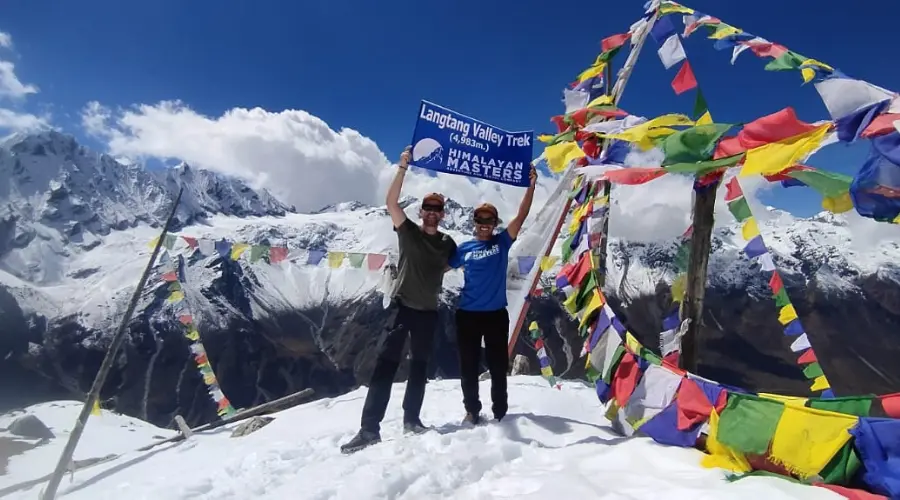
Celebrating the journey at Tserko Ri viewpoint, surrounded by prayer flags and high-mountain energy
We will be spending 30 minutes to 1 hour, depending on the weather and your wishes. Take time to immerse yourself in the beauty of Langtang, take photographs and video, and have some snacks.
By 2-3 pm, you can return back to Kyanjin Gompa. Then, you can rest for a while, freshen up, and have lunch.
After lunch, you now have two options for returning. You can return through the same route that we took before, or choose another route which takes an extra 1 hour, but is comparatively easier.
After returning to Kyanjin Gompa, you can spend the remainder of the day resting or further exploring the village.
You can visit a nearby cafe, surf the internet, and upload a few posts while enjoying a cup of coffee. Trekkers can also visit the helipad ground or Langtang Lirung Lake. Or, just strolling around the village is also an excellent choice.
Finally, you can have your dinner at your usual time, at around 7 pm. Likewise, you’ll be given a short briefing about the next day’s trek route. Share your trekking experience with each other, and give time to have successfully reached the final destination of the trek, and now it’s time to return.
: Breakfast, Lunch & Dinner
: Tea House
: 7 to 8 Hours (Walking)
Day 06:
Trek back from Kyanjin Gompa to Lama Hotel (2,470 m)
Trek Route: Kyanjin Gompa → Langtang Village → Thyangsyapu → Ghodatabela → Lama Hotel Beginning Point: Kyanjin Gompa (3,870 m / 12,697 ft.) Ending Point/ Overnight: Lama Hotel (2,470 m/ 8,104 ft) Kyanjin Gompa to Lama Hotel Distance: About 18 km (11 miles) Lunch: Ghodatabela or Riverside Lodge Total Descent: 1,400 m/ 4,593 ft
Now, it’s time to return. After enjoying the last breakfast at Kyanjin Gompa, you will trace back the same route to Lama Hotel at around 7:30 to 8 am.
It is a long walking day, but a comfortable descent compared to a steep descent. To be precise, it’s the longest walking day in our Langtang Trek Itinerary, approximately 18 km (11 miles), about 7.5 to 8 hours walk.
Trek from Kyanjin Gompa to Ghodatabela – 4 hours
The route navigates via Langtang Village, Thyangsyapu, and Ghodatabela. You can further explore villages en route, visit monasteries, and experience the rich Tamang culture. Interestingly, some of the most breathtaking scenery appears during the return journey, as views that were once behind you slowly unfold and feel entirely new.
Today, we’ll be having our lunch at Ghodatabela. Reaching Ghodatabela takes about 3.5 to 4 hours. There are only 2 teahouses in Ghodatabela.
Trek from Ghodatabela to Lama Hotel – 2.5 hours
After having rested and a delicious Dal Bhat lunch, we continue trekking to Lama Hotel. Lama Hotel is also called Changtang village.
We’ll most probably reach Lama Hotel by 3-4 pm. There are about 5-6 teahouses in Lama Hotel. Upon arriving in the village, you will be checked in at one of the teahouses for an overnight stay with a fantastic dinner. However, do not expect any exotic teahouse. Teahouses here are basic yet warming.
Along the route, you can enjoy alluring mountain views, lush rhododendron forests, and several picturesque villages. You begin to remember all the tough ascents you did over the past few days, while cherishing the memorable moments from the trek.
Excellent mountain view in the Langtang region with cloudy weather
: Breakfast, Lunch and Dinner
: Tea House
: 5 to 6 Hours (Walking)
Day 07:
Trek back from Lama Hotel to Syabrubesi (1,503 m)
Trek Route: Lama Hotel → Bamboo → Syabrubesi Beginning Point: Lama Hotel (2,470 m / 8,104 ft) Ending Point/ Overnight: Syabrubesi (1,503 m / 4,931 ft.) Lama Hotel to Syabrubesi Distance: About 10 km (6 miles) Total Descent: 1,010 m/3,314 ft Lunch: Bamboo Lodge (1,970 m) or Pahare Hotel
Majestic Mountain range seen from Langtang
It is the last trekking day, as the last (8th day) of the trek includes a drive to Kathmandu. Today, you will have to cover about 10 km (6 miles), about a 4.5-hour walk.
Trek from Lama Hotel to Bamboo – 3 hours
After breakfast at the Lama Hotel, around 7 to 7:30 am, you will begin the trek to Syabrubesi at our usual time (around 8 am). After walking for 20-30 minutes, we will reach Rimche, from where we will take a different route from the one we took before. Or, your guide decides which route to take depending on your stamina and weather.
Instead of trekking towards Sherpagaon, we trek towards Bamboo and Domen, finally connecting to Syabrubesi.
After about a 45-minute trek, there is a short section where there is a risk of a landslide and a small rock-falling zone. There might be a chance that we might need to return and trek via Sherpagaon. This will be decided by your trekking guide. Therefore, always listen to your guide’s instructions.
Then, with another 45-minute walk, we will stop at Bamboo for a cup of tea or coffee, with the sound of roaring Langtang Khola. If you’re lucky enough, you may spot a red panda hidden inside a nigalo (a type of Himalayan bamboo) forest. Sometimes, you might also see deer, monkey, wild pheasant, and fowl.
After a warm drink, we continue our trek towards Pahiro, which is going to be our lunch place for day 7. It’s an easy, slightly downhill route, about 1 1-hour walk. Trek through lush nigalo and rhododendron forest is quite entertaining.
Trek from Pahiro to Syabrubesi – 1.5 hours
As per our plan, we can reach Pahiro by 11:30 am. After our last lunch in the mountains, we continue our final section of trekking journey towards Syabrubesi via Domen. It’s a total of 1.5 hours walk from Pahiro.
After a 20-30 minute walk, the route after Domen meets motor road and continues up to Syabrubesi. We can reach Syabrubesi by 2-3 pm.
After reaching Syabrubesi, take some time to rest and rejuvenate. We can also go swimming in Langtang Khola or take a dip in a hot spring nearby, Syabrubesi.
In the evening, we can toast/celebrate successfully completing the trek. After a week’s basic accommodation and challenging days, you deserve a celebratory drink and a comfortable and cosy night’s stay in one of the best lodges in Syabrubesi.
Note: If you are short on time or want to reduce the overall trek itinerary, you can drive to Kathmandu on the same day.
Trekkers trekking in the Langtang region through lush forest with mountain views
: Breakfast, Lunch & Dinner
: Tea House
: 5 to 6 Hours (Walking)
Day 08:
Drive back from Syabrubesi to Kathmandu (1,400 m)
Trek Route: Syabrubesi → Dhunche → Trishuli → Kathmandu Beginning Point: Syabrubesi (1,503 m / 4,931 ft.) Ending Point/ Overnight: Kathmandu (1,400 m / 4,593 ft.) Distance from Syabrubesi to Kathmandu: 122 km/75.8 miles Lunch: Trishuli
After having breakfast at Syabrubesi, you will head to the capital city, Kathmandu, at around 8-9 am. A private jeep will pick you up from the teahouse and take you back to Kathmandu.
You will be back through the same route, enjoying the beautiful scenery from the window. After 5 to 6 hours of travel, you will arrive in the city, check in at the hotel, and rest.
If time allows, you can explore Kathmandu Valley. Or, you can go for a relaxing spa or massage. Additionally, you can go for a walk around Kathmandu Durbar Square or Thamel. It has a pleasant environment in the evening.
Note: If you are travelling on a local bus/vehicle, it takes about 7 hours.
: Breakfast and Lunch
: 3-Star Hotel
: 6 to 7 Hours (Driving)
include / exclude
Trip Cost Includes
International Airport pick-up and drop-off service in a private vehicle
Kathmandu to Syabrubesi and back to Kathmandu by a Comfortable private jeep
Two nights of basic accommodation in Kathmandu with breakfast
Seven nights: Best available clean and comfortable teahouse accommodation during the trek
All meals (breakfast, lunch, and dinner) with tea or coffee during the trek
Staff insurance and necessary ground support for support staff
Licensed experienced guide for eight days of adventure
Trekking permits: Langtang National Park permits
If you don’t already have, sleeping bag that can withstand -25°C for the trek
A pulse oximeter to check your SpO2 and BPM at high elevations
BPA-free water bottles and purification tablets
Your guide is equipped with a first aid kit box and an oxygen bottle that you can use in case of emergency
Seasonal fruits for dessert
The Himalayan Masters Brand Duffle Bag for the Trip (If you hire a porter)
Himalayan Masters Brand Trekking T-Shirt and Cap as a souvenir
Langtang Valley Trek Package covers all the Local and Government taxes and administrative charges
Trip Cost Excludes
Extra-night accommodation in Kathmandu in case of early arrival or late departure
Trekking porters
Lunch and dinner in Kathmandu
Nepal Visa fee
Travel and medical insurance
International flights
Excess baggage fee at the airport
Personal trekking gear and equipment
Tips for guide (at least 10% of the trip is expected for tips)
The Langtang Valley Trek difficulty is classified as moderate. Although it is comparatively tricky, it is hard for most individuals, especially those with below-average physical fitness.
This trek includes daily hikes of approximately 6-7 hours with possible elevation gain that causes altitude sickness. Above 2,500 meters, there is a high chance of getting altitude sickness. We recommend including acclimatization/rest days in your itinerary and ascending gradually.
Ascending in such terrain isn’t the only challenge; descending is also equally difficult. While descending, your back and knees exert pressure, making walking challenging. Additionally, there are blisters and chaffing that further add to your difficulties.
While no technical climbing skills are required, there are some sections that include long uphill sections, especially at lower elevations and on hike days, which might be quite challenging for most.
Trails are a mix of stone steps, forest paths, and dirt trails. So, trekkers need to step carefully, especially during the monsoon season and snow.
Walking across snow-covered trails, surrounded by pristine white landscapes and silent peaks
Additionally, be aware that small rocks falling off the cliff and landslide-prone sections could be tricky. Check for landslide updates with local guides and news channels for recent trail updates.
Furthermore, unpredictable weather can affect trail conditions, especially in the monsoon and winter, and the trekking experience. Make sure you are mentally prepared and pack according to the weather or season you are trekking in. Crampons might be required to navigate through ice.
Nonetheless, if you’re up for an additional challenge and want to extend your adventure, you can extend your treks to Menchhyamsa Ri, Ganja La Pass, or even attempt Yala Peak Climbing.
Is it possible to hike Langtang Valley without a guide?
No. Trekkers aren’t allowed to trek to Langtang Valley without a licensed trekking guide. The Langtang National Park committee has made hiring a licensed trekking guide compulsory from April 2023, imposed by the Nepal Tourism Board.
It is important that trekkers follow these rules for their own safety. Ignoring the rules, if you attempt to trek without a guide, there is a high chance that you will get lost. In rare cases, there could be life-threatening instances like getting injured from falling rocks, being left stranded due to a landslide or snow, altitude sickness, health issues, and so on.
Due to a few such accidents in past years, the local government made getting an experienced licensed guide compulsory.
Mountain range of Langtang view from Kyanjin Ri
How can Langtang trek guides help you during the hike?
Himalayan Masters’ licensed, experienced Langtang trek guide helps you in planning a trek, handles logistics, books accommodations, and helps you during emergencies.
They will also help you arrange an emergency helicopter evacuation if need be. You don’t have to worry about any of those things and just focus on trekking.
These seasoned guides are also well-versed in the terrain and weather patterns. As they frequently visit the Langtang region every season, they know which sections are comparatively difficult and where special attention is required.
Furthermore, they will help you communicate with locals and understand their culture and lifestyle.
Although trekking solo gives you freedom and fun, getting to meet new people and having a companion never hurts.
Can children and senior citizens trek to Langtang Valley?
Yes, trekkers of all ages, from children to senior citizens, can trek to Langtang Valley. However, it is essential that you’re in reasonably good health and properly prepared.
It is a fun and educational adventure for children, offering a close connection with nature and local culture. Moreover, their pace, diet, and rest must be carefully managed. For that, the Himalayan Masters’ team arranges shorter walking hours, frequent breaks, and comfortable teahouses suitable for families.
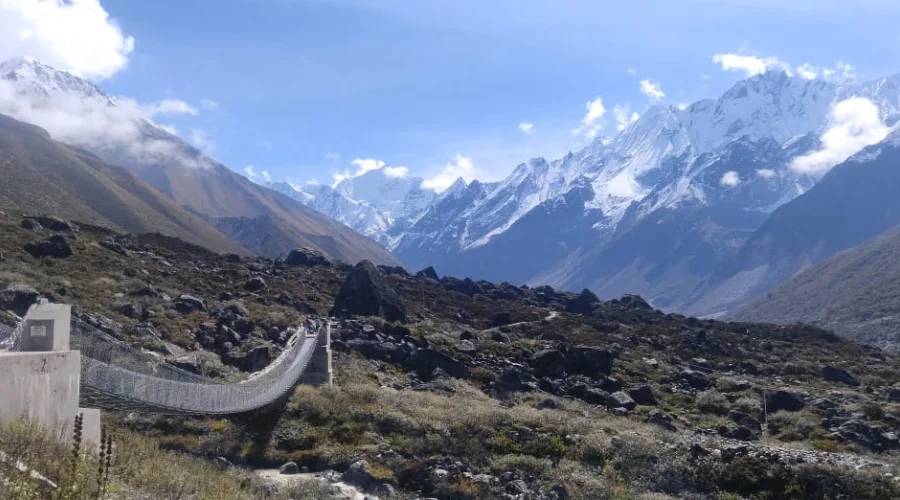
Suspension bridge on the way to Kyanjiin Village
Furthermore, for senior citizens, we prioritize their health and safety above all. The guide monitors their altitude-related symptoms and oxygen level and provides support if needed.
For both children and seniors, ascending gradually is essential to acclimatize properly. Additionally, we advise you to consult your doctor and undergo basic fitness training at least 2 to 3 months before stepping on the Langtang trail.
Who Can Participate in This Trek?
Anyone willing to experience the Himalayan lifestyle along the Langtang Valley route can participate in this trek.
Unlike some of Nepal’s demanding high-altitude, remote treks, Langtang does not require technical climbing skills, prior trekking experience, or excellent physical fitness.
If you feel like you have a decent enough fitness level, strong cardiovascular health, and good stamina, you can do this trek. However, we suggest you get a thorough medical checkup, so that you know if you’re fit for this trek or not.
With proper preparation, guidance, and a positive attitude, this trek can be completed and enjoyed by every trekker. Langtang Valley Trek is a perfect choice for trekkers looking to begin their trekking journey.
Langtang Valley trek during Autumn
The overall cost of the trek depends on the group size
The trip cost listed on our website reflects the group joining price. Our Langtang Valley hike is operated as a small group tour, with a maximum of 7 participants per departure, typically consisting of 3 to 5 trekkers.
For those interested in a private trek, we’re happy to arrange a personalized trekking experience. However, please note that solo trekkers must pay a $200 single supplement fee due to the additional logistics and services involved.
What is the Highest Langtang Valley Elevation?
The highest elevation in the Langtang Valley Trek route is 3,870 meters (12,697 ft) at Kyanjin Gompa. However, we have side trips, acclimatization hikes to Kyanjin Ri (4,773 m/15,659 ft) and Tserko Ri (4,983 m/16,348 ft), which are significant elevations.
Although it is not as high as Everest Base Camp or crossing Thorong La Pass, there is a high chance of getting altitude sickness if you are not careful.
Moreover, knowing the elevation you’ll reach helps you prepare mentally. You get a rough idea of what to expect on the road and accordingly pack clothing, appropriate trekking, and sleeping gear.
Altitude Sickness in Langtang Valley Trek
During the Langtang Valley Trek, the trek reaches almost 5,000 meters, which poses a significant risk of altitude sickness. Some symptoms of altitude sickness include headache, nausea, fatigue, and shortness of breath.
To avoid altitude sickness, one should start ascending gradually and include rest days in between. Additionally, we suggest you stay hydrated and drink at least 3-4 liters of water daily. In addition, eating healthy, easily digestible food is necessary.
If signs of altitude sickness do not resolve or worsen, it’s suggested to descend to a lower elevation. In the worst-case scenario, you might need a helicopter evacuation.
As our guides are equipped with a pulse oximeter, they will be checking your pulse and oxygen level every day to ensure your safety and avoid any further risks.
Altitude Chart for Langtang Valley Trek
What Type of Experiences Do I get During Langtang Valley Trek?
Langtang Valley trekking offers a perfect blend of natural beauty and cultural immersion. You will walk through rhododendron and bamboo forests, through several small traditional Tamang villages.
Although the Langtang Valley Trek is easy, some trekking experiences are always desirable. It involves crossing rugged terrain and slopes, parts of which may be pretty steep at times and thus require very rigorous hiking.
But with proper physical preparation, guidance, and quick thinking from your guide, even those who have never trekked before can successfully complete the Langtang Valley Trek.
Additionally, if you have limited time or prefer a less-crowded trek, easily accessible from Kathmandu, the 8 day Langtang trekking is an excellent option.
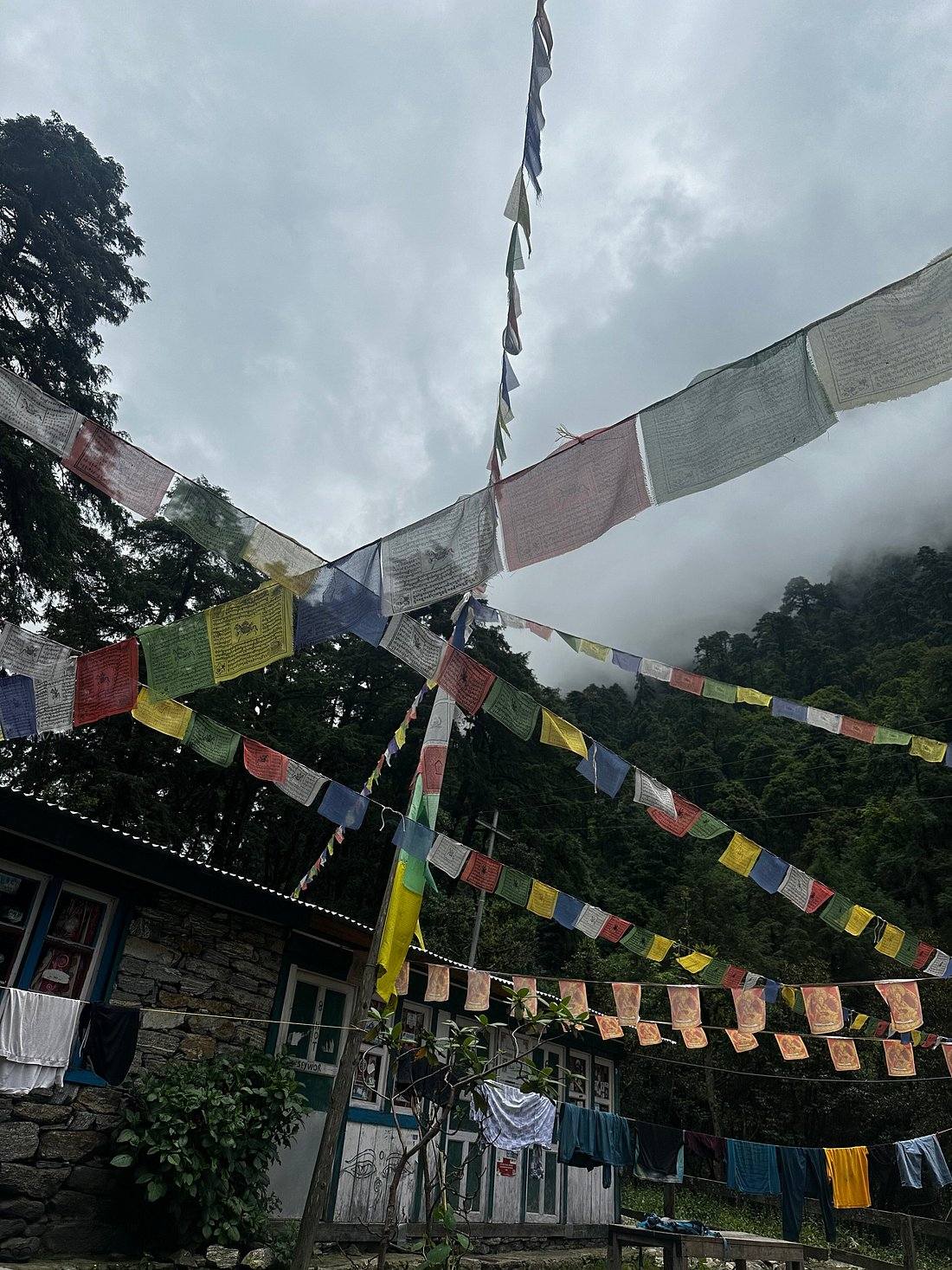
Buddhist flags all over the houses
Most Popular Treks in Langtang Region
We, Himalayan Masters, believe in customer satisfaction, safety, and sustainable tourism. For this sole reason, we offer what trekkers need and the type of trek they want. That’s why we help them customize treks in Langtang based on their needs.
Whether it’s trekking past traditional Tamang villages, crossing one of the highest mountain passes in Nepal, or walking along panoramic views, Himalayan Masters offers all.
Here is a different trek in the Langtang region that we can customize as you want:
Trek
Days
Highest Altitude
Approx. Distance
Trek Starting/Ending Point
Short Langtang Valley Trek
5 Days
4,773 m Kyanjin Ri
60-65 km round trip
Syabrubesi
Langtang Trek
6 Days
4,773 m Kyanjin Ri (or up to 4,984 m for Tserko Ri)
65-70 km round trip
Syabrubesi
Langtang Valley Trek
8 Days
4,983 m (Tserko Ri)
75-80 km round trip
Syabrubesi
Gosaikunda Lake Trek
6 Days
4,610 m (Lauribina/Lauribinayak Pass)
77 km
Syabrubesi
Tamang Heritage Trek
12 Days
3,165 m (Nagthali Hill)
60-70 km
Syabrubesi
Langtang Valley with Ganja La Pass Trek
14 Days
5,130 m (Ganja La Pass)
100-112 km
Syabrubesi/Melamchi Bazaar
Langtang Helambu Trek
6 Days
3,690 m (Thadepati)
70 km
Sundarijal/Melamchi Bazaar
Langtang Valley via Yala Peak Climbing
11 Days
5,732 m (Yala Peak)
105 km
Syabrubesi
Emergency and Evacuation
This is self-explanatory, as everybody needs to be prepared during a medical emergency or other situations en route during the trek.
In case of a medical emergency, Himalayan Masters provides support as soon as possible. All our licensed guides are equipped with a first-aid kit and well-trained to provide quick, basic medical support.
In case of any medical conditions or injury, our expert guides will analyze the situation and take immediate action. If it is minor, the guide will patch you up and continue the trek.
However, if the condition is critical or needs immediate rescue, we are available 24/7 and provide immediate helicopter rescue, based on the situation.
Moreover, trekkers are advised to get comprehensive travel insurance that covers all their medical and helicopter evacuation expenses. Make sure to go through all the terms and conditions policies.
Packing List for Langtang Valley Trek
Appropriate clothing and other items are essential for a comfortable and safe trek in the Langtang Valley. Trekkers should wear warm, waterproof, and windproof layers and appropriate footwear.
Walking poles and a good-quality backpack should also be taken. Other items include a headlight, a water flask/bottle, sunblock, personal medication, and essential documents that may be required.
While packing gear for the Langtang Valley Trek, one must carry as little as possible while ensuring all the needed items are packed. More importantly, packing according to the season you are traveling is important.
Some trekking gear, such as trekking poles, crampons, a down jacket, and a sleeping bag, is provided by Himalayan Masters for the trek. If you need assistance with buying or renting gear, we will be happy to help.
Langtang Valley After the 2015 Earthquake
The earthquake that struck Nepal in 2015 had a devastating effect on Langtang Village. Langtang village was almost completely destroyed by it.
A huge glacier burst caused the avalanche breakdown in the Langtang Village. Almost 300 people died during the earthquake in Langtang.
However, the people of Langtang Valley stayed strong after the disaster. They rebuilt the settlement stronger and better, just a little above where the village stood.
Today, there are more than 35 teahouses and lodges along the trail. They provide decent accommodation to spend the night and a hearty meal for energy. These teahouses are rebuilt with modern facilities but with a perfect balance of authentic village and trekking comfort. Langtang Valley after the 2015 earthquake bounced back strongly and better.
All these have aided in generating the economy and further improved the living and lifestyle of the local people of Langtang Valley.
Do I Need Special Training to Trek Langtang Valley?
No special training is needed for the Langtang Valley Trek. However, it would still be wise to get some training and complete some paperwork before the trek.
Furthermore, doing some cardiovascular endurance exercises and core muscle-building exercises to help you adjust to breathing at high altitudes is recommended.
Additionally, engage in leg exercises like lunges and squats, and practice short hikes with weight. Doing at least one long walk carrying a day-pack, ideally on uneven terrain, is advised. This also helps in breaking in your hiking boots, so that you do not get blisters during the Langtang Valley trek 8 days.
Understanding cloud patterns and learning how to orient a map and compass is an important skill that you can learn to navigate through the remote terrain of Langtang Valley.
Why Spring and Autumn are Perfect for Langtang Valley Trekking
No doubt the best time to trek Langtang Valley is spring (March to May) and autumn (September to November). During these times, the climate is warm, the weather is stable, and the skies are clear, offering some of the best panoramic mountain views.
However, although the days are warm, the mornings and nights are cold, especially at higher elevations. Additionally, the trails are in perfect condition, dry and lush, for trekking.
Autumn colors and snow-capped mountains creating a striking contrast in Langtang Valley
Mostly, the forests in the lower Langtang region of Nepal are lively. Although rare, you might get a glimpse of a red panda in the jungle around Bamboo and Rimche. The fragrance from the rhododendron forest lures every trekker.
For many, the crowd during these peak seasons could be a downside. Nonetheless, it is a great time to get social with other trekkers en route. You get to meet new people from different countries and learn about their cultures.
In contrast, monsoon (June to August) is the wettest period, characterised by occasional flooding and a higher risk of landslides. There are high chances of insect bites (mosquitoes) and leech bites. So, we don’t recommend Langtang Valley trekking during the monsoon, but it is still achievable.
Likewise, Langtang trek in winter (December to February) is also not recommended. During these months, the weather remains very cold, with occasional snowfall, making navigation difficult.
That said, trekking in off-peak seasons is possible if you’re well-equipped, flexible, and prepared for limited services.
Peak Climbing in Langtang region Nepal
What does the Langtang Valley Weather Feel Like?
The weather in Langtang Valley changes depending on altitude, season, and even time of day. While daytime conditions are warm, pleasant, and comfortable, the mornings and nights are often cold.
At lower elevations, in villages like Syabrubesi and Lama Hotel, the Langtang Valley weather remains mild throughout the year. However, in higher regions such as Kyanjin Village and Kyanjin Gompa, the weather can get cold, especially at night.
Daytime temperature during spring and autumn generally feels like 12 to 22°C, but the nights can fall as low as -5 to -10°C, especially during nights in higher villages around Langtang Village and Kyanjin Gompa.
Weather conditions in the mountains can change quickly. Even a clear morning can change to a cold, windy afternoon in open valley sections and near glaciers. Cloud cover often increases after midday, so learn to read weather and cloud patterns. Or, you can leave it to your guide.
Clouds obstructing the view over rugged ridgelines
During winter, temperatures at night in higher villages drop well below -15°C. Moreover, monsoon months are featured with humidity, making the air feel heavier, and the temperature in lower elevations may feel warmer, while higher areas still remain cool but damp.
Nevertheless, proper layering, warm inner layers, windproof outerwear, and thermal clothing for the evening can make the Langtang Trek Nepal comfortable and memorable.
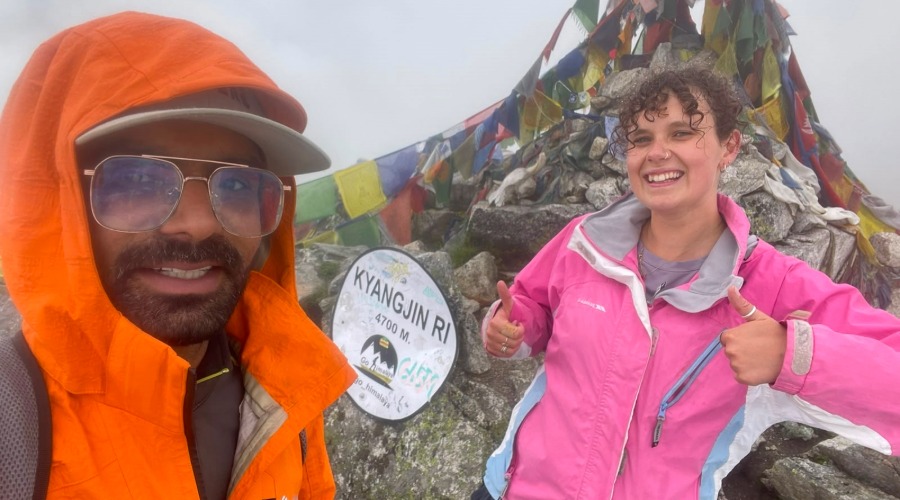
Real trekking moments: smiles, rain jackets, and shared experiences that define the adventure
Do I need a TIMS card for the Langtang Valley Trekking?
No, you don’t need a Trekkers’ Information Management System (TIMS) card to trek Langtang. Previously, a TIMS card was mandatory for Langtang Valley trekking. However, as of 2025, you don’t need it.
Moreover, obtaining a Langtang National Park entry permit is compulsory, imposed by the Nepalese government. Trekkers can obtain Langtang permits from the Nepal Tourism Board at Pradarshani Marg, Bhrikurimandap, Kathmandu. Or you can issue it in Dhunche or Ghodatabela, or, better yet, leave it to the experts. You can ask your trek organizer to arrange all Langtang permits.
Why do I need these permits?
These permits aren’t just pieces of paper; they ensure your safety, too.
You need to register these permits at every checkpoint, so that in case you get lost or something, evacuation operations can be conducted quickly. The amount collected from the permit is used for infrastructure development and maintenance of the national park.
Make sure you carry a copy of your permit, and your guide will ensure all paperwork is in place.
Food & Accommodation During Trek
During the Langtang Valley Trek, accommodation and food facilities range from teahouses to camping. Teahouse accommodation offers basic bedding with locally prepared meals, while camping is more private and offers freedom.
These teahouses are usually shared basis, providing blankets, simple bathrooms, and cozy, comfortable bedding. For private accommodation, you need to book in advance while it is still available.
Meals are typically freshly prepared by teahouse owners or a local chef. The menu includes Nepalese staples like Dal Bhat, chowmein, soups, toast, omelette, noodles, and macaroni. You might even find some western-style items like pizza, spaghetti, pasta, and pancakes, depending on the lodge.
If you have any dietary constraints, like being lactose intolerant or vegan, you should inform your guide. Then they will request the teahouse owner to prepare it for you.
Deep-fried Mo: Mo with sauce served in one of the teahouses of the Langtang region
How Reliable Are Electricity and Water Facilities in the Langtang Trekking
Most villages in Langtang Valley are powered by the national electricity line. So, trekkers don’t have to worry about electricity and battery charging. However, carrying a power bank or extra batteries is advised, as there might be an electricity outage or limited power.
Moreover, in the villages around Lama Hotel, Bamboo and Pairo, teahouses rely on solar power. In some places, they may charge extra or may only be available for certain hours.
As for fresh drinking water, it is readily available from springs and streams. However, it must be treated or purified before consumption to eliminate waterborne diseases. Himalayan Masters provides water purification tablets for the trek, a complimentary service.
Bottled water is also available en route, but it might be expensive, and spending $10-$20 daily for water isn’t budget-friendly.
How feasible are Wi-Fi and mobile networks in the Langtang Trek itinerary?
You’ll get a good mobile network in the lower villages of the Langtang region. However, as you go higher, network connections become a little difficult or nonexistent. Some teahouses may offer Wi-Fi to stay connected with friends and family, but the speed may be slow, or the connection may be unstable.
So, it would be wise to download offline maps or carry a physical map of Langtang Valley. Additionally, you can get a Nepali SIM card (NTC or Ncell) or have a roaming data plan. In addition to that, inform your contacts that connectivity will be limited at times.
Roads on the Trek & How to Avoid Them
Trekkers can see motorable roads in the lower section of Langtang, particularly up to Sherpagaon. Trekkers can drive a little before Sherpagaon, and then start trekking, for about an hour, up to the village to spend the night.
However, the Langtang trek itinerary offered by Himalayan Masters includes driving to Syabrubesi and starting the trek. Our guide is well-known with local, inner routes, so you can ask them to take you through a less-traveled, quiet route.
Also, the routes might be blocked or damaged due to rain and landslides. Keep updated on Langtang Valley road conditions.
Alternative Routes of Langtang Valley Trek
Apart from the traditional Langtang Valley Trek, Langtang Valley hosts several other adventurous alternatives.
The Gosaikunda Lake Trek takes trekkers to one of the famous pilgrimage destinations for Hindus and Buddhists, the Gosaikunda Lake. This takes trekkers through the rugged terrain, crossing Lauribina Pass, offering a serene spiritual experience.
If you want to connect the Langtang Valley trek with Gosaikunda Lake, you can do so from Domen via Thulo Syabru and Sing Gompa. Then, you can return the same route, tracing back to Syabrubesi, or cross Lauribina Pass to meet Dhunche.
Likewise, the region offers another traditional trekking route, the Helambu Trek. The trek navigates around Helambu Valley, offering a chance to explore Hyolmo and Yolmo villages, their culture, and stunning panoramas.
Himalayan Masters Team on the Langtang Helambu Trek
Or, you can cross Ganja La from Kyanjin Gompa to reach Tarke Ghyang, connecting Langtang Valley Trekking with the Langtang Helambu Trek. However, you should know that this route requires camping for 2-3 days, and is only recommended for experienced trekkers.
Similarly, another alternative trek route is the trek to Tamang Heritage, which takes you to the picturesque Tamang village. You can explore the cultural village of Thuman, which is known for its rich Tamang culture. Further, connecting the trek with the standard Langtang Trek at Khanjim. This trek is perfect for those looking for cultural immersion along with natural diversity.
Further, if you want to elevate the adventure, you can extend the trek up to the top of Yala Peak. Yala Peak is an easy trekking peak that you can include in your standard Langtang treks.
Langtang Village Nepal
What does a day on the Langtang Valley Trek look like?
Our typical Himalayan Langtang Valley Trek Itinerary includes five days of trekking, two days in a hotel, and one rest day at Kyanjin Gompa.
Each day is a new challenge and an exciting experience. Our trip begins with the drive from Kathmandu to Syabrubesi. On the 2nd day only, our trek starts.
Trekkers enjoying the scenery
Generally, our trek day starts with a beautiful morning view of the mountains from around 6 a.m. to 7 a.m. Then, you will have a delicious breakfast, which can be ordered the previous evening.
After having breakfast, at around 8 o’clock, you will get ready and set out for the next destination point, where you will spend the night.
The guide will suggest one of the teahouses for lunch from 11 a.m. to 12 p.m. You can always choose any teahouse on the way whenever you feel like.
You can also select food from the menu, but we suggest Dal Bhat. Usually, it takes about an hour for the food to be prepared. Meanwhile, you can either catch your breath or stroll around the teahouse.
Finally, after a rejuvenating lunch, you will reach your destination at around 4 p.m. There, you can order your dinner and rest again or visit any tourist sites nearby the village.
Lastly, you can have your dinner at around 7 pm. After a belly-full dinner, your guide will brief you about the next day’s trek and check/ask how you’re feeling. You can share your trekking experience with other trekkers and go to sleep around 10 pm.
Is Travel Insurance for Langtang Valley Trek Mandatory?
It’s not mandatory to have travel insurance for the Langtang Valley Trek. However, we strongly suggest you get one.
When getting insurance, make sure it covers trip cancellations, medical complications or emergencies, and evacuations. Check if your insurance policy covers high-altitude trekking (up to 5,000 meters) and helicopter evacuation.
So, read the insurance policy thoroughly and buy from a trusted agency only.
Additional Expenses on Langtang Valley Trek Nepal
These can include extra snacks and beverages, tips, and shopping for and during the trek. Other than this, it can consist of services like guided city or national park tours and cultural activities.
We recommend one budget for tipping guides and porters in Nepal, since it is expected. Tipping at least 10% of your trek amount is suggested.
Other possible expenses include:
Hot water and a hot water shower.
Using Wi-Fi/internet.
Charging electronics (prices increase as you trek higher and more remote).
Buying trekking gear, in case you forget to buy it, or it gets damaged.
Offerings at temples and monasteries.
Trekkers usually spend around $15-20 each day during the trek. It can cost even more. Knowing these expenses helps trekkers plan accordingly and trek without any surprise expenditure.
Trekkers posing with the Nepali flag against a stunning Himalayan backdrop
ATMs on Langtang Valley Trek
The Langtang region has very few ATM facilities, and the best chance of using an ATM is at Syabrubesi, the beginning point of the trek. After Syabrubesi, the only banking service or ATM available is Kyanjin Gompa. However, they can be non-functional sometimes.
It is suggested that trekkers carry enough cash with them before the trek, as there may be no facilities such as an ATM. Teahouses and most shops do not accept credit or debit cards.
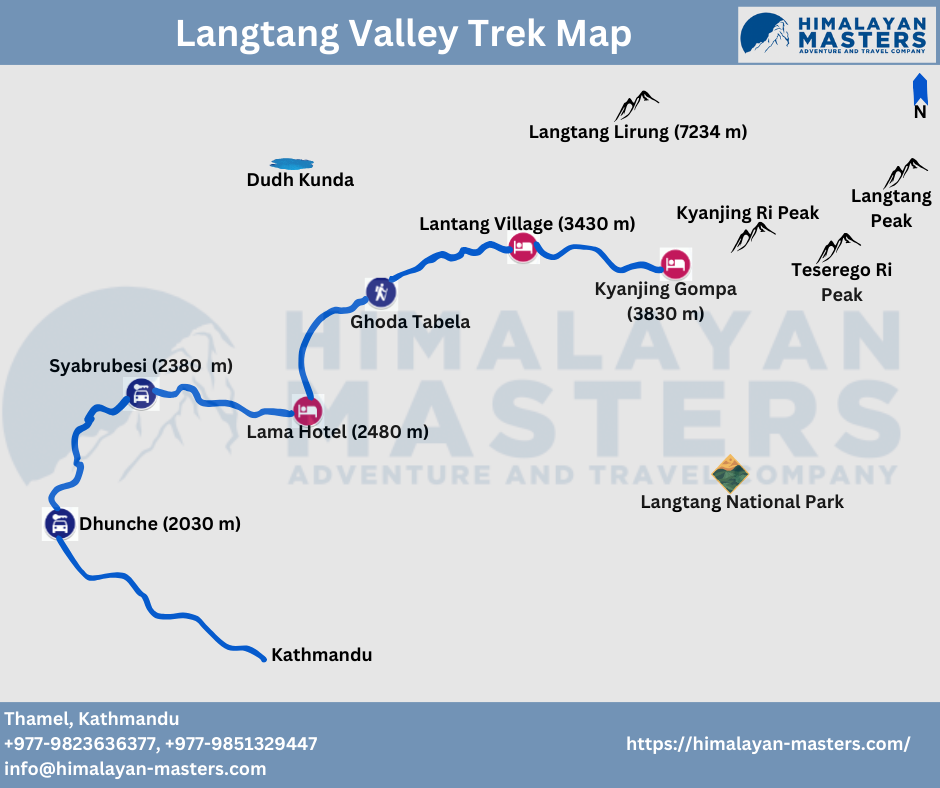
Route Map
FAQs
Can I go camping in Langtang Valley trek?
Yes, camping during the Langtang Valley Trek is possible; however, the Langtang trail has comfortable hotels and teahouses, so you won’t need camping, and also camping is comparatively expensive.
What foods are available in Langtang trek?
You can eat local foods like Dal Bhat, Mo: Mo. Thukpa, potato items, egg, porridge, Tibetan bread with honey or jam, chocolate roll, chowmein, and some western food too in the Langtang Trek.
Is there any ATM on the Langtang Valley trekking route?
Once you leave Kathmandu, the only places where ATMs are available are Syabrubesi and Kyanjin Gompa.
What animals are found in Langtang National Park?
There are over 40 species of mammals, including red panda, snow leopard, Himalayan Tahr, black bear, musk deer, etc., over 250 bird species, 4 species of reptiles, and 40 species of fish in Langtang National Park.
What does Langtang Village look like today?
After being affected by the 2015 earthquake, Langtang Village looks a little more modern and stronger today, with new houses, teahouses, schools, and memorials constructed while preserving its traditional essence.
Have they rebuilt Langtang Valley?
Yes, the reconstruction of Langtang Valley is almost complete now, with many old houses having been left, and new houses have been built along the villages.
Can you visit Langtang Valley trekking?
Yes, anyone with decent physical health and determination can visit Langtang Valley.
What is the religion of the Langtang village?
The Langtang region is dominantly inhabited by the Tamang people and some settlements of Gurung, Rai, Limbu, and Sherpa in this area, who originated from Tibet and follow Buddhism.
How high is Langtang Trek Nepal?
The highest point of the Langtang Valley trek is 3,830 meters (12,697 ft) at Kyanging Gompa, but you can hike to other viewpoints that can go up to 4,983 meters at Tserko Ri and 4,773 meters at Kyanjin Ri.
Do Nepalese need a permit for trekking to Langtang.
Yes, Nepalese need to pay a Langtang National Park permit fee of NRP 100 to enter the park.
When is best time to trek Langtang?
Autumn (September to November) and spring (March to May) are the best times to trek Langtang; however, it is quite low-altitude and close to Kathmandu, so off-season trekking is also possible.
How much does the Langtang trek cost for Indians?
Langtang Trek can cost anywhere between INR 20,000 and 40,000 per person for Indian nationals, depending on the itinerary and services they take.
Is the Langtang trek worth it?
Yes, trekking to Langtang Valley is worth every bit due to its easy accessibility, affordability, and its Himalayan experiences, all within a short interval.
Can you trek to Langtang Valley without a guide?
No, following a recent update from the Nepal government, hiring a licensed guide for all high-mountain treks, including the Langtang Trek, is now compulsory.
Is travel insurance for Langtang trek compulsory?
While having travel insurance for the Langtang trek packages is not compulsory, we recommend that you have one that covers high-altitude rescues, some medical bills, and trip cancellations.
Is Langtang Valley trek safe for solo trekkers?
Yes, Langtang Valley Trek is among the safest travel destinations for solo trekkers.
How difficult is the Langtang Valley trek?
Langtang today is graded as easy to moderately difficult, making it suitable for beginners with a reasonable level of fitness.
What are the festivals celebrated in Langtang region?
While Lhosar is the major festival celebrated in the Langtang region, they also celebrate Dashain, Tihar, Janai Purnima, Bussha Jayanti, and Dumji, as per the lunar calendar.
How to extend the trip in Nepal?
After the Langtang Trek, to extend your trip in Nepal, you can contact us, and we will help you arrange it.
How to charge your phones in Langtang Valley?
Every teahouses in Langtang Valley provides phone and other device charging facilities in both the dining hall and the rooms; however, there might be a small additional cost, so inquire in advance.
Is there internet at Langtang Trek?
There is Wi-Fi in all teahouses along the way in Langtang, but the connection is limited and can be disrupted by bad weather, so buying a local SIM and a data package is recommended.
Can I trek Langtang Valley with my kids?
Yes, you can trek Langtang Valley with your kids, and we suggest a shorter overnight stay and extending the trek itinerary by a few more days.
How far is Langtang from Kathmandu?
Langtang is 153 km (90 miles) from Kathmandu; the drive from Kathmandu to Syabrubesi is 122 km (75.8 miles), and the trek from Syabrubesi to Kyanjin Gompa is 31 km (19.2 miles).
Where is Langtang National Park located?
Langang National Park is located in the Rasuwa and Nuwakot districts of Bagmati Province, about 50-60 km north of Kathmandu, Nepal, stretching up to the border with Tibet (China).
Can you see Everest from Langtang?
No, you cannot see Mount Everest from Langtang Valley because it is too far and is blocked by other mountain ranges between Everest and Langtang.
How to train for Langtang Valley Trekking?
Engage in regular walking, stair climbing, short hikes, swimming, and cycling, which build your strength and stamina for Langtang Valley trekking.
Reviews
Rosie-Jane W
England
August 6, 2026
Verified Purchase
Langtang Valley Trek- July 2026
Guided By:
Bashu Dhakal
Me and my friend had a wonderful week with the Himalayan masters on the Langtang Valley trek! We had 5 days trekking in the amazing landscape and safe travel to and from via Jeep hire. Despite it being monsoons season
...
Me and my friend had a wonderful week with the Himalayan masters on the Langtang Valley trek! We had 5 days trekking in the amazing landscape and safe travel to and from via Jeep hire. Despite it being monsoons season we still managed to see some glaciers and Himalayan views at the top of Kyangjin Ri (4700m)! Bashu our guide was amazing, and helped us when my friend got altitude sickness. The experience was an amazing Nepal trip with food from lovely hostels, meeting the people who live in the villages along the way, and seeing the Himalayas. Thank you!
L
lukas m
Germany
Verified Purchase
An unforgettable journey
We just finished the Langtang Valley trek with Himalayan Masters, and we couldn’t have asked for a better guide than Hari. From day one, he felt more like a friend than a guide. He has an incredible way of sharing
...
We just finished the Langtang Valley trek with Himalayan Masters, and we couldn’t have asked for a better guide than Hari. From day one, he felt more like a friend than a guide. He has an incredible way of sharing his knowledge about the mountains, the local culture, and the best “Dal Bhat” spots while always keeping a close eye on our safety and well-being.
If you are looking for a guide who is knowledgeable, supportive, and simply a great person to be around, ask for Hari!
T
Thia
Norway
Verified Purchase
A cultural and mesmerizing experience
Our hike in the Langtang Valley was not only beautiful, but mesmerizing. Our guide – Raj Acharya – guided us with his steady and peaceful personality not only through some of the most beautiful landscape you’ll ever see, but also
...
Our hike in the Langtang Valley was not only beautiful, but mesmerizing. Our guide – Raj Acharya – guided us with his steady and peaceful personality not only through some of the most beautiful landscape you’ll ever see, but also through Nepals comforting food, its language, animals and people.
Can highly recommend Raj as a guide from Himalayan Masters.
J
James
Austraila R
Verified Purchase
An amazing introduction to Nepal
My wife and I recently completed a 10-day trek in the Langtang Valley with Himalayan Masters, and the entire experience from start to finish was exceptional. From the very beginning, the planning process with Sandip was smooth and professional. He
...
My wife and I recently completed a 10-day trek in the Langtang Valley with Himalayan Masters, and the entire experience from start to finish was exceptional.
From the very beginning, the planning process with Sandip was smooth and professional. He was incredibly responsive, answered all our questions, and helped tailor the trip so everything ran seamlessly before we even arrived in Nepal.
Once in Kathmandu, Dipak took the time to meet with us and provide a thorough briefing. This gave us a lot of confidence heading into the trek and showed how organised and experienced the team is.
Out on the trail, our guide Santosh was simply outstanding. His attention to detail, care for our safety and comfort, and constant check-ins throughout the trek made a huge difference. He created such a positive atmosphere on the trail and made us feel like we were trekking as a family rather than just clients on a trip. His knowledge of the region and his genuine enthusiasm for sharing it made the entire experience even more memorable.
Langtang Valley itself is breathtaking, but having such a professional and friendly team supporting us made the journey truly special.
For my wife and I, this trek was an incredible introduction to trekking in Nepal, and we couldn’t have asked for a better company to guide us.
If you’re considering trekking in Nepal, we highly recommend Himalayan Masters. We wouldn’t hesitate to trek with them again.
Chris C
Vietnam
Verified Purchase
Langtang Valley 2025
Had a great experience trekking through Langtang Valley with my guide, Nabu and porter, Narhine. Both of them took great care in ensuring my needs were met 24/7. They had great knowledge of the route, terrain and teahouses, and adjusted
...
Had a great experience trekking through Langtang Valley with my guide, Nabu and porter, Narhine.
Both of them took great care in ensuring my needs were met 24/7. They had great knowledge of the route, terrain and teahouses, and adjusted the pace of the tour based on my requests and fitness level.
To add on, Sandip, the founder of the company, gave me a full briefing in the company’s office of what to expect from the tour to ensure that I was mentally prepared prior to the start.
Would be happy to do a tour with Himalayan Masters again on my next trekking trip in Nepal.
Based on your preferences, location, timeframe, and budget, our team can design your dream trek based on our extensive knowledge and experience of the Himalayas. Get in touch with us for detailed information and assistance planning your dream trek. With our 97% success rate on trekking and climbing trips in 2025 and 2026 spring season, we will answer any questions you may have and guide you for an unforgettable experience.