




Birendra Lake: One of the Best Side Trips on Manaslu Trek
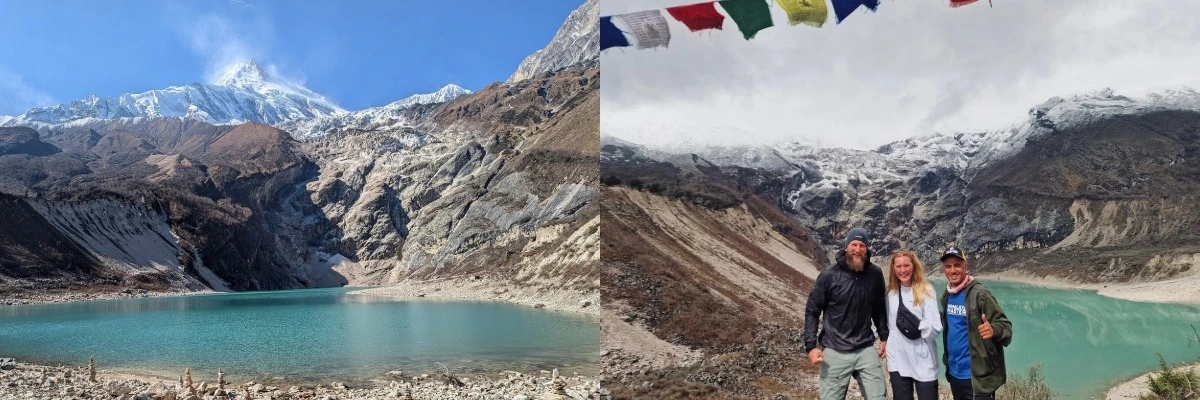
Birendra Lake, situated at an altitude of approximately 11,955 feet (3,644 m) above sea level, sits right above the village of Samagaun. It is a turquoise glacial lake sitting beneath Manaslu Glacier, under the shoulders of Mount Manaslu. For most trekkers on the Manaslu Circuit Trek, this is one of the most popular side trips and a memorable stop on the entire journey.
The lake is even named “mirror lake” for its calm waters and vivid reflections of Mount Manaslu and its neighboring peaks among trekkers and photographers. This Lake also holds cultural significance for local communities, who regard the surrounding landscape as spiritually important.
After days of trekking through various suspension bridges, river gorges, and steep climbs, Birendra Lake offers a quiet sense of stillness that is something rare on this route.
This guide covers everything you need to know about Birendra Lake, including its location, history, formation, geological features, how to reach it, the best time to visit, and its significance in the Manaslu region.
Quick Facts About Birendra Lake
Before diving into the full details, here’s a quick fact table about Birendra Lake.
| Detail | Info |
| Locally known as | Birendra Taal, Yamcho Lake |
| Elevation | 3,644 meters (11,955 feet) |
| Located at | Gorkha District, Gandaki Province, Nepal |
| Coordinates | 28°35′45″N 84°37′42″E |
| Nearest Village on Route | Samagaun |
| Lake type | Glacial (proglacial) Lake |
| Fed by | Manaslu Glacier |
| Conservation Area | Manaslu Conservation Area |
The Story Behind the Name of Birendra Taal
For several decades, the residents of Samagaun knew the sacred Lake above their village simply as Yamcho (यमच्छो), a Tibetan word meaning “upper lake”. This name is now uncommon yet still used among the Nubri Community.
The name was later changed to Birendra Lake after the visit of the late King Birendra Bir Bikram Shah in 1977 AD. Seeing how much the king had come to love the Lake, locals renamed it in his honor as a gesture of affection.
Since then, almost anyone coming to Samagaun knows only the name Birendra Lake, not ‘Yamcho’.
Where is Birendra Lake Located?
Birendra Lake sits within the Manaslu Conservation Area. It lies in Chumnubri Rural Municipality, in Gorkha District, Gandaki Province. Its exact coordinates are 28°35′45″N 84°37′42″E.
It is tucked right above Samagaun, the largest settlement on the upper Manaslu Circuit, which is also the main acclimatization stop before Larke La Pass.

The Lake is only 2–3 km (1.24–1.86 miles) from the village. It is usually visited as a side trip rather than a separate destination. It takes about 2-3 hours round-trip to visit Birendra Lake.
With Himalayan Masters, you’ll reach Birendra Lake on the 7th day of our 13-day Manaslu Circuit Trek itinerary.
How High Is Birendra Lake?
Birendra Lake sits at approximately 3,644 meters (11,955 ft) above sea level, just north of Samagaun village.
You may find slightly different elevations for Birendra Lake across various sources. This variation is not unusual in mountainous regions, where elevations can differ among maps, GPS readings, and published sources.

The elevation of 3,644 m shown on the information board at the lake provides a useful on-site reference and is the figure used here.
Since Samagaun itself sits at around 3,530 meters, the hike up to the Lake gains only about 114 meters. Although it’s a small gain, altitude awareness still matters at this height, even though the walk itself is easy.
Formation and Geology of Birendra Glacial Lake
Birendra Lake was formed when glacial meltwater from the Manaslu Glacier pooled behind a moraine dam. As the glacier moves and gradually melts, it carries rocks, gravel, sand, and other debris. When the glacier retreats, these materials are left behind and can build up into a ridge known as a moraine.
At Birendra Lake, this moraine acts as a natural dam, holding back meltwater and allowing the Lake to form and expand. Continued glacial retreat has also changed the landscape between the Lake and the glacier. It has left exposed bedrock and steep slopes around the upper part of the Lake.
This is what makes Birendra Lake a proglacial lake: a lake formed in a glacial landscape by meltwater from a retreating glacier. Although the Manaslu Glacier once extended much closer to the Lake, it has now retreated and is now separated from it by the surrounding terrain.

According to Poudel et al. (2025), Birendra Lake has expanded considerably over the past few decades. They found that the Lake has grown from approximately 0.09 km² in 1988 to 0.22 km² in 2024.
This expansion is important from an environmental hazard perspective as well. The larger the glacial lake, the more water is behind the natural moraine dam. Disturbances such as ice/snow avalanches can be a threat to the dam. Large masses of material can cause waves when entering the Lake that can even overtop or erode the moraine. This may cause Glacial Lake Outburst Floods (GLOF).
The 2024 Glacial Lake Outburst Flood
On 21st April, 2024, the water level in Birendra Lake suddenly increased causing a sudden surge in the outlet of the lake and into the Budhi Gandaki River below. The sudden release caused the river’s water level to rise sharply, increasing by 69 cm at the Ghap station within just 20 minutes.
The flood also damaged a local bridge along the Manaslu Circuit trekking route. Despite the sudden surge and the damage it caused, no human casualties were reported.
Some avalanche experts explained that the flood was caused by the sliding of accumulated natural debris and ice from the slopes, as Manaslu is prone to avalanches. Climate experts linked this disaster to global climate change. They also noted that the flood probably did not affect the Lake’s dam, as the peak discharge of meltwater has always been seasonal.
Cultural and Spiritual Significance of Birendra Lake
The Lake and the surrounding mountains are sacred to the locals of the Manaslu Region who practice Tibetan Buddhism.
Each year, a puja and prayer ceremony is held at the Lake during the Nepali month of Mangsir (mid-November to mid-December). The Lake itself is considered a center of spiritual peace for the local Buddhist community.
Small prayer flags and stone cairns are frequently placed on the shores, as a mark of passing pilgrims and trekkers. For many, these cairns are more than simple piles of stones. They are a way to mark the journey, express respect for the mountains, and leave behind a small symbol of their presence.
Piling small stones near the water has also become a popular tradition among visitors, adding to the area’s peaceful and spiritual atmosphere.

The Lake draws photographers looking to capture its beauty. It also attracts travelers seeking a peaceful place to experience the area’s cultural and spiritual character.
When you do visit Birendra Lake, treat the place just as the locals do. Keep noise to a minimum and avoid disturbing the surroundings, as it’s a place of spiritual significance for many locals.
The surrounding landscape is also deeply connected to Tibetan Buddhist culture. Monasteries and other important sites can be found throughout the Manaslu region, including Pungyen Gompa above Samagaun.
What Permits are Needed to Visit Birendra Lake?
Since Birendra Lake lies within the restricted Manaslu region of Nepal, trekkers need the same permits required for the Manaslu Circuit Trek up to Samagaun. This includes the Manaslu Restricted Area Permit (RAP) and the Manaslu Conservation Area Permit (MCAP).
Both permits must be arranged through a registered trekking agency in Kathmandu before you start your trek. With Himalayan Masters, your permits are pre-arranged, and you don’t need to make any hassle for it.
Planning these permits in advance can make the process smoother and help you avoid delays before heading off.
As mentioned earlier, since the Manaslu region is a restricted area, solo trekking without a licensed guide isn’t permitted, and the permits required must be arranged in Kathmandu before setting out.
For a complete overview, our Manaslu permits guide explains the application process, permit costs, required documents, and where to apply.
How to Get to Birendra Lake Manaslu: Routes from Kathmandu
If your goal is specifically to reach Birendra Lake rather than to complete the entire Manaslu circuit, the route still goes through the villages of the restricted Manaslu region regardless of the direction you’ll start from.
Kathmandu to the trailhead:
Normally, trekkers drive from Kathmandu to Machha Khola via Arughat in Gorkha District. The journey takes roughly 7–8 hours, which depends mostly on road conditions.
Note:
The Rasuwa flood in August 2026 did not directly affect the Manaslu Circuit Trek and its trail. However, some road sections toward Manaslu region were affected and access to Machha Khola may need an alternative route including Benighat-Arughat route. Check the latest road conditions with your trekking agency or local authorities before you travel.
Machha Khola to Samagaun:
From Machha Khola, the only reliable means of transportation is your legs. Trekking from Machha Khola to Samagaun takes around 6–7 days and covers about 82.5 kilometers (51.26 miles). The route passes through Jagat, Deng, Namrung, and Shyala.
Each day generally involves 7-8 hours of walking along forested trails, across suspension bridges, and through increasingly high-altitude terrain as you gain elevation.
Samagaun to Birendra Lake:
This short final section usually takes 1 to 1.5 hours of trekking. From the center of Samagaun, a signposted trail branches off north towards the glacier lake.

You’ll likely gain about 114 meters of altitude on the 2-3 kms (1.24-1.86 miles) stretch towards the Lake.
Our detailed Manaslu Circuit Trek map guide provides a visual representation of the connections between all these locations.
When is the Best Time to Visit Birendra Lake?
The best time to visit Birendra Lake is in Spring (March to May) or Autumn (September to November). Both seasons offer stable weather, clear mountain views, and comfortable daytime temperatures. These conditions make the trek more enjoyable, both around the Lake and throughout the multi-day journey to reach it.
The route passes through blooming rhododendron forests further down the trail in spring. In autumn, the clear skies create perfect conditions for photographing Manaslu reflected in the water.
Winter and monsoon seasons are also possible for the trek. However, winter brings greater difficulty due to snow-covered trails.
During the monsoon, the trails can become slippery and prone to landslides. For a detailed seasonal guide, check out our guide to the best time for the Manaslu Circuit Trek.
Essentials for hiking to Birendra Lake
A little preparation goes a long way at high altitude. Here’s what you need for a comfortable and enjoyable visit to the glacial Lake.
Gearing up
Although the hike from Samagaun to Birendra Lake is relatively short, the trail sits at an altitude of over 3,500 meters. For this reason, it is important to gear up for high altitudes instead of distance.
Take a warm layer, windproof clothing, sturdy trekking boots, and a small daypack with some snacks and water.
Sun protection is especially important at this altitude, as the sunlight can feel strong and the reflection from the ice and water can be intense. Sunscreen and a hat are recommended, while sunglasses are optional depending on the season.
However, sunglasses are a must during the winter season due to the bright glare from snow and ice.

It is also a good idea to bring your camera or cell phone with sufficient storage and battery. Birendra Lake is one of the most picturesque beauty spots on the Manaslu trek and is ideal for photos of the Lake, mountains, and glaciers.
If you’re planning to do the whole trek, our full Manaslu packing list offers a more comprehensive list of the equipment and clothing you are likely to require.
Pacing Yourself
This trek to Birendra Lake is usually part of an acclimatization day, and there is no urgency. Keep a steady, comfortable pace, take regular breaks as needed. Also, do not forget to give your body time to adjust to the altitude.
For those new to high-altitude trekking, the following article on the Manaslu Circuit Trek for beginners covers general preparations and acclimatization techniques.
Permits and Expenses
There is no separate entry fee or special permit required to visit Birendra Lake. It is usually visited as a side trip during the Manaslu Circuit Trek, Manaslu Base Camp, or Manaslu Tsum Valley trek.
The cost of visiting Birendra Lake is therefore generally included in your overall trekking expenses, such as permits, guide, transportation, accommodation, and meals. You do not need to pay an additional fee specifically for the Lake.
For a detailed breakdown of these expenses, please refer to our Manaslu Circuit Trek cost guide.
Nearby Attractions Around Samagaun and Birendra Lake
Birendra Lake isn’t the only option for the rest day in Samagaun. Two other side trips are commonly paired with the lake hike or chosen instead of it.
Manaslu Base Camp
Manaslu Base Camp (4,800 meters/15,748 feet) is one of the most rewarding and challenging side trips from Samagaun. From the village, there are a couple of ways to approach the route. You can follow the trail toward Birendra Lake first, making a stop at the glacial Lake before continuing higher toward base camp.
Alternatively, you can follow the trail directly towards Manaslu Base Camp and enjoy views of Birendra Lake from higher up along the route. Both options lead to the same destination and offer different perspectives of the surrounding mountain landscape.
The round trip from Samagaun to Manaslu Base Camp is about 19 kilometers (12 miles) and takes about 8 to 10 hours to walk. Total time varies according to your walking speed, weather, trail conditions, and time spent at Birendra Lake.
After the Lake, the trail is steep and rough, passing through rocky moraine and ascending in elevation. This makes the base camp hike a much tougher affair than visiting Birendra Lake on its own.
Pungyen Gompa
Pungyen Gompa is a different kind of experience that has a mix of the spiritual and cultural side of the Manaslu region along with spectacular mountain scenery. The sacred Buddhist monastery is located at an altitude of about 4,050 m (13,287 ft) and offers views of Manaslu and the surrounding glacial landscape.
Nearby, Pungyen Glacier complements to the dramatic scenery, with its ice-covered slopes and rugged surroundings highlighting the beauty of the high Himalayas. The area around the gompa is peaceful and open, making the short detour from Samagaun well worth the effort.
If taken as a specific side trip from Samagaun, the distance and walking time vary by person and are usually quoted at around 12 km (7.5 miles) round trip and 5-7 hours.
Note:
Pungyen Gompa is already included in Himalayan Masters’ 13-day Manaslu Circuit Trek itinerary. You’ll visit the gompa while trekking from Shyala to Samagaun.
Birendra Lake: A Pause Worth the Detour
Birendra Lake does not require an extra day or much effort. It is a short, easy walk to one of the most beautiful views along the entire route.
The hike is manageable, with a gentle climb, a peaceful lakeshore, and a great place to take a break before the more challenging sections of the trek.
Despite its small size, the Lake is an important part of the journey. It can be part of your acclimatization before crossing Larke La and holds deep spiritual significance for the Nubri community.
You can visit Birendra Lake on its own, continue toward Manaslu Base Camp, or combine the trip with a visit to Pungyen Gompa. Whatever you choose, take some time to enjoy the Lake instead of rushing back to Samagaun.
Still having doubts about the Birendra Lake trek or planning your Manaslu journey? Feel free to contact Himalayan Masters for more information and assistance.
FAQs
Where is Birendra Lake located?
How do I get to Birendra Lake?
How long is the hike from Samagaun to Birendra Lake?
What is the altitude of Birendra Lake?
Can I visit Birendra Lake without doing the full Manaslu Circuit Trek?
Do I need a permit just to see Birendra Lake?
Can I swim in Birendra Lake?
What is the best time to visit Birendra Lake?
Why is it called Birendra Lake?
Was Birendra Lake always called by that name?
Is the hike to Birendra Lake suitable for beginners and families?
Is there an entry fee for Birendra Lake?
Is Birendra Lake dangerous because of the 2024 flood?
How was Birendra Lake formed?
Can Birendra Lake be combined with other side trips from Samagaun?
Is there a spiritual or religious ceremony held at Birendra Lake?
Loading...
related post


Author

Jayanta Neupane is a travel content writer with a genuine passion for exploring, researching, and sharing travel experiences. He enjoys turning firsthand experiences and destination research into engaging, informative, and practical content. With an interest in adventure, trekking, and Nepal’s diverse landscapes and cultures, he focuses on creating authentic content that helps travelers better understand and experience their destinations.


Leave Your Comment