There are journeys in the Himalayas that feel like a privilege rather than a plan and the Gokyo Lake Trek with Renjo La Pass is one of them.
This 13-day trek takes you to the quieter side of the Everest area where scenery is expansive; walks are peaceful, and each move is nearly nature. Out of the busier route leading to Everest Base Camp, Gokyo Lakes Trek gives a glimpse of another view to the Himalayas which is much calm, open, and spectacularly breathtaking.
The Gokyo Trek route takes you over the enchanted valley of Gokyo Lakes which has crystal clear turquoise water reflecting the sky and the mountains around like a mirror. Further on, the path leads to the great Ngozumpa Glacier, a huge river of ice glacier.
The climax comes at the Renjo La Pass(5,360 m/ 17,585 ft) where the world simply opens all around. You will see the expansive view of Everest, Lhotse, Makalu, Cho Oyu, incomparable, a single view is spectacular.
The trek is made to suit the adventurers who do not like having destinations only. It is to people who appreciate space, silence, as scenery that remains long after the journey.
The Gokyo Valley has five sparkling, pristine green water lakes at a height of 4790 meters (15,715 ft). Placed right before the beautiful mountains and the semi-arid Himalayan landscape, these glacier lakes represent the most beautiful creation of Mother Nature. This trek is the most wholesome experience you will ever have.
After landing at Lukla, we follow the classic trail to the Namche Bazaar. Moving further north from Namche, we follow a recently opened trail via Dole to Machhermo and reach Gokyo on the 8th day.
Walking along the alpine grasslands of Everest, we will soon reach Gokyo. Exploring one of the highest settlements in the world and an incredible panorama from Gokyo Ri is a blessing. But the adventure is yet to come.
Returning a few more steps on the same route, we get to Namche. A short walk takes us to the Lukla airport on a classic Everest Base Camp Trek route. Finally, flying back to Kathmandu, an extraordinary journey to the Gokyo Lake Trek ends.
About Gokyo Lakes | Freshwater Lakes of Everest Region
Witness the spectacular views of all the lakes of Gokyo Valley, namelyGokyo Cho, Thonak Cho,Gyazumpa Cho,Tanjung Cho,Kyajumba Cho, andNgozumpa Cho. Skip the crowds of the Everest Base Camp while witnessing an even better and more exciting view within the solitude of nature.
Best Seasons: March to May and September to November
Accommodation: Hotel in Kathmandu, Teahouses during trek
Food Options: Veg, Vegan, and Non-veg
Meals: Breakfast, Lunch, and Dinner
Permits: Sagarmatha National Park Permit and Khumbu Pasang Lhamu Rural Municipality Permit
Transportation: Flight to and from Lukla and trekking
Per Day Walk: 6-8 hours
Communication: Local SIM( NTC and NCell) and limited Wi-Fi available (EverestLink and AirLink)
Electricity: Available with extra cost in higher regions
Water Source: Drinking water available at teahouses (boiled/filtered)
Acclimatization: A day in Namche Bazaar and Gokyo
Altitude Risk: Above 3,000 m without the appropriate acclimatization
Trail: Good and there are rocky trails, glaciers and ascending steeps
Solo Trekking: Can be done with guiding assistance
Guide and Porter: Hire for safety and comfort
Wildlife: Musk deer, Himalayan tahr, pheasants and rare sighting of snow leopard
Trek Highlights
Walk along the breathtaking Dudh Koshi River valley crossing suspension bridges and ancient villages to reach the Namche Bazaar.
Arrive at Namche Bazaar, the colorful Sherpa capital and the entry point to high altitude regions at Khumbu.
Take the scenic road leading to Dole and Machhermo in between the mountain forests and mountain valleys.
Explore the old Sherpa villages and observe their Himalayan traditional way of life and the Tibetan culture.
Visit Thame Monastery, which is one of the oldest monasteries.
Go into the magical Gokyo Valley, an ordinary location that is much more silent than the mainstream Everest Base Camp path.
Explore the incredible Gokyo Lakes, which is a group of crystal clear lakes of turquoise with the backdrop of high mountains.
Hike up the Gokyo Ri (5,360 m/ 17,585 ft) and have a glimpse of Everest, Lhotse, Makalu and Cho Oyu.
Pass the exciting Renjo La Pass (5,360 m/ 17,585) with one of the best views in Himalayas in Nepal.
Take memorable sunrise and sunset photos of Everest and other great things in various views.
Visit Sherpa culture, warm and cozy stone-built mountain villages.
Explore the Himalayas in tranquil and less traveled trails which provides a more intimate and quiet Himalayan experience.
With this amazing combination of turquoise lakes, gigantic mountains, ice caps, and high passes, witness one great journey that could not be forgotten.
Visit ancient monasteries such as Tengboche and Khumjung, enriching your cultural experience.
Want an easier trek on Everest? Look for the Everest View trek instead.
Where are Gokyo Lakes Located?
Gokyo Lakes is the glacier lake formed by Cho You Mountain at the Khumjung Village, which lies in the east-north of Nepal in Solukhumbu District.
The Gokyo Lakes are in Khumbu, northeastern Nepal, Ward No. 4 of Khumbu Pasang Lhamu Rural Municipality of the Solukhumbu District. These lakes are of high altitude and are located within Sagarmatha National Park.
The lakes lie in the upper part of the Gokyo valley, right on the western side of the main trail of Everest Base Camp, and thus it is a less busy and more tranquil option within the Everest region.
Gokyo Lake is about 17 km (10.5 miles) away from the famous Everest base camp trek route and about 10.6 km (6.58 km) away (aerial distance) from the Namche Bazaar. You can hike to Gokyo Lake from Namche in just two days. From Kathmandu, the capital of Nepal, Gokyo is about 136 km (84.5 miles) away.
To be more precise, the Gokyo Lakes are situated to the north of Namche Bazaar and above the small villages of Dole and Machhermo that are used by trekkers on their way to Gokyo.
The lakes are along the eastern side of the huge Ngozumpa Glacier, the longest glacier in Nepal. They are located in the Himalayan alpine region at approximately 27.95° N latitude and 86.69° E longitude.
Beautiful Gokyo Lake Nepal
Gokyo Lake Trekking Route
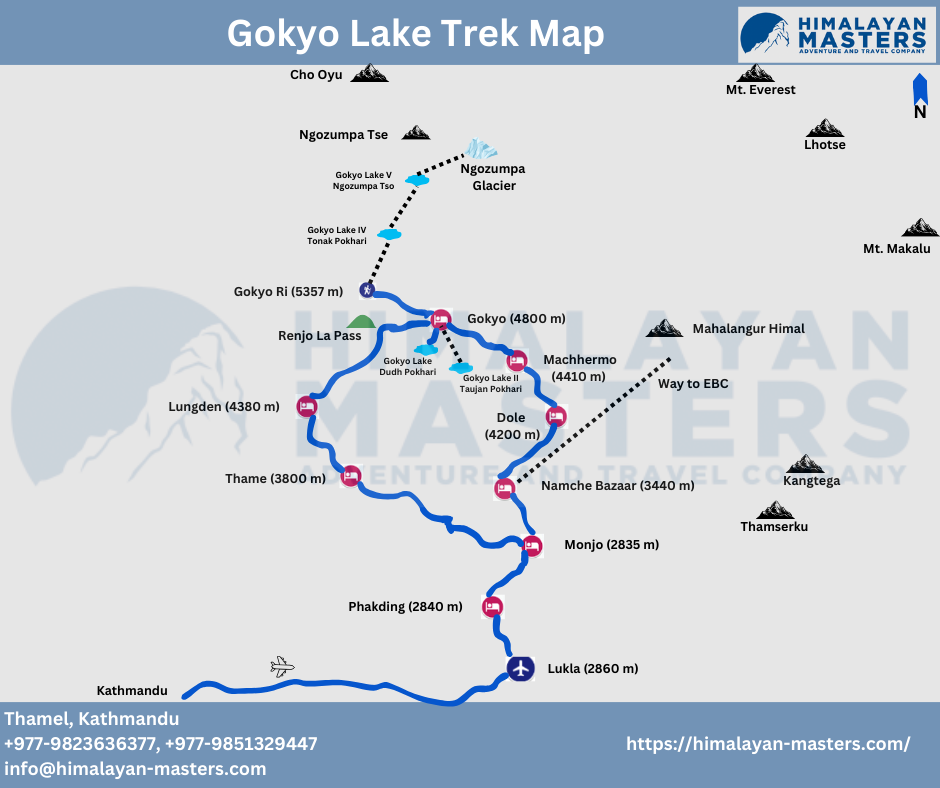
To reach the Gokyo Lakes, you follow the traditional route of the EBC trek from Lukla to Namche. Then, you head north towards Dole and climb to Machhermo before hiking to Gokyo.
On the west, you can find another route separating from Monjo. From Monjo, you must go to Thame, Lungden, and Renjo La Pass before getting to Gokyo Ri.
If you want to include the Everest Base camp trek on the same journey, there is another route from Lobuche to Dzongla and Thangnak that takes you to Gokyo Lake Trek.
Culture and Wildlife
Gokyo Lake Trek is culturally rich and has a wonderful view of nature. The Sherpa people are so welcoming. Their culture is different; Buddhism influences it.
It covers the traditional Sherpa villages that include Namche Bazaar and Khumjung, where one is able to talk with the locals, understand how they live their lives, andstudy customs and traditions.
Further up the trek, one goes through Sagarmatha National Park, a part of UNESCO’s list of world heritage sites. It is highly known for its diverse flora, fauna, and equally rare species like the snow leopard and red panda.
You might also encounter Himalayan Thar, musk deer, and various species of birds on the trek, more so golden eagles. So, with such a rich cultural background and added diversity in the wildlife, this is one unique trek.
A Typical Day on Gokyo Lake Trek
Trekkers get up in the morning with stunning mountain views at their hotel windows and enjoy a hot breakfast at the lodge. After breakfast, the trekkers pack their things and head off hiking.
The trails vary from easy to strenuous, often with gentle slopes and steep ascents. Generally, trekkers walk anywhere from 5 to 8 hours daily, depending on the itinerary. One can always stop and rest at various spectacular views or, besides that, local teahouses.
Pinkish sky surrounding the tallest mountain, Mt. Everest
Lunch is usually taken en route and normally consists of local recipes. At the end of a day’s trek, the trekkers generally reach their next destination by late afternoon or early evening. They freshen up and sit around the dinner table, narrating the day’s tales.
Most days end with relaxation among fellow trekkers or sightseeing around the nearby areas. At night, the trekkers prepare for a night’s sleep to rise fresh the next morning to see another brilliant day among these awesome landscapes.
Notes to Remember for Gokyo Lake Trek
Build up your system to cope with altitude and avoid such sickness.
It is wise to carry clothes according to the climate, where multiple layers are recommended.
Ensure you take a lot of water in the course of the day in order to maintain body fluid balance.
While visiting communities and villages, be culturally sensitive and polite with the people.
Make sure you are fit, for some steeps become rather competitive.
You should purchase travel insurance that will cover trekking.
Please add extra buffer days just in case for any inconvenience that can happen while in Nepal.
Everyday you must start the trek early to reach the destination on time.
Since the mountain weather changes suddenly so make sure to check the weather forecast daily.
Gokyo Lake Trek Itinerary Outline from Kathmandu
Day
Itinerary
Sleep Altitude
Distance
Time
01
Fly to Lukla and trek to Phakding
2,610 m
144.2 km
25 min & 4 hrs
02
Trek to Namche Bazaar from Phakding
3,440 m
12 km
6-7 hrs
03
Acclimatization Day at Namche Bazaar
3,440 m
9 km
4 hrs
04
Trek to Dole from Namche Bazaar
4,200 m
11 km
6-7 hrs
05
Trek to Machhermo from Dole
4,470 m
6.8 km
6-7 hrs
06
Trek to Gokyo from Machhermo
4,790 m
6 km
7-8 hrs
07
Hike to Gokyo Ri and back to Gokyo
5,360 m
1.8 km
5 hrs
08
Hike to Fifth Lake and back to Gokyo
4,990 m
4.2 km
5 hrs
09
Trek to Lungden via Renjo La pass
4,368 m
8 km
6-7 hrs
10
Trek to Thame from Lungden/Lumde
3,820 m
10 km
6-7 hrs
11
Trek to Monjo from Thame
2,835 m
13 km
4-5 hrs
12
Trek to Lukla from Monjo
2,840 m
13 km
5-6 hrs
13
Fly back to Kathmandu from Lukla
1,400 m
138 km
25 min
We’ll talk about the details of the full itinerary below.
In the morning, a private car picks us up from the hotel gate and drives us to the airport. Soon, we will fly above the lush hills beyond Kathmandu Valley.
During the peak season, you might also need to take a flight from Ramechhap for Lukla. So in that case we will drive up to Ramechhap then take the earliest flight to Lukla if possible.
Flight from Kathmandu to Lukla:
The flight to Lukla is one of the most exciting part of this whole trek. It takes around 20-25 minutes to reach Lukla from Kathmandu via flight. But it takes 18-20 minutes to reach from Ramechhap.
During the flight you can enjoy the surreal views of the deep valleys, mountains, and gradually rising snow-peaks. On clear days you can even spot Mt. Everest from the Lukla flight itself.
About Lukla:
Lukla is a small village where our Everest or Gokyo Lake trek begins. There are many Sherpa communities in the area, and there are around 50-60 houses of local Sherpa people. Most of the people are engaged in trekking and guiding.
After some stops here, we slowly moved along the Dudh Koshi River. After a few hours of upward and downward walking, we will reach our destination for the day, i.e. Phakding. This will be your first tea house experience during the Gokyo EBC trek.
About Phakding:
Phakding is also a small village located at a lower altitude than Lukla. Around 150-200 people reside in the area, which includes a health post, a school, and several monasteries.
Teahouses at Phakding:
Consists of 20-30 teahouses with basic services like wifi, electricity and charging, hot showers, etc. You will find warm and cozy beds on Phakding.
: Breakfast, Lunch and Dinner
: Tea House
: 25 mins flight and 4 hours trek
Day 02:
Trek to Namche Bazaar from Phakding
Trek route: Phakding → Toktok → Banker → Monjo → Jorshalle → Namche Beginning Point: Phakding (2610 m / 8563 ft.) Ending Point: Namche Bazaar (3440 m / 11319 ft.) Phakding to Namche Distance:12 km / 7.5 miles Total Ascent: 830 m (2723 ft.) Lunch: Jorsalle Overnight: Namche Bazaar
View from Namche Nepal
Leaving Phakding, we head further north. Walking closer to the mountains along the river bank is very relaxing. Our day’s highlight is crossing several suspension bridges, including the Hillary Suspension Bridge.
Moving to the classic village of Monjo, we stopped to get our permits checked. This is the entry point of the Sagarmatha National Park. From Jorsale, we take a steep ascent directly to the Namche Bazaar. The beauty and lights of Namche will surely captivate you.
About Namche: Namche Bazar is also known as the major trade centre of the Everest region. On Thursday and Friday, you can find street markets in Namche.
Teahouses at Namche:
You will find various kinds of teahouses in Namche. You will find all kinds of accommodation, from luxury guesthouses to basic guesthouses. At the same time, the luxury ones will charge you more than the basic ones.
They all have the facilities of a Hot shower, Wi-Fi, a single bedroom, an attached bathroom, and even a spa.
: Breakfast, Lunch and Dinner
: Tea House
: 6-7 hours trek
Day 03:
Acclimatization Day at Namche Bazaar
Our plan for the day is to relax in the mountains and let our souls feel peace before we succeed in Gokyo Chola’s pass. If you are feeling excited, you can hike to the Hotel Everest View for an awesome panorama of Mt. Everest, Lhotse, Tawache, Kwangde Peak, Kusum Peak, Kangaru Peak, and other peaks.
Or, you can stay in your hotel and visit the Namche Village in the evening. There’s a local museum, school, classic village, and a large market you can visit in the daytime.
: Breakfast, Lunch and Dinner
: Tea House
: 4-5 hours trek (Optional: If you want to hike to Hotel Everest View.)
Day 04:
Trek to Dole from Namche Bazaar
Trek Route: Namche Bazaar → Mong La → Dole Beginning Point: Namche Bazaar (3,400 m/11,155 ft.) Ending Point: Dole (4038 m/13,248 ft.) Namche Bazaar to Dole Distance: 11 km (6.84 miles) Total Ascent: 638 m/ 2,093 ft. Lunch: Along the trail Overnight: Dole
Climbing beyond Namche, we first reach the lower slopes of Khumbila. Further moving deep into the Khumbu region, our next stop will be Mong La.
Climbing along with the occasional colorful prayer flags and the beautiful forest of pine and Rhododendrons, we reach Dole before sunset. The beautiful view of the mountains and the glacier lakes keeps on joining us towards Gokyo village.
About Dole:
Dole is a small village en route to Gokyo Lake. Most of the people who reside in the area are Sherpa. Around 12-15 houses of local people are in the area. The area consists of local people, but it is more like a business area for running teahouses.
Teahouses at Dole:
The area Dole consists of around 7-8 teahouses with comfortable teahouses. The teahouse has facilities with Wi-Fi, a hot shower, a single room, and an attached bathroom. Local sim NTC network also works in the region.
: Breakfast, Lunch and Dinner
: Tea House
: 6-7 hours trek
Day 05:
Trek to Machhermo from Dole
Trek Route: Dole → Khumjung → Machhermo Beginning Point: Dole (4,038 m/ 13,248 ft.) Ending Point: Machhermo (4470 m/ 14,665 ft.) Dole to Machhermo Distance: 6.8 km/ 4.24 miles Total Ascent: 432 m/ 1,417 ft. Lunch: Along the trail Overnight: Machhermo
From Dole, we plan to reach Machhermo before lunch. Today’s short walk to Machhermo helps us acclimate before entering the highlands of Gokyo. The tiny village has new lodges that remain empty most of the year.
The people of Khumjung and Khunde often use the land of Machhermo to graze their cattle. You can see many yaks and sheep in the summer in these highlands.
Teahouses at Macchermo:
There are around 8-9 teahouses in the area. The services and facilities provided by the teahouses are the same as those provided by Dole.
You have to pay an extra charge for the additional facilities like a hot shower and Wi-Fi.
: Breakfast, Lunch and Dinner
: Tea House
: 6-7 hours trek
Day 06:
Trek to Gokyo from Machhermo
Trek Route: Machhermo → Gokyo Beginning Point: Machhermo (4470 m/ 14,663 ft.) Ending Point: Gokyo (4750 m/ 15,584 ft.) Machhermo to Gokyo Distance: 6 km/ 3.73 miles Total Ascent: 280 m/ 919 ft. Lunch: Along the trail Overnight: Gokyo
Teahouses at Gokyo Valley
This is going to be a short and relaxing day in the mountains. First, we hike up via the thorny alpine vegetation. Above the village, we can see Cho-Oyo, Kangtega, Tabuche, Chola Che, and Thamserku smiling down at us.
Here, we see the first glimpse of the Ngozumpa Glacier before ensuring the long walks to Gokyo. Along the way, you can find small streams and some mane walls.
With the prodigious blue-green Dudh Pokhari before us, we stop at one of the small tea houses in Gokyo.
The Gokyo Lake area has 5 lakes. We will see 3 of them while trekking up to Gokyo Lake.
Teahouses at Gokyo Lake:
In the Gokyo Valley region, you will find different ranges of teahouses. You can even find a luxury teahouse in the area. Besides the luxury teahouses, the basic teahouses provide cozy and warm hospitality services.
There are around 10-12 teahouses on Gokyo Lake. Services are a bit expensive compared to the other areas.
: Breakfast, Lunch and Dinner
: Tea House
: 7-8 hours trek
Day 07:
Hike to Gokyo Ri and back to Gokyo
Hiking Route: Gokyo → Gokyo Ri → Gokyo Beginning/Ending Point: Gokyo (4750 m/ 15,584 ft.) Gokyo to Gokyo Ri Distance: 1.8 km (1.12 miles) one-way Total Ascent: 607 m/1,991 ft. Lunch: Back in Gokyo Overnight: Gokyo
View of Mt. Everest
Early in the morning, start your journey to Gokyo Ri. It will be a lifetime experience watching the sunrise over the Himalayas. The trail to Gokyo Ri is steep and rocky.
Take your time to enjoy the views as you go higher.
After a trek of about 2.5 hours, you will reach Gokyo Ri at an altitude of 5360 meters.
The top gives a fantastic view: a panorama of the Everest area, such as Mount Everest and Cho Oyu, and below the Gokyo Lakes.
The steep walk to the Gokyo Ri isn’t ever easy, but the tranquil Gokyo Lakes make it all worth it. We can see the beautiful Makalu (8485 meters), Cho Oyu (8201 meters), and Lhotse (8516 meters).
Everest looks magical. This hilltop at 5,357m will be one of the highest points of our trek. After an awesome view from the top, we get back to Gokyo.
The total walk will be around 5 hours. You will hike up to Gokyo Ri Lake trek and then return to Gokyo for lunch as far as possible.
After spending time up there, snapping great photos and enjoying the scenery, start your way down to Gokyo again. The downhill hike from Gokyo Ri will take approximately 2 hours.
Once back at Gokyo, enjoy a well-deserved lunch at your teahouse. After lunch, take the rest of the day to relax and analyse the beautiful surroundings of Gokyo.
If you don’t want to trek such a long distance just to see the lakes, we have an Everest Base Camp Helicopter tour that can also take you to Gokyo Lakes.
: Breakfast, Lunch and Dinner
: Tea House
: 5 hours walking (Round Trip)
Day 08:
Hike to Fifth Lake and back to Gokyo
Hiking Route: Gokyo → Fifth Lake → Gokyo Beginning/Ending Point: Gokyo (4750 m/ 15,584 ft.) Gokyo to Fifth Lake Distance: 4.2 km (2.6 miles) one-way Total Ascent: 230 m (755 ft) Lunch: Back in Gokyo Overnight: Gokyo
Today, we will hike to the 4th and 5th Gokyo Lakes. Gokyo You is almost 3km from central Gokyo. After that, we will hike to the 5th lake, Ngozumpa Glacier. Gokyo Ri Lake is just magnificent.
Start your hike in the morning after breakfast. The trail to Fifth Lake offers stunning views of the surrounding mountains and lakes. The trail is moderate, with some rocky sections. Enjoy the breathtaking scenery along the way.
After about 2 hours of hiking, you will reach the Fifth Lake at 4990 meters. The lake is known for its striking turquoise colour and is surrounded by impressive peaks. Take time to enjoy the views and capture photos of the stunning landscape.
After lunch, relax and explore Gokyo. You can take a leisurely walk around the village or visit the nearby lakes if you have energy.
About the Fifth Lake:
The Fifth Lake, also known as Ngozuma Cho/Tsho, is one of the highest lakes in the world. Its stunning turquoise waters reflect the surrounding mountains, making it a must-visit spot on your trek.
: Breakfast, Lunch and Dinner
: Tea House
: 5 hours walking (round trip)
Day 09:
Trek to Lungden via Renjo La pass
Trek Route: Gokyo → Renjo La Pass → Lungden Beginning Point: Gokyo (4,750 m /15,584 ft.) Ending Point: Lungden (4,380 m / 14,370 ft.) Distance: 8 km (4.97 miles) Total Descent: 370 m (1,214 ft.) Lunch: Packed lunch on the trail Overnight: Lungden
Gokyo Lakes of Nepal
This is going to be another long day in the mountains. We start the trek early morning and initially walk to the Renjo La Pass.
This can be an exciting walk to the high pass at approx 5360 m. From the top, the entire view of the Everest region looks more beautiful. You can also see Cho Yu, Lotshe, Nuptshe, Pumori, and Ama Dablam.
On this day, we will try to reach Lungden for lunch; if anyway we cannot reach Lungden before lunch, then we will have to pack our lunch. We will find some streams on the way.
However, instead of heading to Everest from Gokyo-Ri Lake, we descend steeply into the northern valley. We can see the Tibetan Valleys beyond the border quite close to your eyes. After a couple of hours from Renjo La, we crashed at the tea house of Lungden.
Teahouses at Lungden:
Sherpa and Rai people run the teahouses in this area. There are around 4 teahouses in the area. All these teahouses provide basic services.
: Breakfast, Lunch and Dinner
: Tea House
: 6-7 hours trek
Day 10:
Trek to Thame from Lungden/Lumde
Trek Route: Lungden → Thame Beginning Point: Lungden (4,380 m /14,370 ft.) Ending Point: Thame (3,750 m / 12,303 ft.) Lungden to Thame Distance: 10 km (6.21 miles) Total Descent: 560 m/ 1,837 ft. Lunch: Packed lunch on the trail Overnight: Thame
As we head downwards, we plan to walk slowly without any rush. We start the trek late in the morning and descend to the gorge of Thame.
As we plan to have lunch at Thame, we will wake up at around 6 and begin our trek. The path has a gradual ascent, and we can encounter monasteries, stupas, and rivers along the way.
About Thame:
A beautiful Sherpa settlement will be a great time to learn about the unique mountain culture. The village will be even more vibrant during festivals and celebrations. There are around 30-40 local houses in the area.
Teahouses at Thame:
Thame is an area with around 20-25 teahouses. You will be staying at a comfortable teahouse with WIFI, electricity charging, and a private and attached bathroom.
: Breakfast, Lunch and Dinner
: Tea House
: 6-7 hours trek
Day 11:
Trek to Monjo from Thame
Trek Route: Thame → Monjo Beginning Point: Thame (3,750 m / 12,303 ft.) Ending Point: Monjo (2,765 m /9,072 ft) Thame to Monjo Distance: 13 km (8.08 miles) Total Descent: 985 m (3,232 ft) Lunch: Packed lunch on the trail Overnight: Monjo
Instead of taking the classic route where we stop at Namche, this Itinerary directly takes us to Monjo. We leave the Thame after breakfast and start heading to the south. With a satisfying expedition to Namche, we stop here for lunch.
You will come across Hillary Bridge, checkpoints, the Sagarmatha National Park area, and various stupas. If you want to celebrate in the restaurant and bars of Namche, we can also end the day here. Otherwise, we plan to stop at the traditional village of Namche.
About Monjo:
Monjo is also a village area with teahouses. Around 30 local houses are in the area. Most people are Sherpa, and only a few Rai people are in Monjo.
Most people in the area are raising cattle and trekking, guiding, and pottering.
Teahouses at Monjo:
Monjo has around 15 teahouses with comfortable and basic facilities in the area. Extra services can be a bit cheaper than at high altitudes.
: Breakfast, Lunch and Dinner
: Tea House
: 4-5 hours trek
Day 12:
Trek to Lukla from Monjo
Trek Route:Monjo→Phakding→Ghat→Lukla Beginning Point: Monjo (2,765 m /9,072 ft.) Ending Point: Lukla (2860 m/ 9383 ft.) Monjo to Lukla Distance: 13 km (8.08 miles) Total Descent: 222 m/ 728.6 ft. Lunch: Phakding Overnight: Lukla
Lukla airport
We walk from Monjo to Lukla on a familiar path downwards from the Dudh Kosi valley. Here, we cross multiple suspension bridges and walk beyond the village of Phakding. However, This is our last day of trekking.
Reaching Lukla, we shall all gather to celebrate victory over Gokyo Ri Lakes. Since most of the Himalayan master’s crew are from theEverest region, you will likely see them here for the last time.
The stunning morning flight from Lukla is prodigious. Flying parallel to the Himalayas, we see a final glimpse of the mountain from our window plan. Then, we soon see the sub-tropical forest and the small houses of Kathmandu.
Moreover, In less than 30 minutes, we landed at Kathmandu airport. Here, a driver takes you to the hotel. Back at the hotel, you have some time to shop for souvenirs and visit the places around Thamel. Later, you can enjoy the nighttime and colourful streets of Thamel.
Do you want an extension of your trip? We think this Nepal destination page may be more helpful to you.
: Breakfast
: 3-star Hotel
: 25 mins flight
include / exclude
Trip Cost Includes
International and domestic airport pickup and drop-off by private vehicle.
3 nights at a 3-star hotel in Kathmandu (2 nights before the trek and one night after the trek).
Kathmandu or Ramechhap to Lukla and back to Kathmandu airfare.
A Professional English-speaking Trekking Guide, as per the itinerary.
1 set breakfast, 1 set lunch, and 1 set dinner with tea and coffee during trekking days.
3 cups of hot drinks a day.
Best available private room accommodation with private bathrooms with hot showers in Phakding, Namche, and Lukla.
In the Namche, three nights of accommodation with electricity blankets.
Sagarmatha National Park fees.
Khumbu Rural Municipality Area permits.
Guide and Porter Insurance.
All government taxes and company service charges.
Complementary services from Himalayan Masters
A -25-degree sleeping bag during the trek.
A -20-degree down jacket during your trek.
Check your spo2 and bpm with a pulse oximeter at high altitudes.
Water bottles and purification tablets.
First aid kit box.
Seasonal fruits for dessert.
Himalayan Masters Brand Duffle Bag for the Trip (Porter will carry the duffel bags).
Himalayan Masters Brand Trekking T-Shirt and Cap.
Trip Cost Excludes
International Flight Ticket.
Nepal visa fee.
One trekking porter for 13 days, USD 286 (optional).
Gokyo Lake Trek difficulty is considered moderate to difficult. Gokyo Lakes Trek Nepal is a 13-day trek in tough mountain terrain, where you must hike for 6 to 8 hours a day, protecting a distance of 12 to 18 km.
Gokyo Ri climb is not technical, and you do not need any previous high-altitude climbing skills or mountain gear.
A beginner trekker with decent physical strength and prepared well can reach the Gokyo Lakes safely. Gokyo Valley to Gokyo Ri Lake is simply a mile of a soothing uphill hike; hence, there is no need to worry about it.
Trip Grade: Fitness level, Medical and Health
The Gokyo Lake trek is relatively moderate in trek difficulty, and average trekkers with good fitness levels can enjoy it. The daily walk is to journey for 5-7 hours.
To ensure a successful trekking, preparing well in advance is crucial. Regular exercises, such as jogging, hiking, or cardio workouts, for several months before the trek will empower you to conquer the challenges of this trek.
The major point is that health and medical issues are vital to trekking in Nepal; no one can debate this.
The altitude of the high mounts can cause uneasiness and illness. Therefore, a good sun exposure habit or sun protection is vital. Enjoy a walk at the park, rest throughout the day, and don’t try to hurry it all up.
Altitude Sickness in Renjo La Pass
The main trouble of the Gokyo Lakes in Sagarmatha National Park Nepal is altitude sickness since the height is high due to the high altitudes. The hike begins at Lukla (2,860 meters) and Gokyo (4,750 meters), which comes a bit later as we gradually gain height.
Therefore, as you move higher in the atmosphere, the air gets thinner, so your body cannot breathe the oxygen it requires. Symptoms of mountain sickness include headaches, dizziness, nausea, and considerably reduced ability to breathe. It is important to take immediate action on the identified signs and ensure the business stays on track.
Acclimatization is the best of all solutions by far. Gokyo Trek Nepal will have day-long trips where you rest, like in Namche Bazaar (3,440 meters), to let your body adjust to the high altitude.
Trekkers enjoying at Gokyo Lake Nepal
Trekking Experience Gokyo Valley
The Gokyo Lake trek is a unique experience that combines the excitement of adventure, the beauty of nature and the cultural heritage. The trail begins in Lukla, where trekkers go through the jungle, villages of Sherpa, and towns like Namche Bazaar, where they have a market.
As you get higher, the surroundings become more spectacular, with panoramic views of the mountain ranges such as Everest, Lhotse, and Cho Oyu.
The trekking Gokyo Nepal is famous for its stunning glacial lakes; above all, the lakes are the epitome of natural beauty, offering a wonderful reflection of the surrounding mountain ranges.
The journey consists of an uphill walk to the peak of Gokyo Ri Nepal (5,357 meters), allowing passengers to enjoy the beautiful panoramic views of the Himalayas.
During the hike, you will meet the friendly locals and monastic complexes and be immersed in the Sherpa culture.
Emergency and Evacuation
There are options for evacuation and medical assistance in emergencies during the Gokyo Lake trek. Most trekking agencies provide guides trained in basic first aid and altitude sickness management. They can assist with minor injuries and illnesses.
For more serious cases, helicopters can be called to evacuate hospitals in Kathmandu or nearby towns. It’s necessary to have travel insurance that covers helicopter evacuation and medical expenses. Trekkers should carry a copy of their insurance policy and emergency contact numbers.
In an emergency, notify your guide immediately and follow their instructions. Being prepared and informed about emergency procedures ensures a safer trekking experience.
Essential Kits and Equipment
Clothing
Base Layers
Insulating Layers
Outer Layers
Trekking Pants
T-shirts and Long-Sleeve Shirts
Warm Hat and Gloves
Sun Hat and Sunglasses
Buff or Scarf
Footwear
Trekking Boots with ankle support
Trekking Socks
Gaiters
Camp Shoes
Equipment
Backpack (A 40-50-litre pack)
Daypack
Sleeping Bag (minus degree rated) (complimentary by Himalayan Masters)
Trekking Poles
Water Bottles (complimentary by Himalayan Masters)
Water Purification tablets (complimentary by Himalayan Masters)
First Aid Kit
Multi-tool or Knife
Trekking Map and Compass
Miscellaneous
Sunscreen and Lip Balm
Toiletries
Towel
Snacks
Cash
Camera or Smartphone
Optional
Portable Charger
Sleeping Bag Liner
Binoculars
Travel Pillow
Special training
Special training for the Gokyo Lake Trek Nepal is not essential. Yet, cardio exercises and weight lifting are valuable to get the body ready for the physical strains of the trek. Increase endurance, leg strength, and stamina through hiking, jogging, riding a bicycle, and going up and down.
Besides, take a couple of walks with a loaded backpack to adapt to the trekking conditions. Adaption and adequate hydration are essential; therefore, learn about the specific hazards and acclimatization of high-altitude hiking.
What is the Best Time
Best time for Gokyo Lake Trek with Renjo La Pass
Favourable weather climates will contribute to a memorable travel experience you are having. Numerous travellers and agencies advocate travelling at the following times:
Between March and April and between October and December. During these months, before and after the monsoon season, you’ll enjoy good weather with a clear sky full of dry and delightful paths to your hiking route.
In autumn, we celebrate mountain festivals like Mani Rumdi, and Kathmandu districts celebrate Dashain/Tihar. Therefore, if you want to blend different cultures in a single trekking experience, this will be the best time of year for trekking in Nepal.
However, the blooming of the Rhododendron in the spring is the very picture of the forest, especially its arrangement and hues. The most important thing is that this national flower of Nepal will be the cherry on top of the beauty of the trekking trail.
Weather Information
The weather in the region of Gokyo Lake is diverse from the point of view of a season. During the spring season (between (March and May), the weather is mostly gentle and rarely cloudy, with blossoming flowers flanked close.
Temperatures are variable; temperatures of 15 degrees Celsius at midday and -5 degrees Celsius at night are the extremes. The weather is better in late autumn (September to November), with mild, warm days and cool nights.
The mean temperature in the daytime ranges from 10-15 degrees Celsius, but at nighttime, it can reach -10 degrees Celsius.
Permits for Gokyo Lakes Trekking Nepal
You will need two permits for the Gokyo Lake trek: permits for the Sagarmatha National Park Entry and the Gokyo Cho La Pass Trek, which are now issued in electronic form.
The permit entree fee for Sagarmatha National Park is approximately USD 30 per individual, obtained in Kathmandu or Monjo.
Also, a Khumbu Rural Municipality Local Area Permit costs around 20 dollars per person. It would help if you had the permits with you during the whole hike because they will be controlled on the checks of the trail’s intervals.
Accommodation and Food
Teahouses in this trek can be as simple as basic accommodation and as luxurious as comfortable beds. Tearooms are basic dorm-style accommodations that may come with simple linen beds.
Toilet facilities and maybe even washbasins are usually shared. Lodges offer way more comfort in the secluded rooms and even with an attached bathroom in some places. The accommodation at Gokyo Lake costs from USD 5 to USD 20 per good night, depending on where you’re staying.
It is so that the trail food options are small in number, with a typical teahouse offering a menu that is quite similar to many of its neighbouring teahouses. Regular meals usually contain rice, noodles, soup, Tibetan bread, and tea or coffee.
It’s good advice to stick with vegetarian dishes and avoid eating meat to reduce the risk of foodborne disease. Bottled water and other beverages for sale are placed on the path to quench your thirst while you are on your journey.
Though the accommodation and food choices are not luxurious in any of these places, they are the essentials trekkers need to get through the trip.
Electricity and Battery Recharge at Gokyo
The majority of the teahouses along the Gokyo Lake trek have electricity. Generally, it is provided either through solar power or hydroelectricity. Nevertheless, one should mind having a USB charger or power bank to charge out the devices in the event of an electricity outage. It might cost extra to charge.
Majestic view of Mountains en route to Everest
Gokyo Lake Trek Cost
The trekking to Gokyo Lakes costs around $1,400, and upon its inclusion, the Everest base camp trek will cost $200 per trip. Here comes the reward you deserve and the reason for all – trek to the Gokyo Ri and EBC (including).
You will spend approximately $50 per day on food and accommodation, $40 on Porter/guide, $50 on everything that needs to be permitted, and about $400 on that flight.
Travelling together in a larger group, you can affordably share the trek cost of the accommodation of porters and guides. Thus, your journey itself will not be quite expensive.
Insurance
As far as talking about insurance, it is imperative to have travel insurance yourself. The additional expenses that make up the case for taking an insurance plan for yourself can be medical attention or emergency evacuation, though it may cost extra.
Most advanced features of the insurance are intended to cover such situations. The need for a travel insurance policy from a very respectable and credible firm is high.
Additional Costs
Further expenses for trekking towards Gokyo Lake may include permits, accommodation expenses, dining charges, some drinking and snack bills, trekking gear for rent, tips for guides and porters, and personal expenses.
Let’s not forget tipping, one of Nepal’s few conventions. Also, visitors should add money for souvenirs and internet usage among the expenses they should have in their budget. In summary, USD50 to USD100 per day is an acceptable budget equal to Gokyo Lake.
ATM availability in the trek route
Namche Bazar is the only ATM at the last point on the Gokyo Lake trek. So please make sure to carry enough cash for the trek.
The teahouses and villages also accept cards, but sometimes, due to an internet issue, the card might not work.
Some places only accept Nepali cash. Make sure that you have essential Nepali cash for the trek.
Having enough water in your body is crucial during the Gokyo Lake Trek. Drink 3 to 4 litres of water daily while trekking is recommended. Even though it might be cool in temperature, the body still needs ample hydration.
Easy purification methods include boiling, chlorine or iodine tablets, and a portable water filter.
Get a refillable water bottle to reduce plastic waste. If you don’t like the taste of plain water, you can add electrolyte tablets or flavour packs of drink mixes in your water for taste and to help replace salt lost in your sweat.
Communication
SIM Card
Buying a local SIM card in Kathmandu is the best way to be connected during the trek. It is supposed to give you mobile data; you can call anyone wherever the coverage is good.
Landline
The Landline services are available in bigger villages like Namche Bazaar. These are not that reliable for urgent communications, so it’s better to depend on mobile networks for as long as possible.
Postal Services
A postal service is in place, although it can be very slow and unreliable. Letters and packages can take weeks to get delivered, so plan accordingly if you must send items back home.
Walkie-talkie
Walkies-talkies can be a workable communication device for groups trekking together. They will allow immediate, effortless communications over short distances without relying on mobile networks.
Wifi / Internet
You can find wifi in most places in the Everest Region. One can buy EverestLink wifi, which works in the region. It will cost you a few dollars.
Safety And Security
Safety is the most important aspect when trekking in the Himalayas. Always let someone know your itinerary and when you plan to return. Stick to well-marked paths and avoid solitary treks into remote areas.
Carry a first-aid box and understand basic first-aid procedures for common injuries. Acclimatization is very important; ascend gradually to avoid altitude sickness. Trust your instincts, and if you start feeling worse, seek help.
Guided vs Solo Trekking
Whether you hire a guide to trek with or go solo, it is up to experience. Guides can give you great security, local knowledge, and enhancements in the experience of the local culture. They can also help with navigation or even communication at some point.
The advantage of solo trekking is the quantity of freedom that one experiences, but it requires decent planning and good navigation skills.If you have no experience in this field or are unfamiliar with trekking at high altitudes, it’s best to hire a guide due to safety concerns and proper support.
Porters Versus No Porter
This pays off greatly by lightening your load and giving you more time to enjoy the views. Moreover, a porter can carry roughly 25 kg of gear, making the trek easier.
Tips for Hiring Porter
Most of the porters are hired from the local villages for economic support. Talk about rates before the trek. The average wage maybe $15 – $25 per day on an ordinary day. Ensure they have all the proper equipment for the trip. Respect. The porters should be treated as respectfully as possible; they are part of your tour.
Tipping Culture for Guides and Porters
Tipping in Nepal is a kind of appreciation for the services provided. In the case of guides, normal tipping amounts to 10% of the total cost of a trip, while for porters, it is about $5 to $10 per day, according to their service quality.
Tip according to the service rendered at all times. Also, giving tips directly at the end of the trek and not via an agency would be better.
Alternative Gokyo Treks And Expedition Routes
You may try the Everest Base Camp Trek and Annapurna Circuit routes if you want an alternative to the Gokyo Lake Trek. The treks have magnificent scenery and good cultural experiences but differ in difficulty and duration. Another option may be the Langtang Valley Trek,
Extended Everest Gokyo Renjo Pass Trek
If you wish to extend the days, then you will have the opportunity to visit nearby attractions like Gosaikunda Lakes or explore the cultural diversity of Kathmandu Valley. Further days can be used for shorter treks or cultural sightseeing to make the trip full.
How to Book with Himalayan Masters?
Online booking through Himalayan Masters is possible through their website, or one may reach them directly through email or phone. They have different packages to suit a range of tastes and budgets.
How Do I Book an Adventure Trip at the Last Minute?
To book a last-minute trip with Himalayan Masters, You can contact them instantly through their phone or email address for availability. Or you can even book through their site.
Why Choose Himalayan Masters?
Himalayan Masters presents a company dedicated to Tourism. Our familiar staff will be happy to help tailor your trips to your individual needs for an unforgettable adventure in the various stunning landscapes of Nepal.
Team of Himalayan masters with clients
Trip Cancellations
In the event of a trip cancellation, the amount you paid will not be refunded. However, you can use that amount to book a trek or trip with us at any time in the future. If you’re unable to trek with us yourself, you also have the option to refer friends, family, or relatives to use the same amount for their trip.
Feedback/Review
Feedback from previous trekkers always speaks highly of the quality of the services provided by Himalayan Masters and the lifetime memories created with them. Most of them felt grateful for the knowledgeable guide services and well-organized Gokyo Lake Trek Itinerary, which suited people with different skill levels.
Route Map
FAQs
How long is Gokyo Lake Trek?
As per the Himalayan Master’s Itinerary designed by the experts, this Gokyo Lake trek is 13 days long. If you add some rest days, it might extend up to three weeks. However, if you skip the trek to Everest Base Camp and head directly down from Gokyo Valley, the overall trek can be completed in less than 12 days.
How hard is Gokyo Lake Trek?
The rough mountain terrain and the long trekking days in a remote valley of Nepal are not a piece of cake. Moreover, this Itinerary with the two highest passes in the Everest region, i.e. Gokyo- Ri (5,357 m) and Renjo La pass (5,340 m), makes it very challenging.
How do I get to Gokyo Lake?
As mentioned above, you need to fly to Lukla and then trek to Namche before hiking to Gokyo. Some people also get a public bus to Jiri and hike to Namche for about six days before taking the route to Gokyo. On the way back, you can walk directly down to Machhermo or Everest base camp and then to Namche.
Is there internet in the Everest region?
Everest regionand Gokyo have almost every good internet connection throughout the trail. Beyond that, only a few places have Wi-Fi connections, and that costs you some amount ($1 to $3). Furthermore, if you have been issued a local SIM card in Kathmandu, you can use the mobile internet.
What kind of food do you get in the Everest region?
You can enjoy oats, pancakes, muesli, and bread. Tea/ coffee/ milk is also available. You can have Nepalese Dal/Bhat for dinner and lunch, which has an unlimited supply. Other options like Noodles, Thukpa, spring rolls, momos, and spaghetti are also popular.
How much does it cost to do the Gokyo Lake trek?
Trek to Gokyo Lake costs about $1400, and including the Everest base camp trek on the same trip will add another $200 for the tour.
How high is the Gokyo Pass?
Gokyo Pass, also called Gokyo Ri, is at a height of 5,357 m (17,575 ft) above sea level in the eastern North of Nepal.
Can you see Everest from Gokyo Lakes?
Yes, it is not just Everest; you can see three other 8,000-metre peaks, including Lhotse, Makalu, and Cho Oyu.
How many peaks can you see from Gokyo Ri?
The summit consists of four mountain peaks, i.e., Mount Everest, Lhotse, Makalu, and Cho Oyu. Also, this is the most amazing viewpoint for other 7000 and 6000 m peaks located in the Everest region. The views of Gokyo Lakes and Gokyo Valley look amazing at the same time.
Is Gokyo Ri difficult?
Gokyo Ri is a 13-day trek in the challenging Mountain landscape where you need to hike for 6 to 8 hours each day, covering a distance of 12 to 18 km. So yeah, obviously, it is a difficult trek. However, the Gokyo Ri climb is not a technical climb, and you do not need any previous high-altitude climbing skills or mountain gear.
How big are the Gokyo lakes?
The Gokyo Lake system of 19 lakes is spread over an area of 196.2 ha (485 acres), lying between 4,600 and 5,100 m (15,100 and 16,700 ft). The Gokyo Cho or Dudh Pokhari, located south of Gokyo Valley, is the major lake here and spreads over an area of 42.9 ha (106 acres).
Do you need a guide for Gokyo Lakes?
Yes, the Nepal government has now made it compulsory to hire licensed guides for all trekking in Nepal, including the Gokyo Valley trek.
How far is Gokyo to Dole?
From Dole, the hiking distance to Gokyo Lake is about 14 km or 8.6 miles. Mostly, travellers stop at Machhermo before hiking to Gokyo directly from Dole.
Can you swim in Gokyo Lake?
Swimming in Gokyo Lake is generally not recommended. The lake is located at a high altitude, which makes the water extremely cold, especially during winter when it can freeze.
What is the shortest trek to Gokyo Ri?
The shortest trek to Gokyo Ri usually starts with a flight from Kathmandu to Lukla, followed by a trek through Phakding and Namche Bazaar before reaching Gokyo. The ascent to Gokyo Ri itself can be completed in a day. Which takes approximately 2 to 4 hours from Gokyo village.
What is the trekking distance from Lukla to the Gokyo Lake?
The trekking distance from Lukla to Gokyo Lake is approximately 40-45 kilometres (25-28 miles) for a round trip. This distance may vary depending on the specific route taken and any side trips included in the itinerary.
Reviews
B
Ben H
Pakistan
Verified Purchase
Renjo La Pass review
From my first interaction with Sandip, I’ve felt that Himalayan Masters acts with integrity, offers competitive prices, and genuinely desires to give customers the best experiences in Nepal. I compared the prices, itineraries and reviews of ~10 travel agencies for
...
From my first interaction with Sandip, I’ve felt that Himalayan Masters acts with integrity, offers competitive prices, and genuinely desires to give customers the best experiences in Nepal. I compared the prices, itineraries and reviews of ~10 travel agencies for multiple trips, and Himalayan Masters almost always came out on top in terms of bang for the buck.
Where other companies seemed to cut corners on their proposed itineraries (e.g. trekking in places where you’d spend a lot of time on the road), Sandip went above and beyond to ensure that the trip exceeded expectations. For example, he got me onto a helicopter from KTM to Lukla instead of the plane at no extra cost. He also arranged a circuit trek to visit Gokyo Lakes (going up via Dole, then down via the RenjoLa Pass and Thame) to minimise going out and back along the same route.
Govinda, the guide, was friendly and experienced and went at whatever trekking pace I was comfortable with. He was the ideal guide and was flexible with plans to maximise time in my preferred locations. As my trip ended up being one day shorter than envisaged because of the weather, Sandip, please let me use the unused costs for a second trip I have booked with Himalayan Masters. I wouldn’t hesitate to recommend Himalayan Masters to anyone looking to trek in Nepal.
J
Jason and Valerie
Australia
Verified Purchase
Gokyo Lakes Review
We had a fantastic trek to Gokyo Lakes with Bibek as our guide. A special thank you to Bibek, who was amazing and took great care of us, always attentive to our needs, informative and supportive. Communication with Sandip was excellent; he
...
We had a fantastic trek to Gokyo Lakes with Bibek as our guide. A special thank you to Bibek, who was amazing and took great care of us, always attentive to our needs, informative and supportive. Communication with Sandip was excellent; he was always quick to respond to my emails. He always got us the best tea houses to stay in and organized a helicopter for us when our flight was cancelled due to bad Weather. Overall, it was a great experience, and I would highly recommend Himalayan Masters to anyone looking to trek in the Himalayas. Jason and Valerie Australia
Based on your preferences, location, timeframe, and budget, our team can design your dream trek based on our extensive knowledge and experience of the Himalayas. Get in touch with us for detailed information and assistance planning your dream trek. With our 97% success rate on trekking and climbing trips in 2025 and 2026 spring season, we will answer any questions you may have and guide you for an unforgettable experience.