




Explore Larkya La Pass Manaslu: Nepal’s Hidden Gem
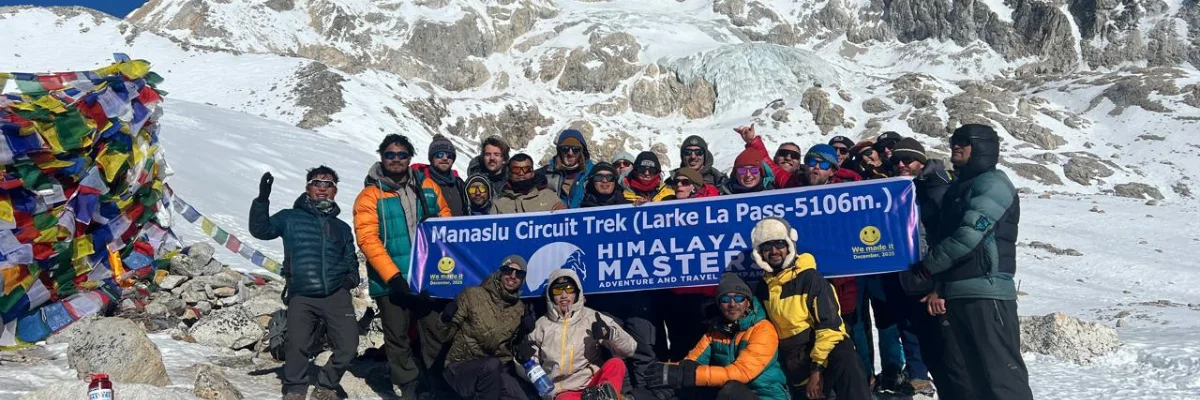
Larkya La Pass is the highest point and defining high-altitude crossing of the Manaslu Circuit Trek. It stands at 5,106 meters (16,752 feet) above sea level.
The pass is normally crossed between Dharamsala, also known as Larkya Phedi, and Bimthang. It is one of the longest and most demanding days of the trek.
Crossing the pass means climbing to a high altitude and then making a long descent. Snow, ice, wind, and visibility can change the trail conditions. Being well-prepared, acclimatized, and keeping a steady pace are key for a safe crossing.
Larkya La Pass at a Glance
- Elevation: 5,106 meters (16,752 feet)
- Location: Manaslu region, Nepal
- Trek: Manaslu Circuit Trek
- Highest point: Larkya La Pass
- Crossing route: Dharamsala/Larkya Phedi to Bimthang
- Typical crossing time: 8-11 hours
- Terrain: Rocky, moraine, snow, and ice depending on conditions
- Departure: Usually before sunrise
- Main challenges: Altitude, weather, terrain, and long walking hours
- Technical climbing: Not normally required
- Best seasons: Spring and autumn
Where Is Larkya La Pass?
Larkya La Pass lies in the high mountain section of the Manaslu region on the border between the Gorkha district and the Manang District of northern Nepal. It is reached after trekkers pass through the upper Budhi Gandaki Valley. It is reached after trekkers pass through the upper Budhi Gandaki Valley. The pass is located at approximately 28.6639° N, 84.5203° E.
The pass lies between Dharamsala on the east and Bimthang on the west. Dharamsala, also called Larkya Phedi, is the final overnight stop before the crossing.

Larkya La lies between the Manaslu Conservation Area and Annapurna Conservation Area, marking the high-altitude crossing between the two protected areas.
After crossing Larkya La, the trail descends towards Bimthang. The pass therefore connects the high Manaslu side with the Bimthang area on the western side of the circuit.
How High Is Larkya La Pass?
Larkya La Pass is 5,106 meters (16,752 feet) above sea level. It is the highest point reached on the standard Manaslu Circuit Trek.
Dharamsala sits at approximately 4,460 meters, while Bimthang is approximately 3,590 meters. The crossing therefore involves a significant change in elevation within one trekking day.
From Dharamsala, trekkers gain around 646 meters before reaching the pass. The trail then descends towards Bimthang to 3,590 meters (11,778 ft).
Why is Larkya La the Highlight of the Manaslu Circuit Trek?
Highest Point of the Manaslu Circuit
Larkya La is the highest elevation reached during the Manaslu Circuit Trek. Reaching 5,106 meters makes it a major milestone of the route. The pass also marks the transition between the eastern and western sections of the circuit.
Dramatic Change in Landscape
The landscape changes noticeably as the trail approaches Larkya La. Lower valleys gradually give way to rocky and barren high-altitude terrain. The surroundings change again as the trail descends towards Bimthang.
High Himalayan Mountain Views

The open terrain around Larkya La provides wide views of the surrounding Himalayan peaks such Himlung, Annapurna II, Larkya peak, Kanguru, Gyaji Kang, Larkya Peak, Namjung and Ratnachuli. Clear weather offers the best visibility, while clouds, snowfall, and strong winds can limit the views around the pass.
Sense of Achievement
Completing the crossing provides a strong sense of achievement, as Larkya La is the highest point of the Manaslu Circuit Trek. The long climb at high altitude can feel exhausting, and some trekkers may even feel like giving up along the way.
Reaching the top after pushing through that struggle brings a powerful sense of relief, pride, and a rush of adrenaline. That feeling of “I did it” makes reaching Larkya La one of the most memorable parts of the entire trek.
Remote High-Altitude Environment
Larkya La lies in a remote mountain environment with very limited facilities. Much of the crossing takes place away from permanent settlements. Trekkers therefore need to prepare for a full day in the high mountains.
Larkya La Pass Crossing: Dharamsala to Bimthang
The Larkya La crossing is normally completed in one long trekking day. The route begins at Dharamsala and continues over the pass before descending towards Bimthang.
Preparing at Dharamsala the Day Before
Preparation for the crossing should begin at Dharamsala the previous evening.
Trekkers should have an early dinner and drink enough water before resting. Clothing, headlamps, trekking poles, and other essential equipment should be checked before bedtime.
Keep items needed during the first few hours within easy reach. If snow or ice is expected, check that suitable traction equipment is ready.
The guide or trekking team should also review the expected weather and trail conditions. An early night allows trekkers to rest before the long crossing.
Starting Before Sunrise
Groups commonly leave Dharamsala before sunrise at 4 AM because the crossing requires several hours of walking.
An early departure provides enough daylight for the long descent and allows extra time if the group moves more slowly than expected.
It also reduces the risk of finishing the descent too late in the day. The exact departure time should depend on the season, weather, trail conditions, and group pace.
Starting early does not mean walking quickly. A controlled pace is more useful for conserving energy throughout the crossing.
Dharamsala to the Upper Moraine
The trail climbs through rocky high-altitude terrain after leaving Dharamsala.
The first section may be completed in darkness, so a headlamp is essential. Temperatures can also be very low before sunrise.
The thin air makes the ascent feel harder than a similar gradient at lower elevations. Short, steady steps help trekkers conserve energy.
Final Ascent to Larkya La Pass
The final ascent becomes more demanding as the trail gains elevation.
The thin air can make breathing harder. Snow and ice may also cover parts of the trail depending on recent conditions.
Some sections can feel exposed. Trekkers may also experience a false-summit feeling when the pass appears close, but another rise remains ahead.
A slow and consistent pace helps manage the final ascent. Groups should also remain together, particularly when visibility or trail conditions are poor.
What to Expect at the Top of Larkya La
Prayer flags and a pass sign mark the top of Larkya La.
The area can be cold and windy, so trekkers should avoid unnecessary exposure. Clear conditions can provide wide views of the surrounding mountains.

Visibility can change quickly at this elevation. After allowing the group to regroup and taking photographs, trekkers should begin the descent towards Bimthang.
Larkya La to Bimthang Descent
Reaching the pass does not mean the difficult part of the day is finished.
The descent towards Bimthang is long and can be hard on tired legs. The route loses considerably more elevation after the pass than it gains on the ascent from Dharamsala.
Uneven ground, loose sections, snow, and ice can make the descent slower. Trekking poles can provide additional stability on difficult sections.
Fatigue can also affect concentration. Trekkers should avoid rushing downhill simply because they have already crossed the highest point.
Arrival at Bimthang
Bimthang marks the end of the Larkya La crossing day.

After the long descent, trekkers can rest and recover at the settlement. The lower elevation also provides relief after spending the day at high altitude.
Completing the arrival at Bimthang means the main Larkya La crossing has been completed.
How Long Does It Take to Cross Larkya La Pass from Dharamsala?
The complete Dharamsala-to-Bimthang crossing generally takes around 8–11 hours.
The actual duration depends on walking pace, rest breaks, weather, snow, and trail conditions.
Dharamsala to Larkya La
The ascent from Dharamsala involves rocky and moraine terrain with around 646 meters of elevation gain.
High altitude naturally slows walking speed, so trekkers should allow several hours for this section.
Larkya La to Bimthang
The descent takes several more hours after reaching the pass.
It involves a much greater overall loss of elevation than the ascent from Dharamsala. This makes the second half an important part of the total crossing time.
Distance and Time
The full crossing is commonly estimated at around 22-25 km (13-15 miles), depending on the route used and how the distance is measured.
An 8-11 hours estimate is more useful for planning than a fixed travel time. Snow, weather, group pace, and rest breaks can all affect the actual duration.
How Difficult Is Larkya La Pass?
Larkya La is one of the most demanding sections of the Manaslu Circuit. Its difficulty comes from the combination of high elevation, changing weather, uneven terrain, and a long walking day.
Physical Difficulty
The crossing requires sustained physical effort for several hours. Trekkers need enough endurance to manage the complete day. Fatigue becomes increasingly important as the crossing progresses.
Altitude Difficulty
The pass reaches 5,106 meters, where oxygen availability is substantially lower than at sea level. Physical fitness does not prevent altitude illness. Proper acclimatization and gradual ascent remain important.
Weather
Weather can change quickly at high elevation. Strong winds, snowfall, cloud, and poor visibility can make the crossing more difficult. Conditions around the pass can also differ from those at lower elevations.
Terrain
The trail includes rocky and uneven sections. Moraine terrain requires careful foot placement. Snow and ice can further change the difficulty of individual sections.
Snow and Ice
Snow and ice can make the trail slippery and harder to cross. The need for traction equipment depends on the actual conditions on the crossing day.
Cold and Wind
Cold becomes a greater concern as the route reaches the pass. Strong wind can increase exposure and make conditions feel considerably colder.
Long Crossing Day
The crossing can take most of a full trekking day. Long walking hours require trekkers to manage their energy from the beginning rather than using too much effort during the initial ascent.

Long Descent to Bimthang
The descent adds another major challenge. Trekkers must continue walking after reaching the highest point. Tired legs can make uneven and slippery sections harder to manage.
The combination of altitude, remoteness, weather, possible snow or ice, fatigue, and long walking hours makes Larkya La demanding.
Does Larkya La Require Technical Climbing Skills?
Larkya La is a high-altitude trekking pass rather than a technical climbing objective under normal conditions. Trekkers do not normally need ropes or advanced mountaineering skills for the standard crossing.
However, heavy snow or ice can substantially change trail conditions. Appropriate equipment and experienced guide support become more important in such situations.
Acclimatization Before Crossing Larkya La
Why Acclimatization Matters
Acclimatization gives the body time to adjust to reduced oxygen availability at higher elevations. At 5,106 meters, atmospheric oxygen availability is substantially lower than at sea level. The body needs time to make physiological adjustments as altitude increases.
Physical fitness does not mean a person is acclimatized. Even fit trekkers can experience altitude illness. The gradual progression of the Manaslu Circuit gives trekkers time to adapt rather than taking them directly to high sleeping elevations.
The CDC identifies gradual ascent as one of the most important measures for reducing altitude-illness risk.
Climb High, Sleep Low
An acclimatization day can involve walking to a higher elevation during the day before returning to a lower elevation to sleep. This exposes the body to greater altitude without immediately increasing sleeping elevation.
Acclimatization Day Does Not Mean Lying in the Teahouse
An acclimatization day does not necessarily mean complete inactivity. A short and controlled hike can provide additional altitude exposure. The activity should still match the trekker’s condition. The purpose is to support acclimatization rather than cause exhaustion.
Why You Shouldn’t Rush the Manaslu Itinerary
A rushed itinerary gives the body less time to adapt to increasing elevation. A faster schedule can also reduce flexibility if a trekker develops symptoms or conditions change. Allowing sufficient time for acclimatization is more important than completing the route as quickly as possible.
Warning Signs That May Mean You Shouldn’t Continue Higher
Trekkers should not continue ascending when they develop symptoms of altitude illness. Symptoms should be taken seriously, especially when they worsen instead of improving with rest. If symptoms become severe or continue to worsen, descending to a lower elevation is the safer decision.
Best Time to Cross Larkya La
Spring and autumn are generally the most suitable seasons for crossing Larkya La. However, conditions vary between individual months.
Larkya La in March
March marks the beginning of the spring trekking season. Snow and ice can still remain around the higher sections. Cold conditions are also more likely at the pass. Trekkers should be prepared for winter-like conditions at higher elevations.
Larkya La in April
April generally brings more favourable spring conditions. Snow can still remain around the pass, particularly after recent snowfall. Visibility is also important for enjoying the mountain scenery.
Larkya La in May
May is part of the late spring trekking season. Conditions can remain suitable for crossing, although high-altitude weather can still change quickly. Trekkers should prepare for colder conditions at the pass than they may experience at lower elevations.
Larkya La in September
September marks the beginning of the autumn trekking period. Early September can still be influenced by monsoon conditions. Visibility and trail conditions may therefore vary. Conditions generally become more favourable as the month progresses.
Larkya La in October
October is one of the most popular months for trekking in the Manaslu region. The pass can offer favourable visibility and trail conditions. Cold and wind remain possible at the highest sections.
Larkya La in November
November can provide clear conditions, particularly earlier in the month. Temperatures become colder as winter approaches. Snow and ice can become more relevant later in the month.
Can You Cross Larkya La in Winter?
Winter crossings require greater caution. Snow accumulation, freezing temperatures, and icy sections can make the route harder to cross. Trail accessibility can also change after heavy snowfall. A winter crossing should depend on current conditions and the assessment of an experienced trekking team.
What About the Monsoon?
The monsoon season can bring cloud, precipitation, and reduced visibility to the Manaslu region.
Conditions around 5,000 meters can differ from those lower on the route. Snow, wind, and poor visibility may affect the pass even when lower sections are wet.
The decision to cross should therefore depend on actual trail conditions rather than the season alone.
Weather and Temperature at Larkya La
Weather at Larkya La is typically colder and more exposed than at lower sections of the Manaslu Circuit.
Conditions vary by season, time of day, wind, and recent weather. Temperatures can drop sharply around the pass, especially before sunrise.
Visibility can also change quickly. Cloud, snowfall, and wind may affect the crossing even when conditions were clear earlier in the day.
When Is Snow Most Likely?
Snow is most likely during winter and after periods of fresh snowfall.
Snow can remain around the higher sections even when lower parts of the route are clear. Spring crossings may therefore still encounter snow.
Does Snow Make Larkya La Dangerous?
Snow does not automatically make Larkya La dangerous.
The risk depends on snow depth, surface conditions, visibility, and the ability to follow the trail safely.
Firm snow and ice can also make the trail slippery and increase the need for careful movement.
What Happens After Heavy Snowfall?
Heavy snowfall can cover established tracks and slow progress. Guides may need to reassess trail conditions before departure. The crossing can be delayed when conditions do not allow safe passage.
Microspikes/Crampons: When Might They Be Needed?
Microspikes or crampons may be useful when sections are covered with firm snow or ice. The appropriate equipment depends on actual conditions. Trekkers should follow their guide’s advice rather than assuming the same equipment is needed on every crossing.
When Should a Crossing Be Postponed?
A crossing should be reconsidered when conditions create an unacceptable safety risk.
Heavy fresh snow, severe visibility problems, dangerous winds, or unsafe trail conditions can justify delaying the crossing.
Serious altitude symptoms are another reason not to continue higher.
What to Wear and Pack in Your Day Pack for Larkya La Crossing Day
The Larkya La day pack should contain only the essentials needed during the crossing. Pack the remaining gear in your duffel bag and refer to our Manaslu Circuit Trek packing list for the complete gear checklist.
What to wear during Larkya Pass?
- Warm layers
- Waterproof and windproof shell
- Insulated jacket
- Warm gloves
- Warm hat or buff
- Trekking boots
- Moisture-wicking socks
What to pack for your day pack?
- Sunglasses
- Headlamp and spare batteries
- Trekking poles
- Water
- Snacks
- Toiletries
- Offline Map
- Personal medications
- Sunscreen and lip balm
- Microspikes if conditions require them
Tips:
Keep frequently used items where they are easy to reach. This is especially useful for gloves, layers, water, and snacks.
Food, Water & Facilities During the Crossing
Facilities are limited once you leave Dharamsala. Trekkers should not expect regular food services along the crossing or at the pass. Carry enough food for the full day before leaving the settlement.
Water should also be carried from Dharamsala. Available water sources along the route may not be reliable. There are no teahouses along the main Larkya La crossing where trekkers can stop for a full meal or overnight stay.
However, after around two hours of walking, you will find a small tea shop offering tea, coffee, warm water, and instant noodles. Toilet facilities are also unavailable, so use the available facilities before starting the crossing and prepare for a long stretch without regular services.
Good crossing day snacks include energy bars, chocolate, nuts, dried fruit, and other compact foods that are easy to eat while walking.
Safety Tips for Crossing Larkya La
Safety begins before leaving Dharamsala. Trekkers should follow the guide’s assessment of the weather, trail, and group condition. A safe crossing also requires enough time to complete the descent before conditions become difficult.
- Check your condition before departure.
- Follow the planned early departure.
- Maintain a steady pace.
- Drink water regularly.
- Eat throughout the day.
- Keep warm layers accessible.
- Use trekking poles on uneven terrain.
- Stay with the group.
- Watch for worsening altitude symptoms.
- Follow the guide’s instructions in poor conditions.
- Be prepared to turn around if conditions become unsafe.
Guide’s Larkya La Crossing Checklist
Before leaving Dharamsala
- Check group health.
- Review weather conditions.
- Confirm trail conditions.
- Confirm departure time.
- Check headlamps.
- Prepare warm layers.
- Pack water and snacks.
- Check traction equipment if required.
During the crossing
- Maintain a steady pace.
- Monitor energy and breathing.
- Keep the group together.
- Adjust clothing as conditions change.
- Reassess the trail if visibility deteriorates.
Before the descent
- Check the group’s condition.
- Confirm the descent route.
- Ensure everyone has enough water and energy.
- Allow enough daylight for the remaining route.
Do You Need a Guide to Cross Larkya La Pass?
Larkya La is part of the regulated Manaslu trekking area. It should therefore be approached as part of a properly organized Manaslu trek.
The pass itself is not treated as a separate trekking route with its own guide requirement. However, the wider Manaslu route is subject to restricted-area trekking rules and permit requirements.
Trekkers should not plan the crossing as a solo trekker after simply arriving at Dharamsala. The required permits and trekking arrangements should be organised before entering the restricted area.
Cost and Permits Required for Larkya La Pass Trek
Larkya La Pass does not have a separate trekking cost because it forms part of the Manaslu Circuit Trek. The cost of crossing the pass generally comes within the overall trekking package. For detailed information about the total trekking cost, see our Manaslu Circuit Trek Cost guide.
Larkya La Pass does not require any additional permit beyond the permits required for the Manaslu Circuit Trek. Trekkers can check the Manaslu Circuit Trek permit requirements for the permits needed for the Larkya La Pass crossing.
Larkya La Pass Trek Itinerary
Larkya La is crossed during the high-altitude section of the Manaslu Circuit. The key route sequence is:
Kathmandu to Maccha Khola → Shyala → Samagaun → Samdo → Dharamsala → Larkya La → Bimthang
Trekkers spend the night at Dharamsala before beginning the crossing the following morning. After crossing the pass, the route continues towards Bimthang.
The number of days allocated to this section depends on the overall itinerary and acclimatization plan.
At Himalayan Masters, we offer different itinerary options for the Manaslu Circuit Trek, allowing you to customize your trip from Kathmandu to Kathmandu.
Common Mistakes Trekkers Make Before Larkya La
Rushing Acclimatization: Trying to reach the high sections too quickly gives the body less time to adapt.
Starting Too Late: A late departure reduces the available time for completing the long crossing.
Underestimating the Descent: Reaching Larkya La is only the midpoint of the day’s route. The descent towards Bimthang still requires several hours of walking.
Carrying Insufficient Layers: Conditions at the pass can be much colder than expected. Inadequate clothing can make the crossing uncomfortable and unsafe.
Not Preparing Equipment the Previous Night: Searching for essential equipment before an early departure wastes valuable time.
Walking Too Quickly Early in the Day: Using too much energy during the initial ascent can make the later sections harder.
Treating the Pass as the End: The crossing is not finished when you reach the pass. Trekkers still need to complete the descent towards Bimthang.
Larkya La Crossing Experience with Himalayan Masters
After leaving Samdo at 9 or 9:30 am, the group walks 3 to 4 hours to Dharamsala, arriving by early afternoon for lunch and rest. Some trekkers add a short side hike to a nearby peak.
Dinner is early, since Dharamsala has no electricity and everyone needs to be up before dawn the next day. Guides then hold a briefing covering the next day’s route, daypack essentials, altitude sickness response, snow glare protection, and how the team will stay together. For larger groups, guides split by pace, one leading front, one with the middle group, one at the back with slower walkers.
The next morning starts around 3 AM, with the group setting off by 4:30 AM into a steep, dark uphill climb. After 2 to 3 hours, a small tea shop offers a short break for tea, biscuits, and noodles before the climb continues. The teashop offers services depending on the season and weather.

From there, it’s another 2 to 3 hours walk to Larkya La at 5,106 meters. After reaching the Larkya La Pass, most trekkers get emotional; they celebrate with their partners and take photos before leaving for the downhill walk to the Larkya Phedi. The trail then drops steeply to Larkya Phedi for lunch and rest. Trekkers have lunch at Larkya Phedi and head toward Bimthang, which is an hour’s walk.
Followed by 2 to 3 more hours to Bimthang. There, trekkers freshen up and gather for tea and shared stories, celebrating the crossing together.
Throughout, guides carry pulse oximeters and oxygen, monitoring trekkers closely and stepping in when needed- if someone struggles seriously, a guide and porter escort them back toward Dharamsala or Bimthang depending on where they are on the trail.
Is Larkya La Pass Worth It?
Larkya La is worth the effort for trekkers looking for a challenging high-altitude experience on the Manaslu Circuit.
The pass combines a major physical challenge with dramatic changes in mountain scenery. It also provides a clear milestone during the trek.
The experience requires preparation and patience. It is not a short viewpoint or easy side trip.
For trekkers who are properly acclimatized and prepared for the conditions, crossing Larkya La can become one of the most memorable parts of the Manaslu Circuit.
Why Trek Larkya La Pass with Himalayan Masters
Himalayan Masters treats the Larkya La crossing as an important part of the overall Manaslu Circuit experience.
Its experienced guides provide local route knowledge and support throughout the high-altitude section. They help trekkers maintain a suitable pace and assess changing trail conditions during the crossing.
Himalayan Masters reports a 97% trek success rate, reflecting its experience in organising treks in the Manaslu region.
The focus is not simply on reaching the pass. A successful crossing also means managing the descent and helping the group reach Bimthang safely.
With proper preparation, acclimatization, and experienced guide support, trekkers can approach Larkya La with a clear understanding of what the crossing demands.
FAQs
Is Larkya La inside the Manaslu Conservation Area?
What mountains can you see from Larkya La?
What does “Larkya La” mean?
Can beginners cross Larkya La?
Is Larkya La always covered in snow?
How much elevation is lost between Larkya La and Bimthang?
Is there mobile network coverage on Larkya La?
Do you need oxygen when crossing Larkya La?
Does Larkya La require technical climbing?
How cold does Larkya La get?
Why do trekkers wake up around 3-4 a.m. for Larkya La?
Can Larkya La be crossed in winter?
What is the best month for crossing Larkya La?
Loading...
related post


Author

Samyog Shrestha is a travel enthusiast and an excellent content writer at Himalayan Masters, the face behind the amazing content who likes to learn from experience.


Leave Your Comment