




Manaslu Circuit Trek vs Everest Base Camp – Which is Right for You?
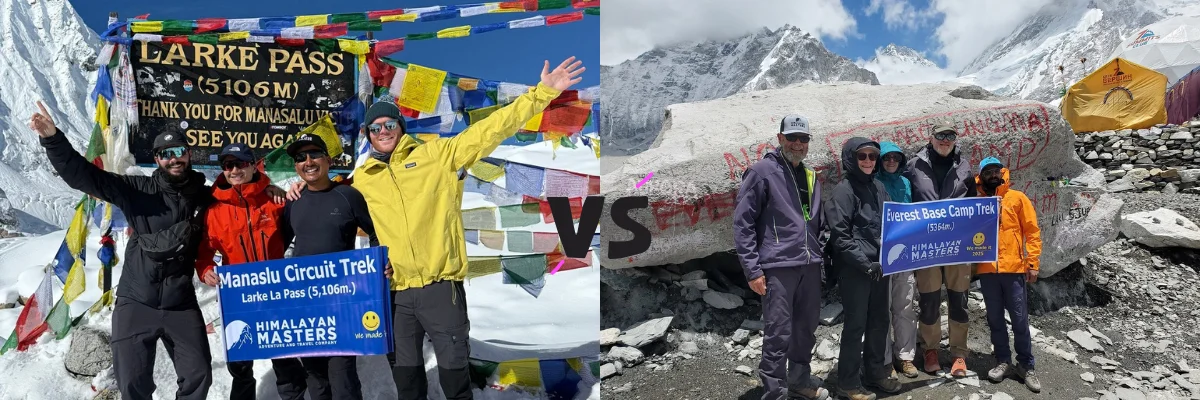
If you’re thinking of doing a trek in Nepal, the two most popular options are the Manaslu Circuit and the Everest Base Camp. Both have absolutely spectacular mountain scenery, but they’re very different in terms of the experience you get.
Your best option is going to be down to your own level of experience, how much comfort you’re after, your budget, how much time you’ve got, and whether you’re after a well-known place or a more remote, quieter route.
The Everest Base Camp Trek takes you into the Khumbu region and to the base camp of Mount Everest, the world’s highest mountain. The trek is known for its Sherpa culture, established teahouses, and views of Everest and other major peaks.
The Manaslu Circuit Trek takes you around Mount Manaslu, at 8,163 meters. It is known for its remote trail, quieter villages, changing landscapes, and the Larkya La crossing. Both treks offer mountain views and cultural experiences, but they differ in their routes, facilities, accessibility, and overall feel.
Quick Comparison Table
|
Parameter
|
Manaslu Circuit Trek
|
Everest Base Camp Trek
|
| Trek duration | 13-18 days | 12-14 days |
| Trek distance | Approximately 180 km | Approximately 130 km |
| Highest point | Larkya La Pass, 5,106 m | Kala Patthar, 5,555 m |
| Difficulty | More physically and logistically demanding | Challenging due to altitude |
| Guide | Licensed guide required | Not compulsory |
| Main permits | RAP, MCAP, ACAP where applicable | Sagarmatha National Park and Khumbu Rural Municipality permits |
| Trail experience | Remote, rougher sections | Well-established and more developed |
| Accommodation | Basic teahouses | More developed teahouses and lodges |
| Communication | Limited at higher elevations | Better mobile and Wi-Fi access |
| Access Point | Long road journey to Machha Khola | Flight to Lukla |
| Main attraction | Remote circuit around Mount Manaslu | Everest Base Camp and views of Mount Everest |
Manaslu Circuit Trek vs Everest Base Camp Difficulty: Which Is Harder?
The Manaslu Circuit Trek is tough because of its remote trails, rough terrain, long days of walking, and the challenging Larkya La Pass at 5,106 meters. Some parts have steep climbs and descents, and the basic accommodation and limited facilities make it even harder. You’ll also need to be ready for changing weather and fewer services in the higher areas.
The Everest Base Camp Trek is mainly challenging because of the altitude. You’ll spend several days above 4,000 m and will reach Kala Patthar at 5,555 m. The lower oxygen levels can lead to feeling very tired and short of breath, and you could very easily get altitude sickness.
The trails are well marked, and there are numerous teahouses, so it’s not difficult to plan the trek; it just doesn’t take away the risks of high altitude. Overall, Manaslu commonly feels tougher because it’s more remote, the trails are rougher, and you need to cross Larkya La.
Everest Base Camp is mainly difficult because of the high altitude. For both treks, you should acclimatize, be physically prepared, and plan well.

Cost Comparison
The Manaslu Circuit Trek costs USD 995 for 13 days, while the Everest Base Camp Trek costs USD 1,640 for 12 days with Himalayan Masters. Even though Manaslu needs a licensed guide and three main permits, it’s still USD 645 cheaper.
This price difference mainly comes from the costs of transportation, accommodation, and what’s included in each package.
The Manaslu package includes a licensed guide, meals, teahouse accommodation, the Restricted Area Permit (RAP), Manaslu Conservation Area Permit (MCAP), and Annapurna Conservation Area Permit (ACAP). Transportation uses a local bus to Machha Khola and a shared jeep from Dharapani to Besisahar.
The Everest Base Camp package includes round-trip flights to Lukla, a licensed guide, a porter, three nights in a three-star Kathmandu hotel, and private-room accommodation during the trek. Private bathrooms with hot showers are also included in selected villages.
The cost of the Lukla flight is a big reason why the Everest Base Camp package is more expensive. Paying for a porter and better accommodation also adds to the price. Manaslu uses road transport and simpler teahouses, which helps keep its cost down.
So, even though Manaslu requires a guide and several permits, it costs less because transportation and accommodation are cheaper. The Everest Base Camp package costs more since it includes extra services and domestic flights.
Transportation and Accessibility Infrastructure
The Manaslu Circuit Trek requires a long road journey from Kathmandu to Machha Khola, which takes around 7-8 hours. Road conditions can be rough, and travel times may vary. After completing the trek at Dharapani, trekkers continue by road toward Besisahar and then Kathmandu or Pokhara.
The Everest Base Camp trek normally starts with a flight to Lukla (approx 30-35 mins from Kathmandu when flights are operating). Weather can of course cause delays or cancellations and in peak season flights may depart from Ramechhap.

Road access is another way of getting to the Everest region. You can go by road to Salleri or Jiri and then continue on foot to the main Everest trail. This bypasses the flight to Lukla but adds in several trekking days depending on where you start and what your itinerary is.
In short, getting to Manaslu means a long road trip to the starting point. For Everest Base Camp, you can either fly or go by road. The Lukla flight saves time if it runs on schedule, but taking the road through Salleri or Jiri adds extra trekking days.

Route Experience
The Manaslu Circuit Trek follows a long Himalayan circuit through remote villages and changing landscapes.
Manaslu Circuit route: Kathmandu → Machha Khola → Jagat → Deng → Namrung → Shyala/Lho → Samagaun → Samdo → Dharamsala → Larkya La → Bimthang → Dharapani.
The Everest Base Camp route follows the Khumbu corridor.
EBC route: Lukla → Namche → Tengboche → Dingboche → Lobuche → Gorak Shep → Everest Base Camp/Kala Patthar → return largely through the same Khumbu corridor.
The Manaslu route is more remote and rough, while the Everest trail has better infrastructure and more facilities.
Region and Mountain Views
The Manaslu Circuit Trek offers views of Mount Manaslu (8,163 m), the world’s eighth-highest mountain. The route passes through river valleys, alpine landscapes, and villages such as Lho, Shyala, and Samagaun, where Mount Manaslu and surrounding Himalayan peaks become major highlights. Trekkers can also see Himalchuli and Ganesh Himal along different sections of the route.

The Everest Base Camp Trek takes trekkers into the Khumbu region, home to Mount Everest (8,848.86 m), the world’s highest mountain. The trail offers views of Everest, Lhotse, Nuptse, and Ama Dablam. Kala Patthar is a major viewpoint for Mount Everest and the adjacent peaks.
To sum up, Manaslu gives you views of the world’s eighth-highest mountain, while Everest Base Camp brings you to the area around the world’s highest peak. Both have unique Himalayan scenery, but the main difference is which mountains and viewpoints you’ll see.
Highest Points of the Treks
The highest point of the Everest Base Camp Trek is Kala Patthar at 5,555 meters.
The highest point of the Manaslu Circuit Trek is Larkya La Pass at 5,106 meters.
Even though Kala Patthar is higher, crossing the high-altitude pass on the Manaslu Circuit is still a tough challenge.
Cultural Experience
The Manaslu Circuit passes through Tibetan-influenced communities; the Nubri people of the upper Manaslu region and the Tamangs along the route.
The villages have monasteries, chortens, prayer flags and all the other trappings of Tibetan influence and Buddhist culture. You get a real feel for the local culture and the way of life in the region as you pass through.
The Everest Base Camp Trek takes trekkers through Sherpa communities, where Tibetan-influenced cultures also visible. Monasteries, chortens, prayer flags, and prayer wheels are common along the trail. Places such as Tengboche Monastery offer opportunities to learn about Buddhist traditions and local religious life.
Both treks have a lot in common culturally because of their Tibetan Buddhist roots, but the people you’ll meet are different. On Manaslu, you’ll visit Nubri and Tamang villages, while the Everest region is home to the Sherpa community. Every trek gives you a unique look at local traditions and ways of life.

Food and Accommodation
Accommodation & Facilities
On the Manaslu Circuit Trek, you’ll stay in basic teahouses with twin beds, mattresses, pillows, and blankets. Facilities are better in the lower villages, but rooms get simpler as you go higher. Shared toilets are common, and some places have squat toilets. Hot showers and Wi-Fi might be available in lower villages, but they’re limited or unreliable higher up. At Dharmasala, the facilities are especially basic.

The Everest Base Camp Trek has a wider range of teahouses and lodges. Most rooms have twin beds, mattresses, pillows, and blankets. Shared toilets are common higher up, but some villages offer attached bathrooms, hot showers, and Wi-Fi for an extra fee. You’ll find more facilities in lower villages and Namche Bazaar than in the upper Khumbu.
Food and Water
On the Manaslu circuit you’ll find dal bhat, noodles, fried rice, soups, potatoes, eggs and Tibetan food. The lower villages will have a greater variety of food, but the menu gets progressively simpler as you go higher.
Dal bhat is a staple meal along the way. You can get boiled water, bottled water where available, or treated water, but what’s available depends on the village.
Teahouses on the Everest Base Camp trek serve dal bhat, noodles, fried rice, soups, eggs, and other local dishes.
In Namche Bazaar, you’ll find more choices, including bakeries and cafés, but menus get simpler as you head toward Gorak Shep and Everest Base Camp.
Bottled, boiled, and treated water are available along the trail, but prices go up at higher elevations.
Overall, Everest offers more choices for accommodation, food, and extra facilities, especially near Namche Bazaar. Manaslu has simpler facilities in its remote upper areas. On both treks, food options, hot showers, and reliable internet become less available as you go higher.
Connection and Communication
The Everest region has better communication. Many villages have mobile networks and Wi-Fi.
The Manaslu region has limited connectivity, especially higher up. Phone signals and Wi-Fi are usually not available in the upper villages.
This difference is important if you want to stay connected during your trek.

Permits and Regulations
The Everest Base Camp Trek requires two main permits:
- Sagarmatha National Park Entry Permit
- Khumbu Rural Municipality Permit
The Manaslu Circuit Trek requires three permits:
- Manaslu Restricted Area Permit (RAP)
- Manaslu Conservation Area Permit (MCAP)
- Annapurna Conservation Area Permit (ACAP), when exiting through Dharapani or Besisahar.
A licensed guide is required for the Manaslu Circuit Trek. Completely independent trekking without the required licensed guide is a separate issue.
Trek Distance and Duration
The Manaslu Circuit Trek covers approximately 180 km from Machha Khola to Tilije, according to Himalayan Masters. The 13-day itinerary includes the road journey from Kathmandu, trekking through remote villages, crossing Larkya La Pass at 5,106 meters, and descending toward Dharapani. Walking days generally take 5-7 hours, with longer days around the pass crossing.
The Everest Base Camp Trek covers approximately 130 km round trip from Lukla, including the journey to Everest Base Camp, the ascent to Kala Patthar, and the return along the Khumbu trail. The standard trek generally takes 12-14 days, depending on the itinerary and acclimatization schedule.
In general, the Manaslu trek covers more distance and is a circuit, while Everest Base Camp is an out-and-back route. The exact distance depends on your itinerary and any side trips.
Weather and Best Time
The best time for Manaslu Circuit is spring (March to May) and autumn (September to November). Autumn has the best weather, with clear skies, dry trails, and good conditions for crossing the Larkya La Pass at 5,106 m.
Spring in Manaslu has warmer days, and the lower forests are in full bloom with rhododendrons. The monsoon is a problem, as it can lead to landslides in the Budhi Gandaki valley, and winter brings freezing temperatures and snow, which can make the pass very difficult or even dangerous to cross.
The best time for Everest Base Camp is in spring and autumn. Spring has milder temperatures at lower altitudes and the mountains are clearly visible.
Autumn is generally dry with good visibility after the monsoon. Monsoon clouds and rain can, of course, obscure mountain views and also affect flights to Lukla. Winter is very cold and snowy, particularly at higher altitudes.
Both treks are best in the same seasons, but the weather affects them in different ways. Manaslu depends a lot on the conditions at Larkya La Pass, while Everest Base Camp is more affected by cold at high altitude and possible flight delays to Lukla.

Festivals and Cultural Celebrations
The Manaslu Circuit and the Everest Base Camp area both have Tibetan Buddhist influences but the festivals are very different in terms of the local traditions and ethnic character.
In the Manaslu area, Dumje is a major festival for the Nubri people with Buddhist rites, prayers, and traditional masked dances.
Gyalpo Lhosar is celebrated in Upper Manaslu, and Tamu Lhosar is the festival of the Gurung people in the lower region. In Tsum Valley, the Dhachyang Festival is all about decorated horse races and the associated festivities.
In the Everest area the Mani Rimdu is one of the main festivals of the Sherpa communities. It’s a festival held at the monasteries (e.g. Tengboche) and involves masked dances, prayers and religious ceremonies. The Sherpas also have their own festivals to celebrate Gyalpo Lhosar and Dumji in accordance with their local customs.
Both areas have Tibetan Buddhist traditions but the festivals are very different in terms of the customs and how they are celebrated. In Manaslu you have the Nubri, Tsumba and Gurung traditions. The festivals on Everest are very much part of the Sherpa culture.
Which Is Better for First-Time Trekkers?
The Manaslu Circuit Trek and Everest Base Camp Trek are both possible options for first-time trekkers with good fitness and proper preparation. However, neither is an easy beginner trek, as both involve several days of walking at high altitude.
The Manaslu Circuit is a tough trek due to the remote trails, the difficult terrain, the very basic facilities, and the Larkya La pass crossing at 5,106m.
The walking days can be long, especially when you’re actually crossing the pass. There’s a marked reduction in accommodation and food options in the upper region, and access to medical facilities is very limited.
Beginners should pick a suitable itinerary, allow sufficient time for acclimatization, and be prepared for the weather, which can change at any time.
The Everest Base Camp Trek is also physically demanding, mainly because of the altitude. The route reaches Everest Base Camp at around 5,364 meters, while Kala Patthar reaches 5,555 meters. The established trail and wider choice of teahouses make the journey easier to manage logistically, particularly around Namche Bazaar.
However, altitude sickness is a concern, even for fit trekkers, so gradual ascent and proper acclimatization. For first-time trekkers, Manaslu delivers a more remote adventure with a tough high pass, while Everest Base Camp is on a more established route with better facilities.
Both treks need good physical preparation, a solid plan, and a realistic idea of what high-altitude trekking involves.
Our Guides’ Perspective: What We See on the Trail
Our guides have led trekkers on both the Manaslu Circuit and Everest Base Camp routes. Their insights may help first-timers get a better sense of what every trek is really like, beyond just distance, cost, and altitude.
On the Manaslu Circuit, trekkers need to prepare for remote trail sections, basic accommodation in the upper region, and the demanding crossing of Larkya La Pass at 5,106 meters. The pass day can be particularly challenging because of the altitude, cold, and long hours on the trail.
On the Everest Base Camp route, altitude is a big issue as you’re spending several days above 4,000 m. The climb to EBC and the optional climb to Kala Patthar both require a steady pace and proper acclimatization.
The route is well-established, and there are plenty of teahouses, so the logistics are fairly straightforward; it doesn’t take away the physicality of high-altitude trekking, though.
For first-timers, your experience will also depend on how well you prepare, your pace, and your itinerary. Guides can offer practical tips on where people usually struggle, which days are the toughest, how accommodation changes as you go higher, and what to pack for every trek.
Which Trek Is Better?
So, which should you choose: Manaslu Circuit Trek or Everest Base Camp? It really depends on what you’re looking for in your trek.
Choose the Everest Base Camp Trek if you:
- Want to visit Mount Everest and trek one of Nepal’s most famous routes.
- Prefer better infrastructure, established teahouses, and more food choices.
- Have around 12-14 days.
- Prefer a more social trekking environment.
Choose the Manaslu Circuit Trek if you:
- Prefer a quieter and more remote trekking route.
- Want to experience remote villages and Tibetan-influenced culture.
- Are comfortable with basic lodges and longer walking days.
- Have around 13-18 days.
- Prefer a circuit route with the Larkya La crossing.
Choosing between the Manaslu Circuit Trek and Everest Base Camp depends on what matters most to you. Everest is all about reaching the famous Mount Everest and trekking a well-developed route. Manaslu gives you a longer, quieter circuit with more remote areas and the challenge of crossing Larkya La.
Loading...
related post


Author

Swostika is a content writer at Himalayan Masters as well as a travel enthusiast. She loves to travel and learn about different cultures and people. With a love for writing, traveling, and embracing diverse cultures, she is on a journey to explore and inspire through words.


Leave Your Comment